
Chapter 5
Physics for Aviation
Circular Motion
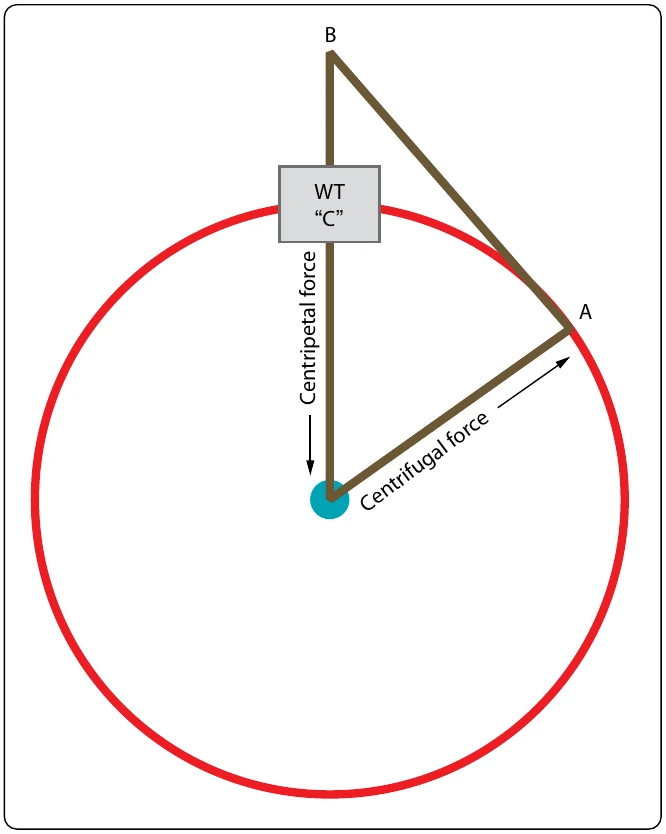
Circular motion is the motion of an object along a curved path that has a constant radius. For example, if one end of a string is tied to an object and the other end is held in the hand, the object can be swung in a circle. The object is constantly deflected from a straight (linear) path by the pull exerted on the string, as shown in Figure 5-26. When the weight is at point A, due to inertia it wants to keep moving in a straight line and end up at point B. It is forced to move in a circular path and end up at point C because of the force being exerted on the string.
The string exerts a centripetal force on the object, and the object exerts an equal but opposite force on the string, obeying Newton’s third law of motion. The force that is equal to centripetal force, but acting in an opposite direction, is called centrifugal force.
Centripetal force is always directly proportional to the mass of the object in circular motion. Thus, if the mass of the object in Figure 5-26 is doubled, the pull on the string must be doubled to keep the object in its circular path, provided the speed of the object remains constant.
Centripetal force is inversely proportional to the radius of the circle in which an object travels. If the string in Figure 5-26 is shortened and the speed remains constant, the pull on the string must be increased since the radius is decreased, and the string must pull the object from its linear path more rapidly. Using the same reasoning, the pull on the string must be increased if the object is swung more rapidly in its orbit. Centripetal force is thus directly proportional to the square of the velocity of the object. The formula for centripetal force is:
For the formula above, mass would typically be converted to weight divided by gravity, velocity would be in feet per second, and the radius would be in feet.
Example: What would the centripetal force be if a 10-pound weight was moving in a 3-ft radius circular path at a velocity of 500 fps?
In the condition identified in the example, the object acts like it weighs 2,588 times more than it actually does. It can also be said that the object is experiencing 2,588 Gs, or force of gravity. The fan blades in a large turbofan engine, when the engine is operating at maximum rpm, are experiencing many thousands of Gs for the same reason.
Heat
Heat is a form of energy. It is produced only by the conversion of one of the other forms of energy. Heat may also be defined as the total kinetic energy of the molecules of any substance.
Some forms of energy which can be converted into heat energy are as follows:
- Mechanical Energy—this includes all methods of producing increased motion of molecules such as friction, impact of bodies, or compression of gases.
- Electrical Energy—electrical energy is converted to heat energy when an electric current flows through any form of resistance such as an electric iron, electric light, or an electric blanket.
- Chemical Energy—most forms of chemical reaction convert stored potential energy into heat. Some examples are the explosive effects of gunpowder, the burning of oil or wood, and the combining of oxygen and grease.
- Radiant Energy—electromagnetic waves of certain frequencies produce heat when they are absorbed by the bodies they strike such as x-rays, light rays, and infrared rays.
- Nuclear Energy—energy stored in the nucleus of atoms is released during the process of nuclear fission in a nuclear reactor or atomic explosion.
- Sun—all heat energy can be directly or indirectly traced to the nuclear reactions occurring in the sun.
When a gas is compressed, work is done and the gas becomes warm or hot. Conversely, when a gas under high pressure is allowed to expand, the expanding gas becomes cool. In the first case, work was converted into energy in the form of heat; in the second case heat energy was expended. Since heat is given off or absorbed, there must be a relationship between heat energy and work. Also, when two surfaces are rubbed together, the friction develops heat. However, work was required to cause the heat, and by experimentation, it has been shown that the work required and the amount of heat produced by friction is proportional. Thus, heat can be molecules, atoms, and electrons in all bodies are in a continual state of motion. In a hot body, these small particles possess relatively large amounts of kinetic energy, but in cooler bodies they have less. Because the small particles are given motion, and hence kinetic energy, work must be done to slide one body over the other. Mechanical energy apparently is transformed, and what we know as heat is really kinetic energy of the small molecular subdivisions of matter.
Heat Energy Units
Two different units are used to express quantities of heat energy. They are the calorie and the BTU. One calorie is equal to the amount of heat required to change the temperature of 1 gram of water 1 degree Centigrade.
of the heat energy in foods. One BTU is defined as the amount of heat required to change the temperature of 1 lb of water 1 degree Fahrenheit (1 °F). The calorie and the gram are seldom used in discussing aviation maintenance. The BTU, however, is commonly referred to in discussions of engine thermal efficiencies and the heat content of aviation fuel.