
Chapter 5
Physics for Aviation
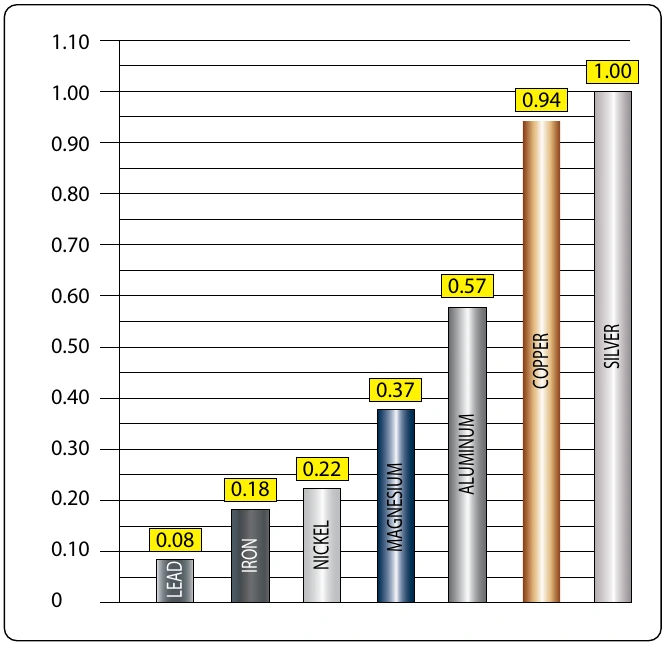
At the point of application of the heat source, the molecules become violently agitated. These molecules strike adjacent molecules causing them to become agitated. This process continues until the heat energy is distributed evenly throughout the substance. The gases are much poorer conductors of heat because molecules are farther apart in gases than in solids.
Materials that are poor conductors are used to prevent the transfer of heat and are called heat insulators. A wooden handle on a pot or a soldering iron serves as a heat insulator. Certain materials, such as finely spun glass or asbestos, are particularly poor heat conductors. These materials are therefore used for many types of insulation.
Convection
Convection is the process by which heat is transferred by movement of a heated fluid (gas or liquid). For example, an incandescent light bulb will, when heated, become increasingly hotter until the air surrounding it begins to move. The motion of the air is upward. This upward motion of the heated air carries the heat away from the hot light bulb by convection. Transfer of heat by convection may be hastened by using a ventilating fan to move the air surrounding a hot object. The rate of cooling of a hot electronics component, such as the CPU in a computer, can be increased if it is provided with copper fins that conduct heat away from the hot surface. The fins provide large surfaces against which cool air can be blown.
A convection process may take place in a liquid as well as in a gas. A good example of this is a pan of water sitting on the stove. The bottom of the pan becomes hot because it conducts heat from the surface it is in contact with. The water on the bottom of the pan also heats up because of conduction. As the heated water starts to rise and cooler water moves in to take its place, the convection process begins.
When the circulation of gas or liquid is not rapid enough to remove sufficient heat, fans or pumps are used to accelerate the motion of the cooling material. In some installations, pumps are used to circulate water or oil to help cool large equipment. In airborne installations, electric fans and blowers are used to aid convection.
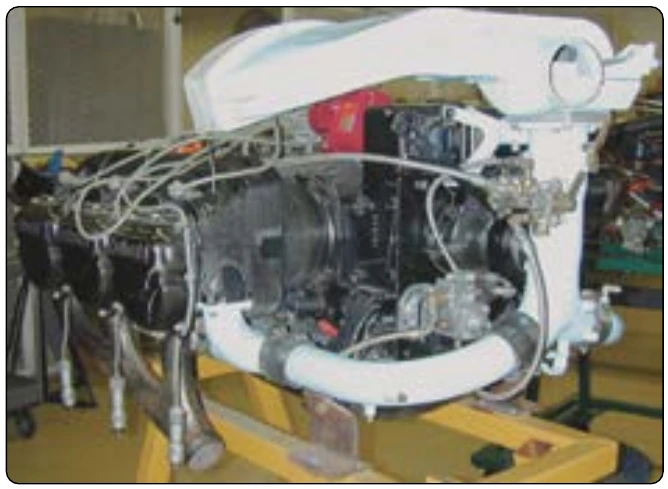
An aircraft air-cooled piston engine is a good example of convection being used to transfer heat. The engine shown in Figure 5-29 is a Continental IO-520, with six heavily finned air-cooled cylinders. This engine does not depend on natural convection for cooling, but rather forced air convection coming from the propeller on the engine. The heat generated inside the engine finds its way to the cylinder cooling fins by conduction, meaning transfer within the metal of the cylinder. Once the heat gets to the fins, forced air flowing around the cylinders carries the heat away.
Radiation
Conduction and convection cannot wholly account for some of the phenomena associated with heat transfer. For example, the heat one feels when sitting in front of an open fire cannot and the cooler currents of air moving toward the fire would more than overcome the transfer of heat outward. Therefore, there must be some way for heat to travel across space other than by conduction and convection.
The existence of another process of heat transfer is still more evident when the heat from the sun is considered. Since conduction and convection take place only through some medium, such as a gas or a liquid, heat from the sun must reach the earth by another method, since space is an almost perfect vacuum. Radiation is the name given to this third method of heat transfer.
The term “radiation” refers to the continual emission of energy from the surface of all bodies. This energy is known as “radiant energy.” It is in the form of electromagnetic waves, radio waves, or x-rays, which are all alike except for a difference in wave length. These waves travel at the velocity of light and are transmitted through a vacuum more easily than through air because air absorbs some of them. Most forms of energy can be traced back to the energy of sunlight. Sunlight is a form of radiant heat energy that travels through space to reach the earth. These electromagnetic heat waves are absorbed when they come in contact with nontransparent bodies. The result is that the motion of the molecules in the body is increased as indicated by an increase in the temperature of the body.
The differences between conduction, convection, and radiation may now be considered. First, although conduction and convection are extremely slow, radiation takes place at the speed of light. This fact is evident at the time of an eclipse of the sun when the shutting off of the heat from the sun takes place at the same time as the shutting off of the light. Second, radiant heat may pass through a medium without heating it. In application, the air inside a greenhouse may be much warmer than the glass through which the sun’s rays pass. Third, although heat transfer by conduction or convection may travel in roundabout routes, radiant heat always travels in a straight line. For example, radiation can be cut off with a screen placed between the source of heat and the body to be protected.
Specific Heat
One important way in which substances differ is in the requirement of different quantities of heat to produce the same temperature change in a given mass of the substance. Each substance requires a quantity of heat, called its specific heat capacity, to increase the temperature of a unit of its mass 1 °C. The specific heat of a substance is the ratio of its specific heat capacity to the specific heat capacity of water. Specific heat is expressed as a number which, because it is a ratio, has no units and applies to both the English and the metric systems.
It is fortunate that water has a high specific heat capacity. The larger bodies of water on the earth keep the air and solid matter on or near the surface of the earth at a constant temperature. A great quantity of heat is required to change the temperature of a large lake or river. Therefore, when the temperature falls below that of such bodies of water, they give off large quantities of heat. This process keeps the atmospheric temperature at the surface of the earth from changing rapidly.
The specific heat values of some common materials are listed in Figure 5-30.
calculating changes in the state of gases.