
Chapter 5
Physics for Aviation
Work
The study of machines, both simple and complex, can be seen as a study of the energy of mechanical work. This is true because all machines transfer input energy, or the work done on the machine, to output energy, or the work done by the machine.
Work, in the mechanical sense of the term, is done when a resistance is overcome by force acting through a measurable distance. Two factors are involved: (1) force and (2) movement through a distance. As an example, suppose a small aircraft is stuck in the snow. Two men push against it for a period of time, but the aircraft does not move. According to the technical definition, no work had been done when the men were pushing against the aircraft. By definition, work is accomplished only when an object is displaced some distance against a resistive force. To calculate work, the following formula is used:
In the English system, the force will be identified in pounds and the distance either in feet or inches, so the units will be foot-pounds or inch-pounds. Notice these are the same units that were used for potential and kinetic energy.
In the metric system, the force is identified in newtons (N) and the distance in meters, with the resultant units being joules. One pound of force is equal to 4.448 N and one meter is equal to 3.28 feet. One joule is equal to 0.74 ft-lb.
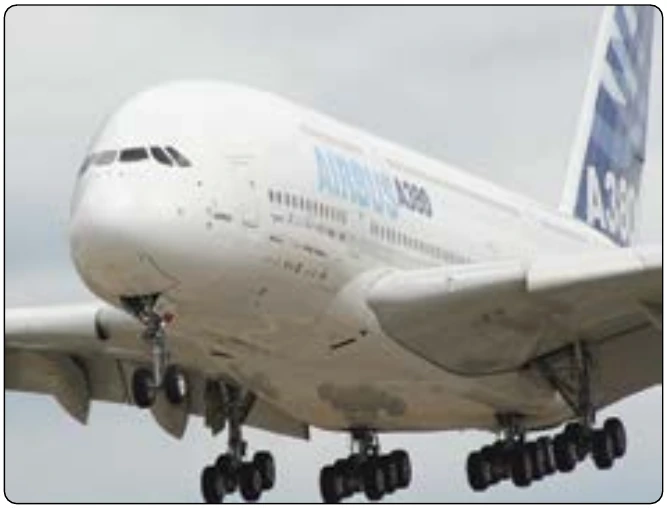
Example: How much work is accomplished by jacking a 150,000-lb Airbus A-320 airplane a vertical height of 4 ft? [Figure 5-4]
Example: How much work is accomplished when a tow tractor is hooked up to a tow bar and a Boeing 737-800 airplane weighing 130,000 lb is pushed 80 ft. into the hangar? The force on the tow bar is 5,000 lb.
In this last example, notice the force does not equal the weight of the airplane. This is because the airplane is being moved horizontally and not lifted vertically. In almost all cases, it takes less work to move something horizontally than it does to lift it vertically. Most people can push their car a short distance if it runs out of gas, but they cannot get under their car and lift it off the ground.
Friction & Work
In calculating work done, the actual resistance overcome is measured. This is not necessarily the weight of the object being moved. [Figure 5-5] A 900-lb load is being pulled a distance of 200 ft. This does not mean that the work done (force × distance) is 180,000 ft-lb (900 lb × 200 ft). This is because the person pulling the load is not working against the total weight of the load, but rather against the rolling friction of the cart, which may be no more than 90 lb.
Friction is an important aspect of work. Without friction, it would be impossible to walk. One would have to shove oneself from place to place, and would have to bump against some obstacle to stop at a destination. Yet friction is a liability as well as an asset, and requires consideration when dealing with any moving mechanism.
In experiments relating to friction, measurement of the applied forces reveals that there are three kinds of friction. One force is required to start a body moving, while another is required to keep the body moving at constant speed. Also, after a body is in motion, a definitely larger force is required to keep it sliding than to keep it rolling.
Thus, the three kinds of friction may be classified as: (1) starting or static friction, (2) sliding friction, and (3) rolling friction.
Static Friction
When an attempt is made to slide a heavy object along a surface, the object must first be broken loose or started. Once in motion, it slides more easily. The “breaking loose” force is, of course, proportional to the weight of the body. The force necessary to start the body moving slowly is designated “F,” and “F'” is the normal force pressing the body against the surface which is usually its weight. Since the nature of the surfaces rubbing against each other is important, they must be considered. The nature of the surfaces is indicated by the coefficient of starting friction which is designated by the letter “k.” This coefficient can be established for various materials and is often published in tabular form. Thus, when the load (weight of the object) is known, starting friction can be calculated by using the following formula: