
Chapter 5
Physics for Aviation
For example, if the coefficient of sliding friction of a smooth iron block on a smooth, horizontal surface is 0.3, the force required to start a 10 lb block would be 3 lb; a 40-lb block, 12 lb.
Starting friction for objects equipped with wheels and roller bearings is much smaller than that for sliding objects. For example, a locomotive would have difficulty getting a long train of cars in motion all at one time. Therefore, the couples between the cars are purposely made to have a few inches of play. When starting the train, the engineer backs the engine until all the cars are pushed together. Then, with a quick start forward the first car is set in motion. This technique is engine to start all of the cars at the same instant, for static friction, which is the resistance of being set in motion, would be greater than the force exerted by the engine. However, once the cars are in motion, the static friction is greatly reduced and a smaller force is required to keep the train in motion than was required to start it.
Sliding Friction
Sliding friction is the resistance to motion offered by an object sliding over a surface. It pertains to friction produced after the object has been set in motion, and is always less than starting friction. The amount of sliding resistance is dependent on the nature of the surface of the object, the surface over which it slides, and the normal force between the object and the surface. This resistive force may be computed by using the following formula:
In the formula above, “F” is the resistive force due to friction expressed in pounds; “N” is the force exerted on or by the object perpendicular (normal) to the surface over which it slides; and “m” (mu) is the coefficient of sliding friction. On a horizontal surface, N is equal to the weight of the object in pounds. The area of the sliding object exposed to the sliding surface has no effect on the results. A block of wood, for same smoothness. Therefore, area does not enter into the equation above.
Rolling Friction
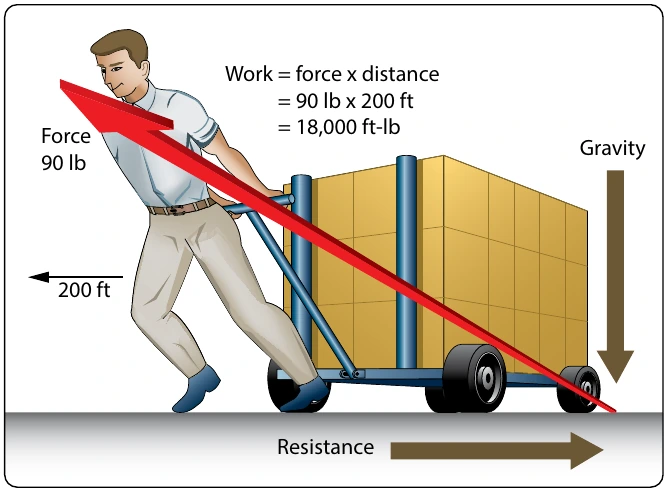
Resistance to motion is greatly reduced if an object is mounted on wheels or rollers. The force of friction for objects mounted on wheels or rollers is called rolling friction. This force may be computed by the same equation used in computing sliding friction, but the values of “m” will be much smaller. For example, the value of “m” for rubber tires on concrete or macadam is about 0.02. The value of “m” for roller bearings is very small, usually ranging from 0.001 to 0.003 and is often disregarded.
Example: An aircraft with a gross weight of 79,600 lb is towed over a concrete ramp. What force must be exerted by the towing vehicle to keep the airplane rolling after once set in motion?
Power
The concept of power involves the previously discussed topic of work, which was a force being applied over a measured distance, but adds one more consideration—time. In other words, how long it takes to accomplish the work. If someone asked the average person if they could lift one million pounds 5 feet off the ground, the answer most assuredly would be no. This person would probably assume that they are to lift it all at once. What if they are given 365 days to lift it, and could lift small amounts of weight at a time? The work involved would be the same, regardless of how long it took to lift the weight, but the power required is different. If the weight is to be lifted in a shorter period of time, it will take more power. The formula for power is as follows:
The units for power will be foot-pounds per minute, foot-pounds per second, inch-pounds per minute or second, and possibly mile-pounds per hour. The units depend on how distance and time are measured.
Many years ago, there was a desire to compare the power of the newly evolving steam engine to that of horses. People wanted to know how many horses the steam engine was equivalent to. The value we know currently as one horsepower (hp) was developed, and it is equal to 550 foot-pounds per second (ft-lb/s) because of this. It was found that the average horse could lift a weight of 550 lb, one foot off the ground, in one second. The values we use today, in order to convert power to horsepower, are as follows:
To convert power to horsepower, divide the power by the appropriate conversion based on the units being used.