
Chapter 7
Aircraft Materials, Hardware, & Processes
Alloy 2117 rivets have moderately high strength and are suitable for riveting aluminum alloy sheets. These rivets receive only one heat-treatment, which is performed by the manufacturer, and are anodized after being heat-treated. They require no further heat-treatment before they are used. Alloy 2117 rivets retain their characteristics indefinitely after heat-treatment and can be driven anytime. Rivets made of this alloy are the most widely used in aircraft construction.
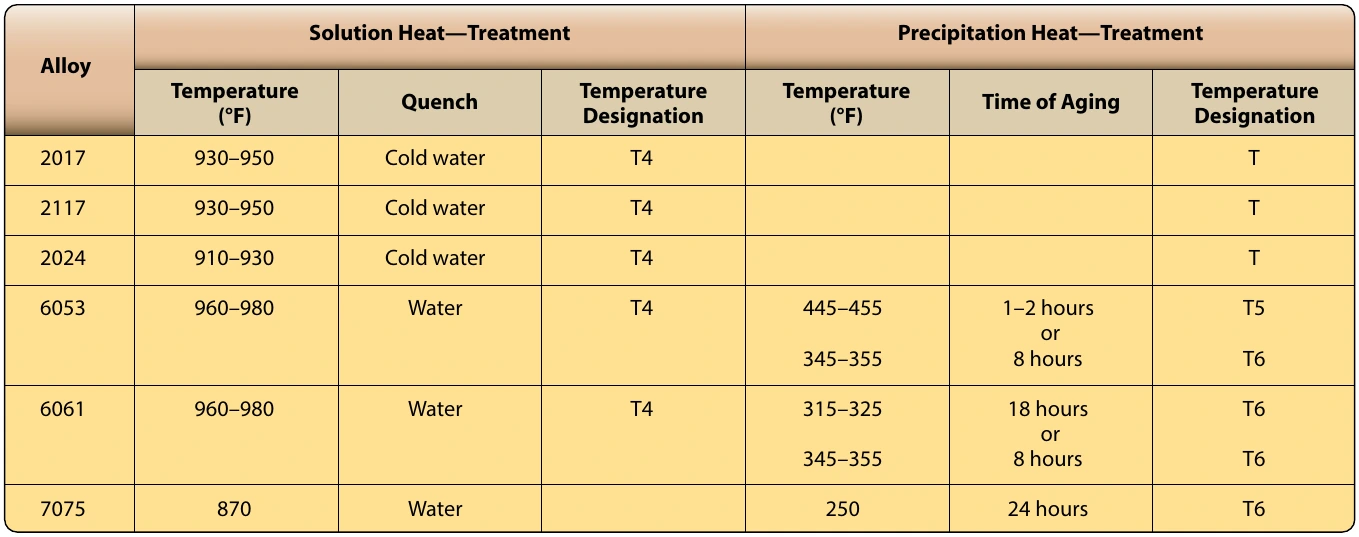
Alloy 2017 and 2024 rivets are high-strength rivets suitable for use with aluminum alloy structures. They are purchased from the manufacturer in the heat-treated condition. Since the aging characteristics of these alloys at room temperatures are such that the rivets are unfit for driving, they must be reheat-treated just before they are to be used. Alloy 2017 rivets become too hard for driving in approximately 1 hour after quenching. Alloy 2024 rivets become hardened in 10 minutes after quenching. Both alloys may be reheat-treated as often as required; however, they must be anodized before the first reheat-treatment to prevent intergranular oxidation of the material. If these rivets are stored in a refrigerator at a temperature lower than 32 °F immediately after quenching, they remain soft enough to be usable for several days.
Rivets requiring heat-treatment are heated either in tubular containers in a salt bath or in small screen wire baskets in an air furnace. The heat-treatment of alloy 2017 rivets consists of subjecting the rivets to a temperature between 930 °F to 950 °F for approximately 30 minutes and immediately quenching in cold water. These rivets reach maximum strength in about 9 days after being driven. Alloy 2024 rivets should be heated to a temperature of 910 °F to 930 °F and immediately quenched in cold water. These rivets develop greater shear strength than 2017 rivets and are used in locations where extra strength is required. Alloy 2024 rivets develop their maximum shear strength in 1 day after being driven.
The 2017 rivet should be driven within approximately 1 hour and the 2024 rivet within 10 to 20 minutes after heat-treating or removal from refrigeration. If not used within these times, the rivets should be reheat-treated before being refrigerated.
Heat-Treatment of Magnesium Alloys
Magnesium alloy castings respond readily to heat-treatment, and about 95 percent of the magnesium used in aircraft construction is in the cast form. The heat-treatment of magnesium alloy castings is like the heat-treatment of aluminum alloys in that there are two types of heat-treatment: solution heat-treatment and precipitation (aging) heat-treatment. Magnesium, however, develops a negligible change in its properties when allowed to age naturally at room temperatures.
Solution Heat-Treatment
Magnesium alloy castings are solution heat-treated to improve tensile strength, ductility, and shock resistance. This heat-treatment condition is indicated by using the symbol –T4 following the alloy designation. Solution heat-treatment plus artificial aging is designated –T6. Artificial aging is necessary to develop the full properties of the metal.
Solution heat-treatment temperatures for magnesium alloy castings range from 730 °F to 780 °F, the exact range depending upon the type of alloy. The temperature range for each type of alloy is listed in Specification MIL-H-6857. The upper limit of each range listed in the specification is the maximum temperature to which the alloy may be heated without danger of melting the metal.
The soaking time ranges from 10 to 18 hours, the exact time depending upon the type of alloy as well as the thickness of the part. Soaking periods longer than 18 hours may be necessary for castings over 2 inches in thickness. Never heat magnesium alloys in a salt bath as this may result in an explosion.
A serious potential fire hazard exists in the heat-treatment of magnesium alloys. If through oversight or malfunctioning of equipment the maximum temperatures are exceeded, the casting may ignite and burn freely. For this reason, the furnace used should be equipped with a safety cutoff that turns off the power to the heating elements and blowers if the regular control equipment malfunctions or fails. Some magnesium alloys require a protective atmosphere of sulfur dioxide gas during solution heat-treatment. This aids in preventing the start of a fire even if the temperature limits are slightly exceeded.
Air quenching is used after solution heat-treatment of magnesium alloys since there appears to be no advantage in liquid cooling.
Precipitation Heat-Treatment
After solution treatment, magnesium alloys may be given an aging treatment to increase hardness and yield strength.
and hardness are improved somewhat by this treatment at the expense of a slight amount of ductility. The corrosion resistance is also improved, making it closer to the “as cast” alloy.
Precipitation heat-treatment temperatures are considerably lower than solution heat-treatment temperatures and range from 325 °F to 500 °F. Soaking time ranges from 4 to 18 hours.
Heat-Treatment of Titanium
Titanium is heat-treated for the following purposes:
- Relief of stresses set up during cold forming or machining.
- Annealing after hot-working or cold-working, or to provide maximum ductility for subsequent cold-working.
- Thermal hardening to improve strength.