
Chapter 1
Aircraft Engines
The operating cycle of an internal combustion reciprocating engine includes the series of events required to induct, compress, ignite, and burn, causing expansion of the airfuel charge in the cylinder and to scavenge or exhaust the byproducts of the combustion process. When the compressed mixture is ignited, the resultant gases of combustion expand very rapidly and force the piston to move away from the cylinder head. This downward motion of the piston, acting on the crankshaft through the connecting rod, is converted to a circular or rotary motion by the crankshaft. A valve in the top or head of the cylinder opens to allow the burned gases to escape, and the momentum of the crankshaft and the propeller forces the piston back up in the cylinder where it is ready for the next event in the cycle. Another valve in the cylinder head then opens to let in a fresh charge of the air-fuel mixture. The valve allowing for the escape of the burning exhaust gases is called the exhaust valve, and the valve which lets in the fresh charge of the air-fuel mixture is called the intake valve. These valves are opened and closed mechanically at the proper times by the valve-operating mechanism. Therefore, the order of the five events of a four stroke cycle engine are intake, compression, ignition, power, and exhaust.
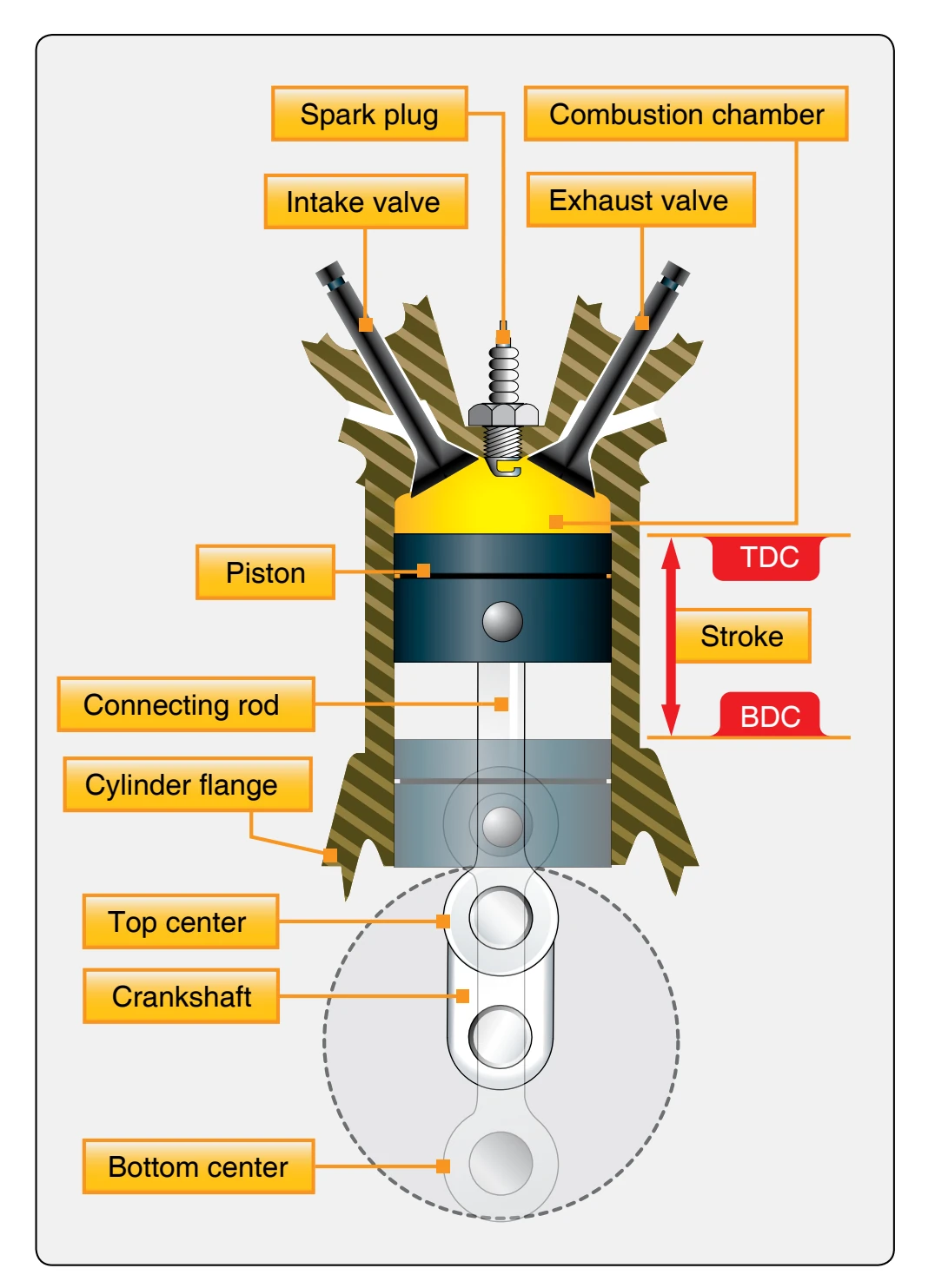
The bore of a cylinder is its inside diameter. The stroke is the distance the piston moves from one end of the cylinder to the other, specifically from top dead center (TDC) to bottom dead center (BDC), or vice versa. [Figure 1-35]
Operating Cycles
There are several operating cycles in use:
- Four stroke.
- Two stroke.
- Rotary.
- Diesel.
Four-Stroke Cycle
The vast majority of certified aircraft reciprocating engines operate on the four-stroke cycle, sometimes called the Otto cycle after its originator, a German physicist. The four-stroke cycle engine has many advantages for use in aircraft. One advantage is that it lends itself readily to high performance through supercharging.
In this type of engine, four strokes are required to complete the required series of events or operating cycle of each cylinder. [Figure 1-36] Two complete revolutions of the crankshaft (720°) are required for the four strokes; thus, each cylinder in an engine of this type fires once in every two revolutions of the crankshaft. In the following discussion of the four-stroke cycle engine operation, note that the timing of the ignition and
the valve events vary considerably in different engines. Many factors influence the timing of a specific engine, and it is most important that the engine manufacturer’s recommendations in this respect be followed in maintenance and overhaul. The timing of the valve and ignition events is always specified in degrees of crankshaft travel. It should be remembered that a certain amount of crankshaft travel is required to open a valve fully; therefore, the specified timing represents the start of opening rather than the full-open position of the valve. An example valve timing chart can be seen in Figure 1-37.
Intake Stroke
During the intake stroke, the piston is pulled downward in the cylinder by the rotation of the crankshaft. This reduces the pressure in the cylinder and causes air under atmospheric pressure to flow through the carburetor, which meters the correct amount of fuel. The air-fuel mixture passes through the intake pipes and intake valves into the cylinders. The quantity or weight of the air-fuel charge depends upon the degree of throttle opening.
The intake valve is opened considerably before the piston
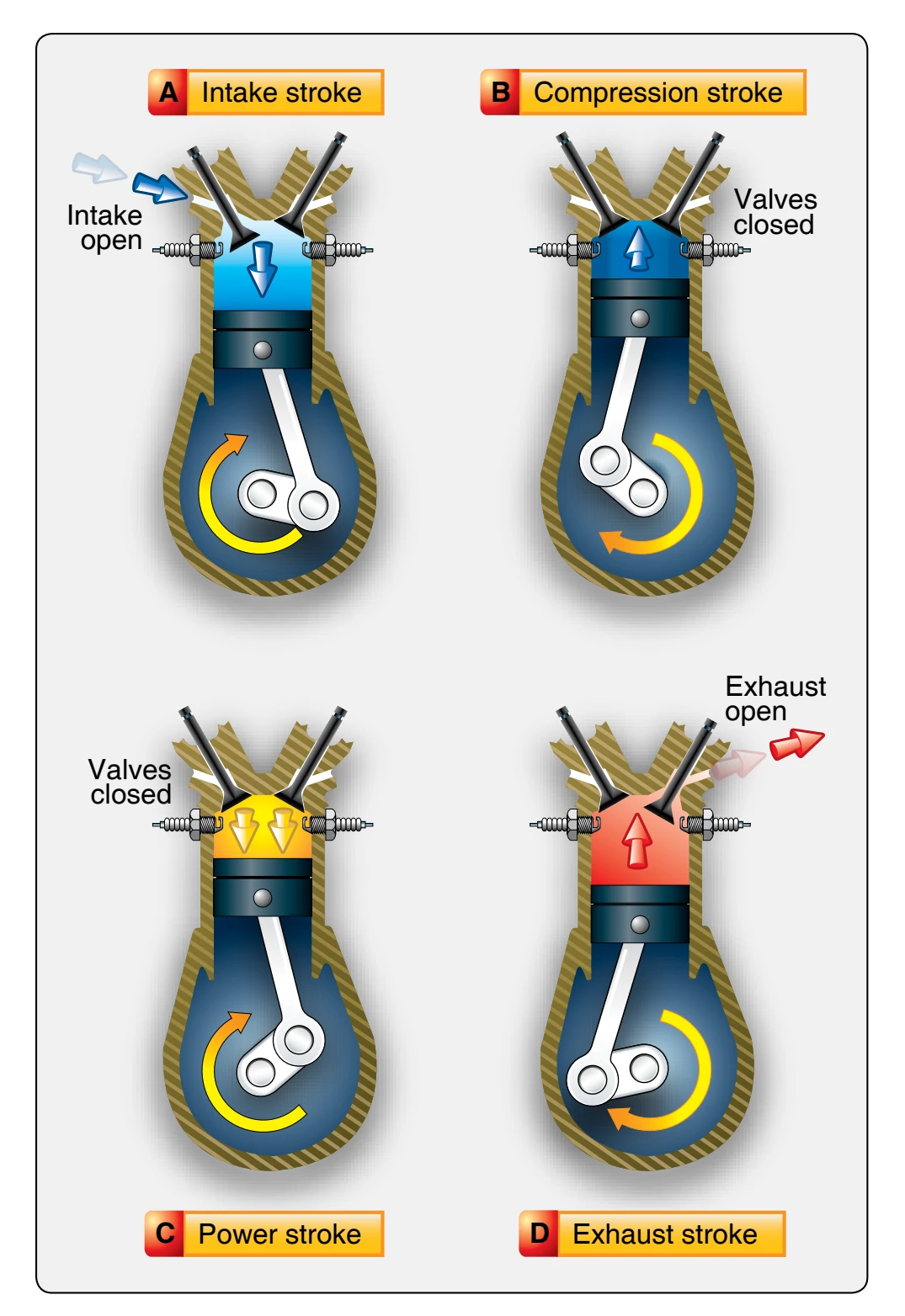
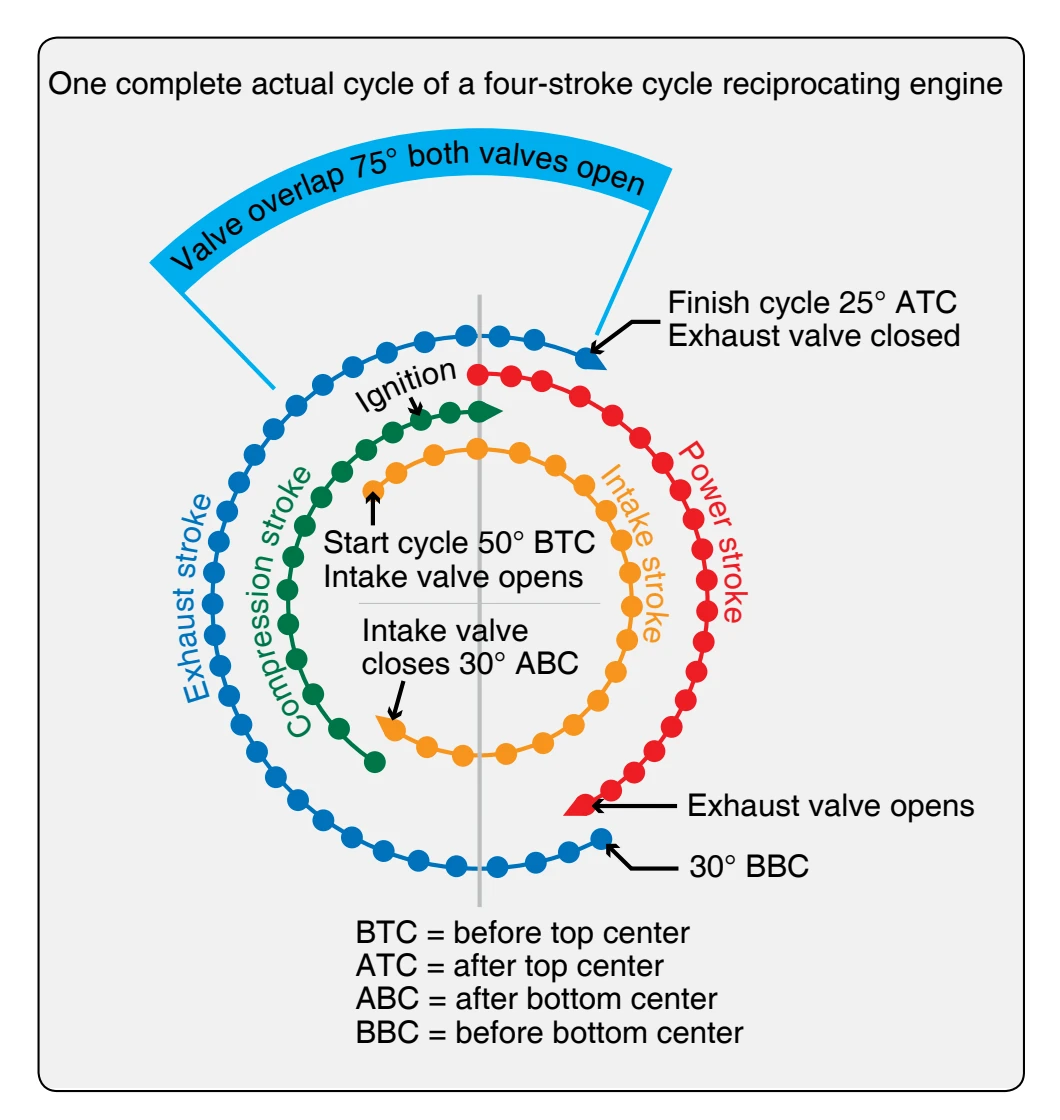
reaches TDC on the exhaust stroke, in order to induce a greater quantity of the air-fuel charge into the cylinder and thus increase the horsepower. The distance the valve may be opened before TDC, however, is limited by several factors, such as the possibility that hot gases remaining in the cylinder from the previous cycle may flash back into the intake pipe and the induction system.
In all high-power aircraft engines, both the intake and the exhaust valves are off the valve seats at TDC at the start of the intake stroke. As mentioned above, the intake valve opens before TDC on the exhaust stroke (valve lead), and the closing of the exhaust valve is delayed considerably after the piston has passed TDC and has started the intake stroke (valve lag). This timing is called valve overlap and is designed to aid in cooling the cylinder internally by circulating the cool incoming air-fuel mixture, to increase the amount of the air-fuel mixture induced into the cylinder, and to aid in scavenging the byproducts of combustion from the cylinder.
The intake valve is timed to close about 50° to 75° past BDC on the compression stroke, depending upon the specific engine, to allow the momentum of the incoming gases to charge the cylinder more completely. Because of the comparatively large volume of the cylinder above the piston when the piston is near BDC, the slight upward travel of the piston during this time does not have a great effect on the incoming flow of gases. This late timing can be carried too far because the gases may be forced back through the intake valve and defeat the purpose of the late closing.
Compression Stroke
After the intake valve is closed, the continued upward travel of the piston compresses the air-fuel mixture to obtain the desired burning and expansion characteristics. The charge is fired by means of an electric spark as the piston approaches TDC. The time of ignition varies from 20° to 35° before TDC, depending upon the requirements of the specific engine to ensure complete combustion of the charge by the time the piston is slightly past the TDC position.