
Chapter 9
Engine Fire Protection Systems
Continuous Fault Monitoring
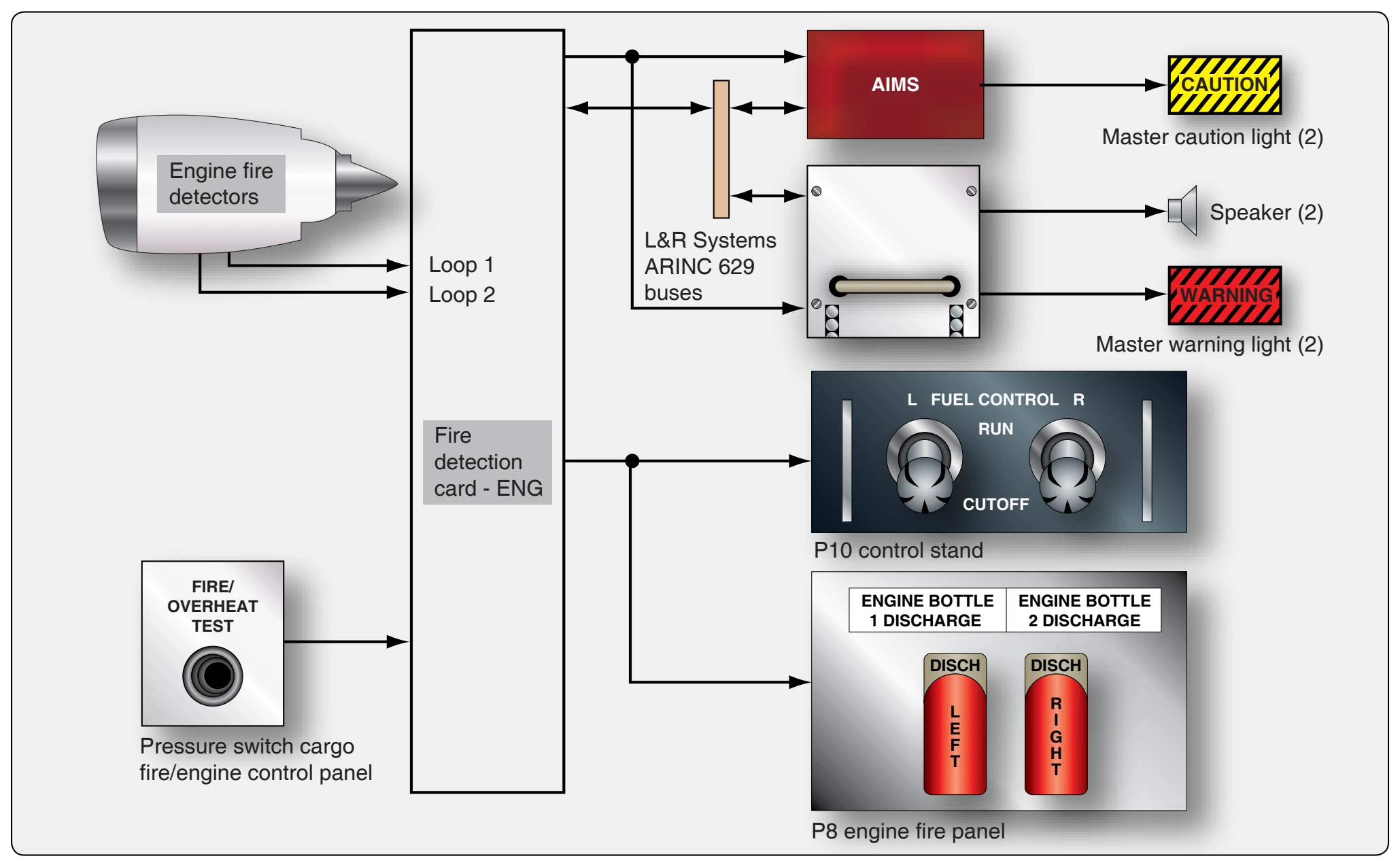
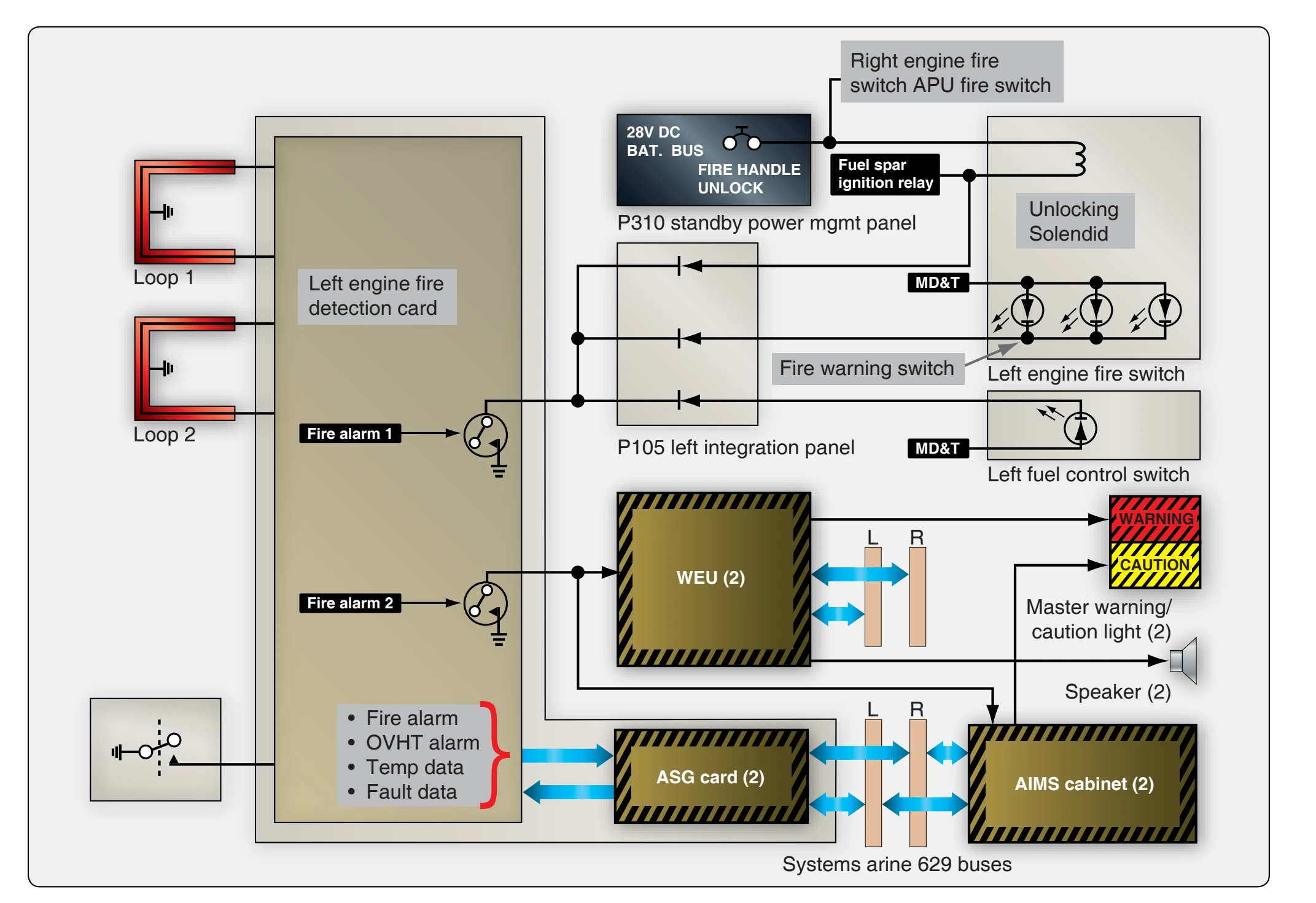
The fire detection card monitors the two loops and their wiring for defects. In normal (dual loop) operation, both loops must have a fire or overheat condition to cause the flight deck indications.
If a failure occurs in a loop, the fire detection card sends the data to the AIMS. A status message shows, and the system changes to single-loop operation. In this mode, fire/overheat indications occur when one loop is defective and the other has a fire or overheat condition.
Single/Dual Loop Operation
The fire detection card monitors the loops for faults. In normal (dual loop) operation, both loops must have a fire or overheat condition to cause the flight deck indications. If one detection loop fails, the card sends data about the failure to the AIMS, and a status message shows. The card changes to single-loop operation, if necessary. If both detection loops fail, an advisory message and status messages are displayed, and the fire detection system does not operate.
System Test
Built-in test equipment (BITE) performs a test of the engine fire detection system for these conditions:
- When the system first gets power.
- After a power interrupt.
- Every 5 minutes of operation. [Figures 9-20 and 9-21]
Boeing 777 Fire Extinguisher System
Fire Extinguisher Containers
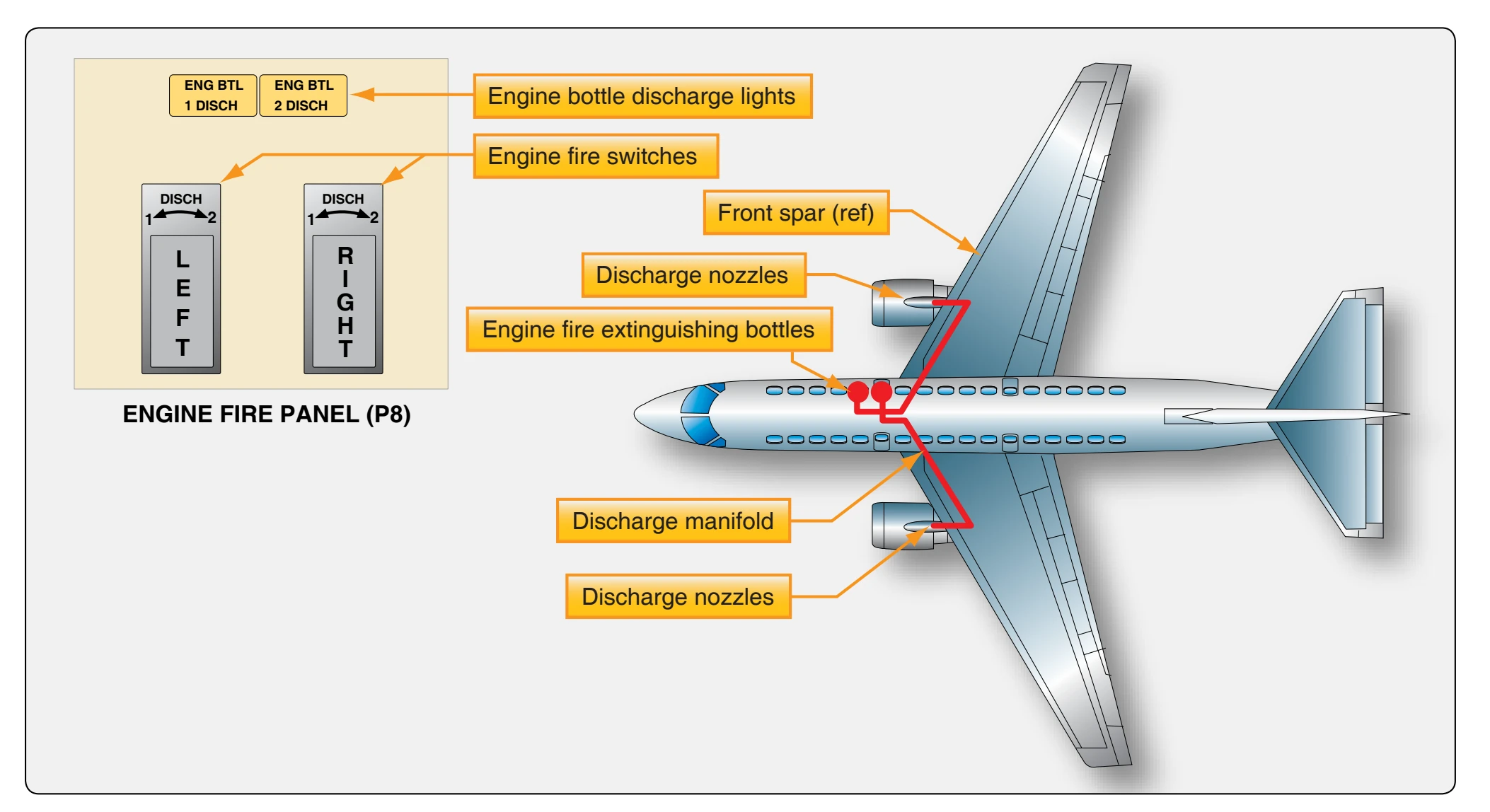
The B777 aircraft has two fire extinguishing bottles that contain Halon fire extinguishing agent pressurized with nitrogen. The engine fire switches in the flight deck are pulled and rotated to release the Halon. Halon from each bottle can be discharged to the right or left engine. Engine indicating and crew alerting system (EICAS) messages, status messages, and indicator lights show when the bottle pressure is low. The two engine fire extinguishing bottles are located behind the right sidewall lining of the forward cargo compartment, aft of the cargo door. [Figure 9-22]
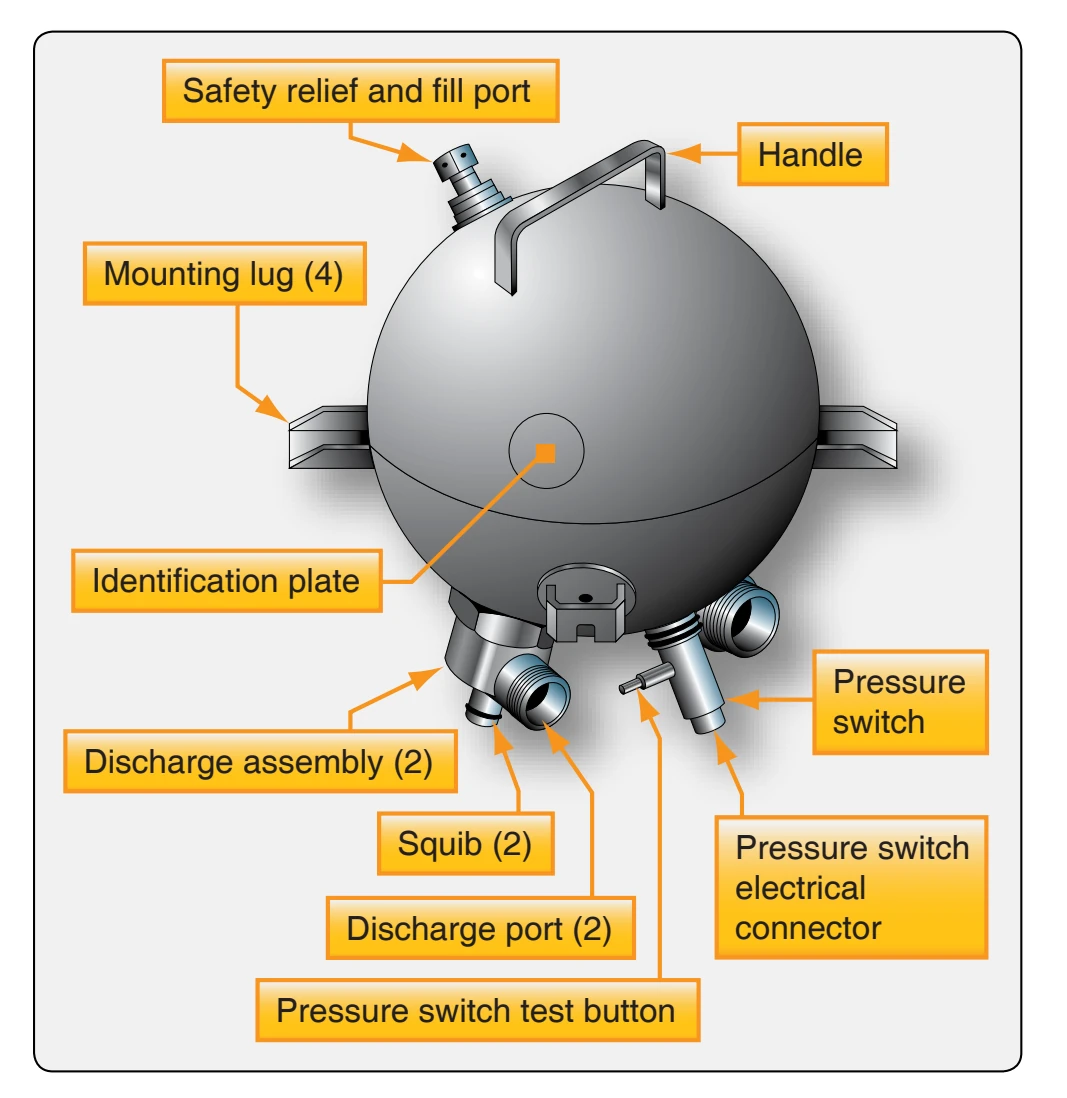
The two engine fire extinguishing bottles are identical. Each bottle has these following components:
- A safety relief and fill port,
- A handle for removal and installation,
- A pressure switch,
- Two discharge assemblies,
- An identification plate, and
- Four mounting lugs. [Figures 9-23, 9-24, 9-25]
The bottles contain Halon fire extinguishing agent pressurized with nitrogen. If the pressure in the bottle becomes too high, the safety relief and fill port opens so that the bottle does not explode. The discharge assembly has an explosive squib. An electric current from the fire extinguishing circuit fires the squib. This releases the Halon through the discharge port. The pressure switch gives flight deck indications when bottle pressure decreases. The switch monitors the pressure inside the bottle and is normally open. When the pressure decreases because of a leak or bottle discharge, the switch closes an indicating circuit.
Squib
The squib is installed in the discharge assembly at the bottom of the fire container. A fire container has two squibs, one for each engine. The squib is an electrically operated explosive device. When the squib is activated, it fires a slug through the breakable disc, and nitrogen pressure inside the bottle pushes the Halon through the discharge port. The squib fires when the fire switch is pulled and turned to the DISCH 1 or DISCH 2 position. [Figure 9-22]