
Chapter 10
Wind
10.1 Introduction
Wind is the air in motion relative to the surface of the Earth. Although people cannot actually see the air moving, it can be measured by its motion of force that it applies on objects. For example, leaves rustling or trees swaying on a windy day indicate that the wind is blowing. Winds are a major factor to both weather and aircraft. Winds cause the formation, dissipation, and redistribution of weather. Winds also affect aircraft during all phases of flight.
Adverse wind is a category of hazardous aviation weather that is responsible for many weather-related accidents. Adverse winds include crosswinds, gusts, tailwind, variable wind, sudden wind shift, wind shear, and mountain wind hazards. Takeoff and landing are the most critical periods of any flight and are most susceptible to the effects of adverse wind. The most at-risk group is pilots flying aircraft with lower crosswind and tailwind threshold values.
This chapter discusses the origin of wind as well as adverse winds.
10.2 Naming of the Wind
Wind is named according to the direction from which it is blowing. For example, a west wind indicates the wind is blowing from the west to the east. There are 36 specific azimuth degrees expressed in intervals of 10 degrees. In aviation, the points of the compass are normally used to represent the direction from which the wind is blowing. For example, north winds come from 360°, east from 90°, south from 180°, and west from 270°.
There are also 16 cardinal compass directions relative to wind. The four primary cardinal directions are north (N), south (S), east (E), and west (W). There are also four intermediate directions, such as northeast (NE), northwest (NW), southeast (SE), and southwest (SW). Additionally, there are eight subdivisions, including north-northeast (NNE), north-northwest (NNW), south-southeast (SSE), south-southwest (SSW), east-northeast (ENE), east-southeast (ESE), west-southwest (WSW), and west-northwest (WNW).
10.3 Forces That Affect the Wind
Three primary forces affect the flow of wind: Pressure Gradient Force (PGF), Coriolis force, and friction.
10.3.1 Pressure Gradient Force (PGF)
Wind is driven by pressure differences, which create a force called the PGF. Whenever a pressure difference develops over an area, the PGF makes the wind blow in an attempt to equalize pressure differences. This force is identified by height contour gradients on constant-pressure charts and by isobar gradients on surface charts.
PGF is directed from higher height/pressure to lower height/pressure and is perpendicular to contours/isobars. Whenever a pressure difference develops over an area, the PGF begins moving the air directly across the contours/isobars. See Figure 10-1.
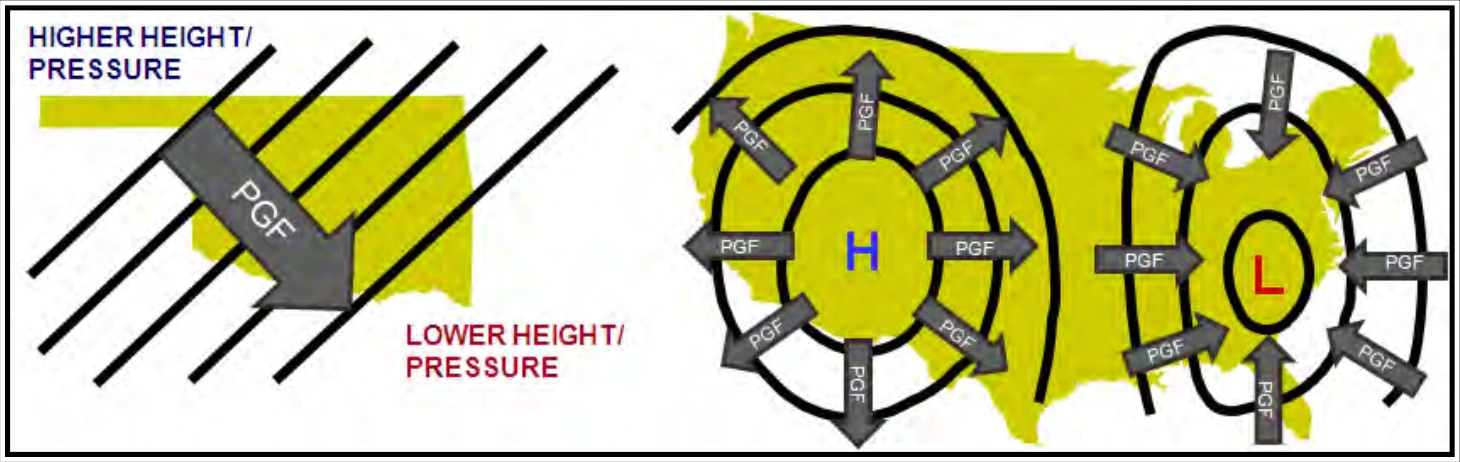
PGF is directed across contours/isobars towards lower height/pressure.
Wind speed is directly proportional to the PGF, which itself is directly proportional to the contour/isobar gradient. Closely spaced contours/isobars indicate strong winds, while widely spaced contours/isobars mean lighter wind. From a pressure analysis, users can get a general idea of wind speed from contour/isobar spacing.
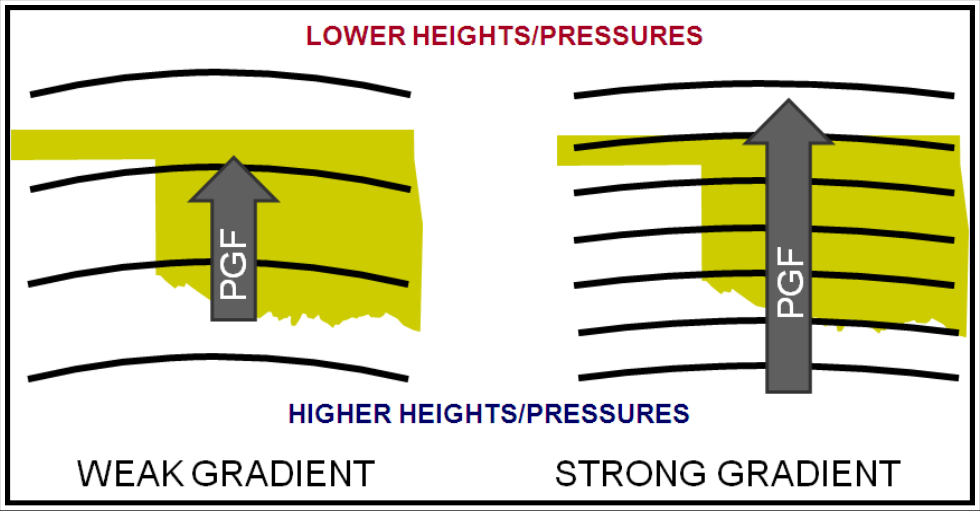
In Figure 10-2, on the left panel, the contours/isobars are widely spaced apart, PGF is weak, and the wind speed is weak. On the right panel, the contours/isobars are more closely spaced, the PGF is stronger, and the wind speed is stronger.
The wind would flow from high to low pressure if the PGF was the only force acting on it. However, because of the Earth’s rotation, there is a second force called the Coriolis force that affects the direction of wind flow.
10.3.2 Coriolis Force
A moving mass travels in a straight line until acted on by some outside force. However, if one views the moving mass from a rotating platform, the path of the moving mass relative to their platform appears to be deflected or curved. To illustrate, consider a turntable. If one used a pencil and a ruler to draw a straight line from the center to the outer edge of the turntable, the pencil would have traveled in a straight line. However, stopping the turntable, it is evident that the line spirals outward from the center (see Figure 10-3). To a viewer on the turntable, some apparent force deflected the pencil to the right.