Chapter 10
Wind
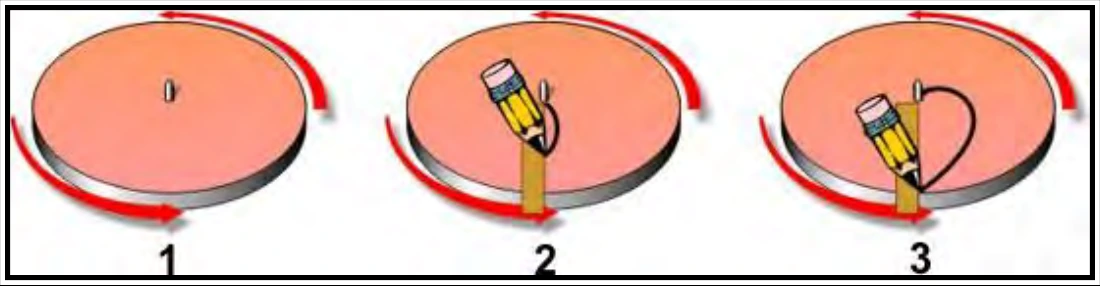
A similar apparent force deflects moving particles on the Earth. Because the Earth is spherical, the deflective force is much more complex than the simple turntable example. The principle was first explained by Gaspard-Gustave de Coriolis, and now carries his name—the Coriolis force.
Coriolis force is an apparent force that affects all moving objects. The force deflects air to the right in the Northern Hemisphere and to the left in the Southern Hemisphere.
Coriolis force is at a right angle to wind direction and directly proportional to wind speed; that is, as wind speed increases, Coriolis force increases. At a given latitude, double the wind speed and the Coriolis force is doubled. Why at a given latitude?
Coriolis force varies with latitude from zero at the Equator to a maximum at the poles. It influences wind direction everywhere except immediately at the Equator, but the effects are more pronounced in middle and high latitudes.
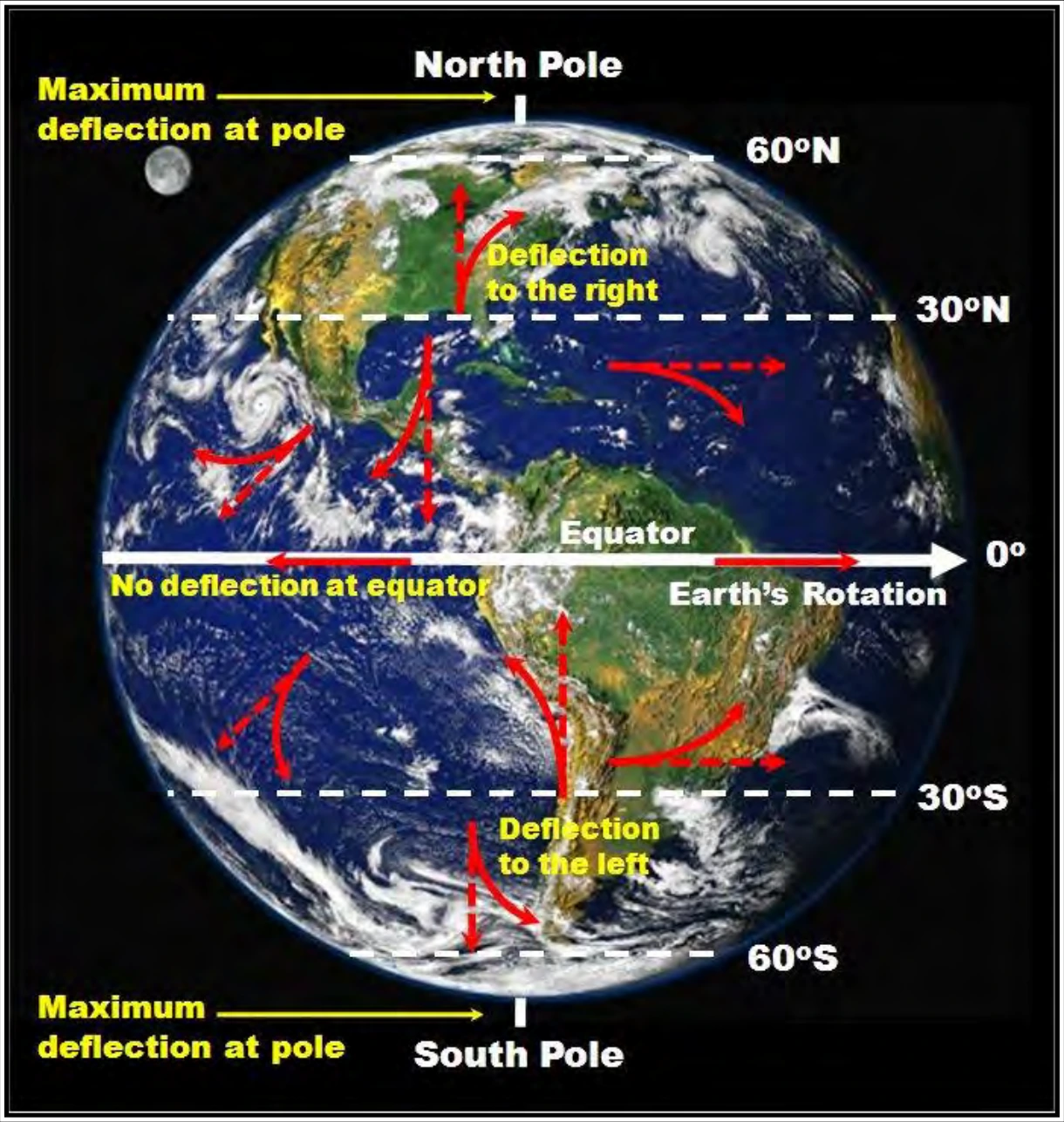
Coriolis force deflects moving objects to the right of their path in the Northern Hemisphere and to the left of their path in the Southern Hemisphere. Coriolis deflection is maximized at the poles and zero at the Equator.
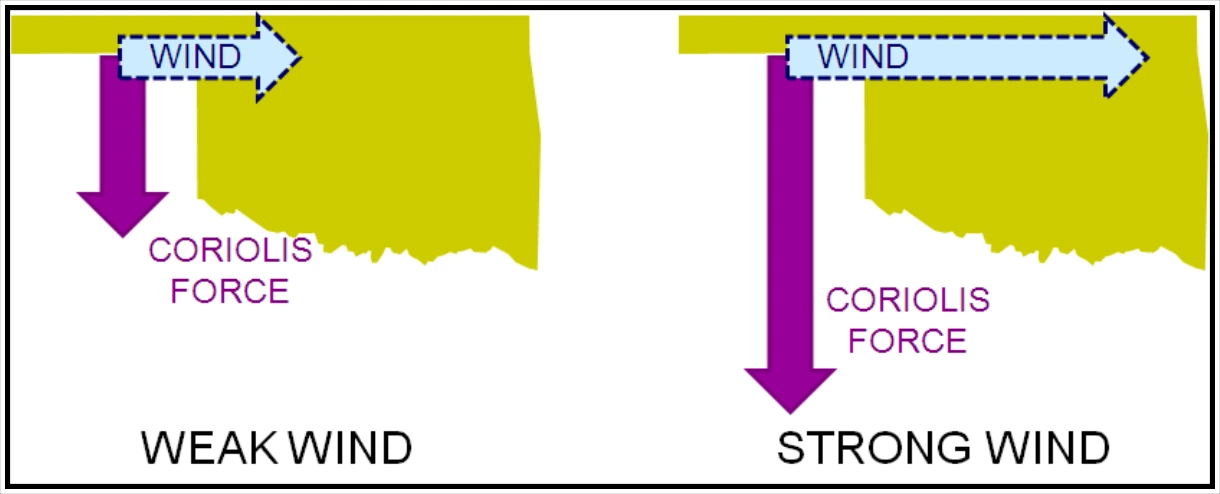
Coriolis force magnitude is directly proportional to wind speed. In Figure 10-5, wind speed is twice as strong in the right panel; thus, the Coriolis force is doubled.
10.3.3 Friction Force
Friction between the wind and the terrain surface slows the wind. The rougher the terrain, the greater the frictional effect. Also, the stronger the wind speed, the greater the friction. One may not think of friction as a force, but it is a very real and effective force always acting opposite to wind direction.
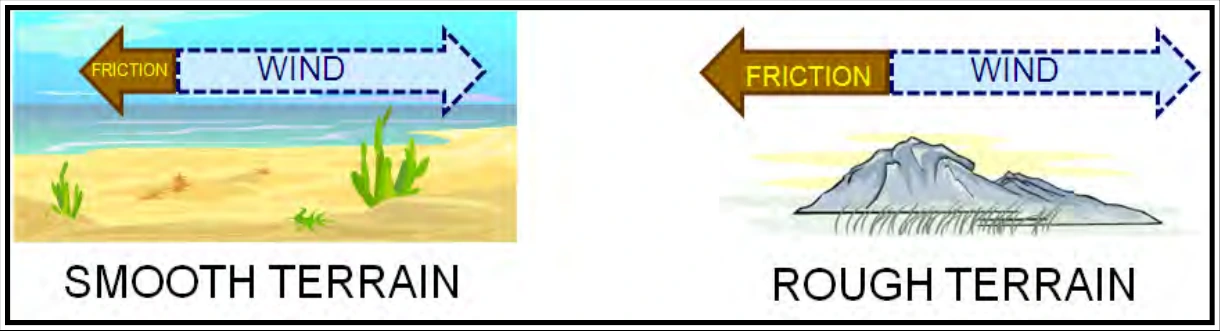
Friction force magnitude is directly proportional to terrain roughness. Even though the wind speed is the same in both panels in Figure 10-6, the terrain is rougher in the right panel; thus, the friction force is stronger.
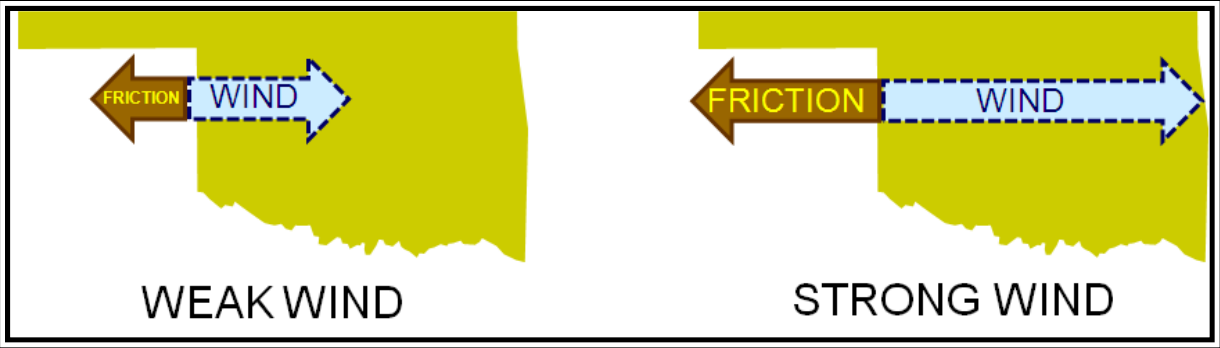
Friction force magnitude is directly proportional to wind speed. In Figure 10-7, wind speed is twice as strong in the right panel; thus, the friction force is doubled.
The frictional drag of the ground normally decreases with height and becomes insignificant above the lowest few thousand feet. However, this may vary somewhat, since both strong winds and rough terrain extend the friction layer to higher altitudes.
10.4 Upper Air Wind
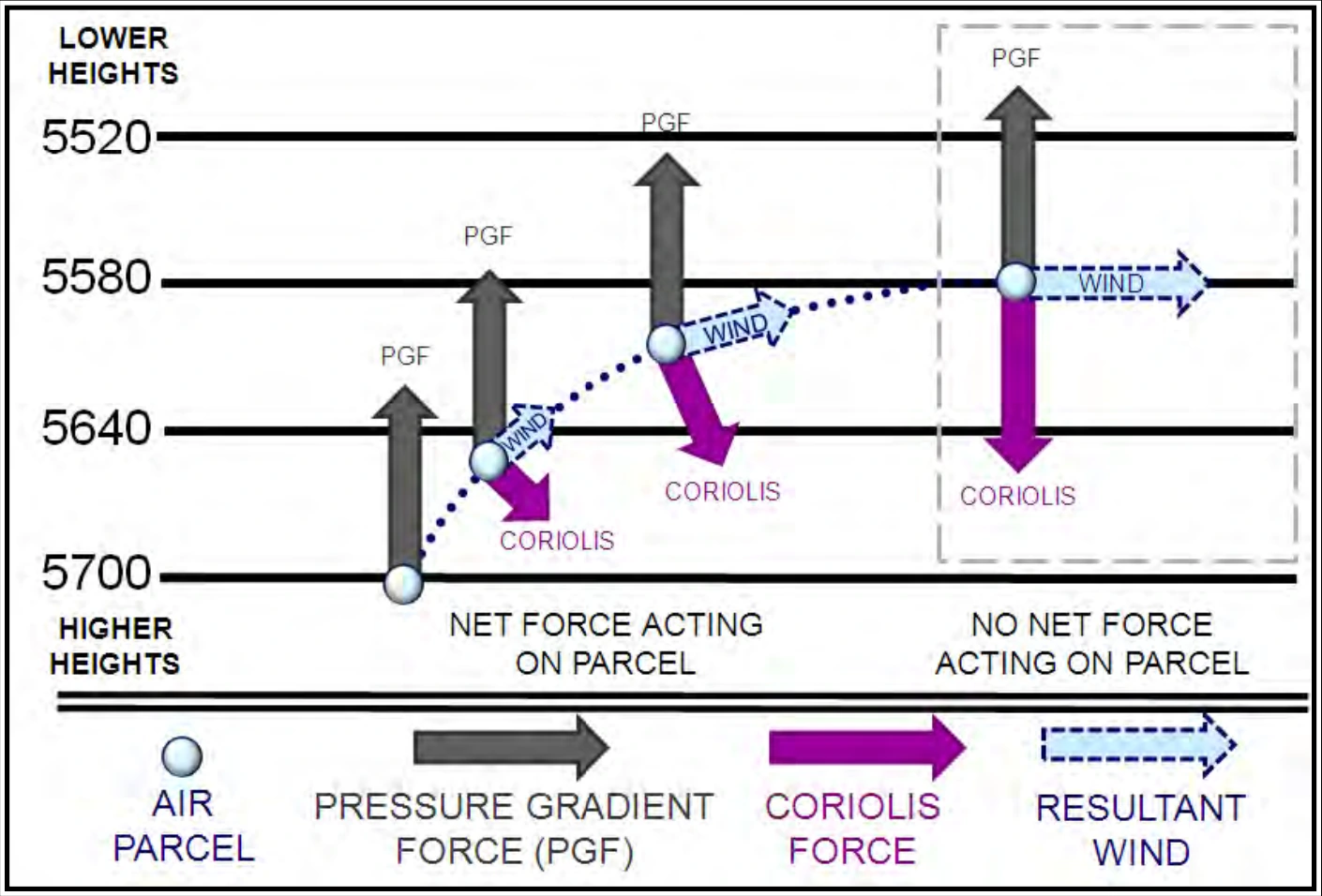
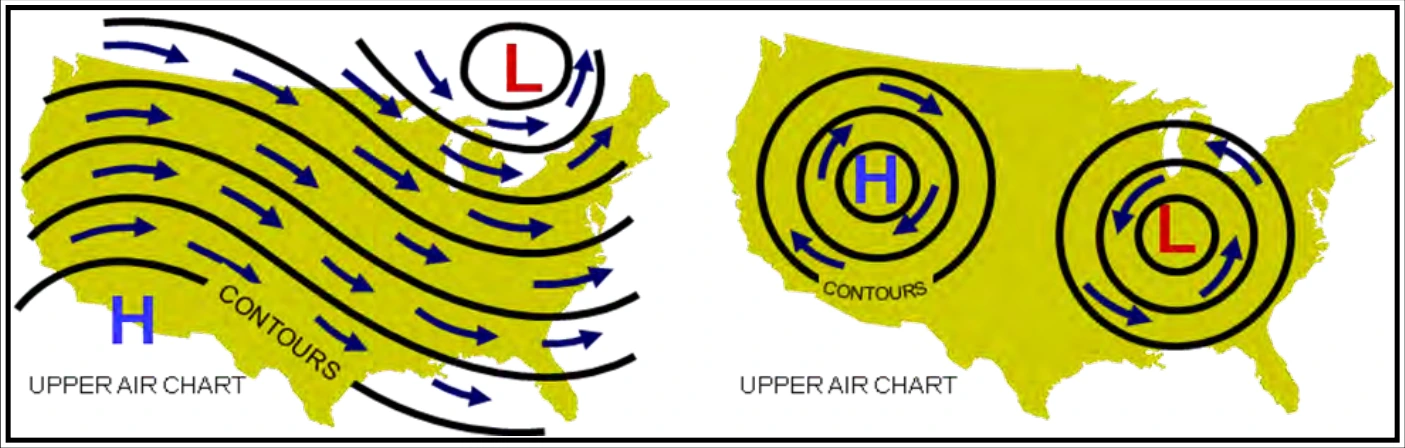
In the atmosphere above the friction layer (lowest few thousand feet), only PGF and Coriolis force affect the horizontal motion of air. Remember that the PGF drives the wind and is oriented perpendicular to height contours. When a PGF is first established, wind begins to blow from higher to lower heights directly across the height contours. However, the instant air begins moving, Coriolis force deflects it to the right. Soon the wind is deflected a full 90° and is parallel to the height contours. At this time, Coriolis force exactly balances PGF, as shown in Figure 10-8 on a 500 mb constant-pressure chart (see Section 25.3 for information on constant-pressure charts). With the forces in balance, wind will remain parallel to height contours as shown in Figure 10-9. This is called the geostrophic wind.