
Chapter 19
Turbulence
Mechanical turbulence is turbulence caused by obstructions to the wind flow, such as trees, buildings, mountains, and so on. Obstructions to the wind flow disrupt smooth wind flow into a complex snarl of eddies (see Figure 19-4). An aircraft flying through these eddies experiences mechanical turbulence.
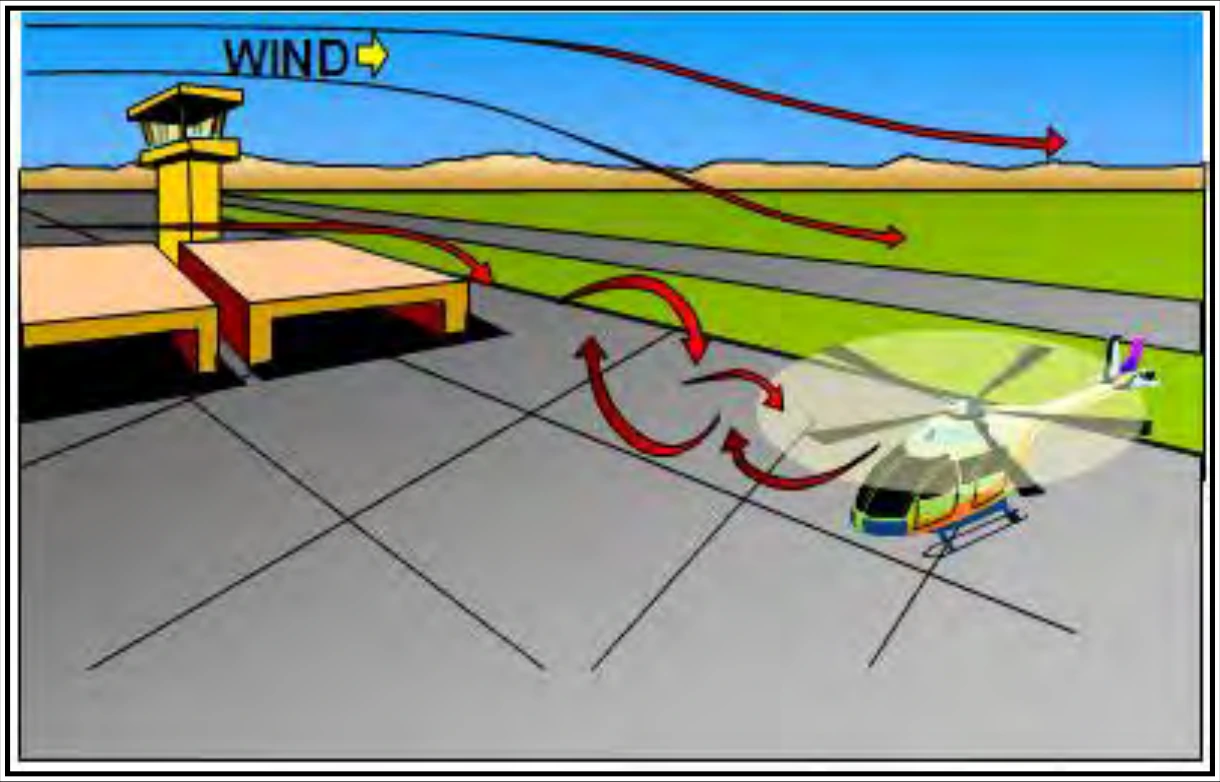
The intensity of mechanical turbulence depends on wind speed, surface roughness, size of the obstructions, and stability of the air. The higher the speed and/or the rougher the surface, the greater the turbulence.
The wind carries the turbulent eddies downstream, with the distance dependent on wind speed and stability of the air. Unstable air allows larger eddies to form rather than those that form in stable air; but the instability breaks up the eddies quickly, while in stable air they dissipate slowly.
19.2.2.1 Mountain Waves
Mountain waves are a form of mechanical turbulence that develop above and downwind of mountains. See Chapter 16, Mountain Weather, for information on mountain waves.
19.2.3 Wind Shear Turbulence
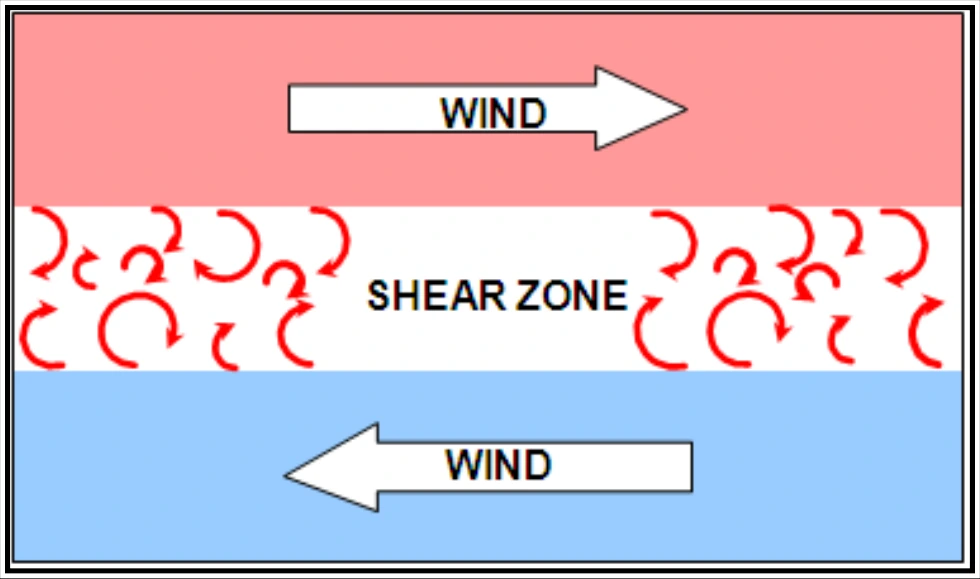
Wind shear is defined in Section 19.2.4. Wind shear generates turbulence between two wind currents of different directions and/or speeds (see Figure 19-5). Wind shear may be associated with either a wind shift or a wind speed gradient at any level in the atmosphere.
19.2.3.1 Temperature Inversion
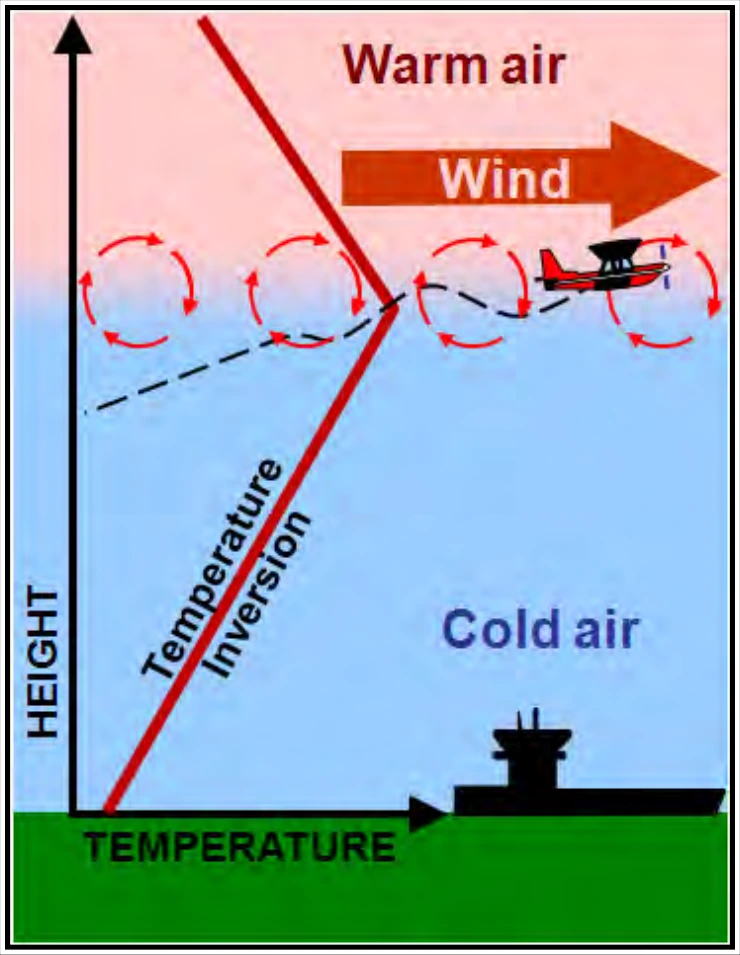
A temperature inversion is a layer of the atmosphere in which temperature increases with altitude. Inversions commonly occur within the lowest few thousand feet above ground due to nighttime radiational cooling, along frontal zones, and when cold air is trapped in a valley. Strong wind shears often occur across temperature inversion layers, which can generate turbulence (see Figure 19-6).
19.2.3.2 Clear-Air Turbulence (CAT)
CAT is defined as sudden severe turbulence occurring in cloudless regions that causes violent buffeting of aircraft. CAT is a higher altitude turbulence (normally above 15,000 ft) particularly between the core of a jet stream and the surrounding air. This includes turbulence in cirrus clouds, within and in the vicinity of standing lenticular clouds and, in some cases, in clear air in the vicinity of thunderstorms. Generally, though, CAT definitions exclude turbulence caused by thunderstorms, low-altitude temperature inversions, thermals, strong surface winds, or local terrain features.
CAT is a recognized problem that affects all aircraft operations. CAT is especially troublesome because it is often encountered unexpectedly and frequently without visual clues to warn pilots of the hazard.
19.2.3.2.1 CAT Discussion
One of the principal areas where CAT is found is in the vicinity of the jet streams. There are three jet streams: the polar front jet stream, the subtropical jet stream, and the polar night jet stream. This handbook does not address the polar night jet stream, as it is a phenomenon in the stratosphere. (See Chapter 9, Global Circulations and Jet Streams, and Figure 9-4 and Figure 9-5 for more information and the polar front jet stream and the subtropical jet stream locations.)
CAT associated with a jet stream is most commonly found in the vicinity of the tropopause. CAT is most frequently found on the poleward side of the jet stream (over the United States, this is to the left side when facing downwind). CAT is also common in the vicinity of a jet stream maxima, a region of stronger winds within the jet stream that translates along the jet stream core.
There are several patterns of upper-level winds that are associated with CAT. One of these is a deep, upper trough. CAT is found most frequently at, and just upwind of, the base of the trough, especially just downwind of an area of strong temperature advection. Another area of the trough in which to suspect CAT is along the centerline of a trough area, where there is a strong horizontal wind shear between the jet core and winds to the poleward side of the jet core. CAT is also found in the west side of a trough in the vicinity of a wind maxima as the maxima passes along the trough.
One noteworthy generator of CAT is the confluence of two jet streams. On occasion, the polar front jet stream will dip south and pass under the subtropical jet stream. The wind shear effect between the two jet streams in the region of confluence and immediately downstream is often highly turbulent.