
Chapter 20
Icing
A favored location for severe clear icing is freezing rain and/or freezing drizzle below a front. Rain forms above the frontal surface at temperatures warmer than freezing. Subsequently, it falls through air at temperatures below freezing and becomes supercooled. The SLDs freeze on impact with an aircraft. If the below-freezing layer is shallow, freezing rain will occur at the surface. If the below-freezing layer is deep, the supercooled droplets may freeze into ice pellets. Ice pellets indicate icing above. The icing can be severe because of the large amount of supercooled water. Icing in freezing precipitation is especially dangerous because it often extends horizontally over a broad area and a pilot may be unable to escape it by descending to a lower altitude.
20.3.8 Icing with Mountains
Icing is more likely and more severe in mountainous regions. Mountain ranges cause upward air motions on their windward side. These vertical currents support large, supercooled water droplets above the freezing level. The movement of a front across a mountain range combines frontal lift with the mountain’s upslope flow effect to create extremely hazardous icing zones (see Figure 20-2).
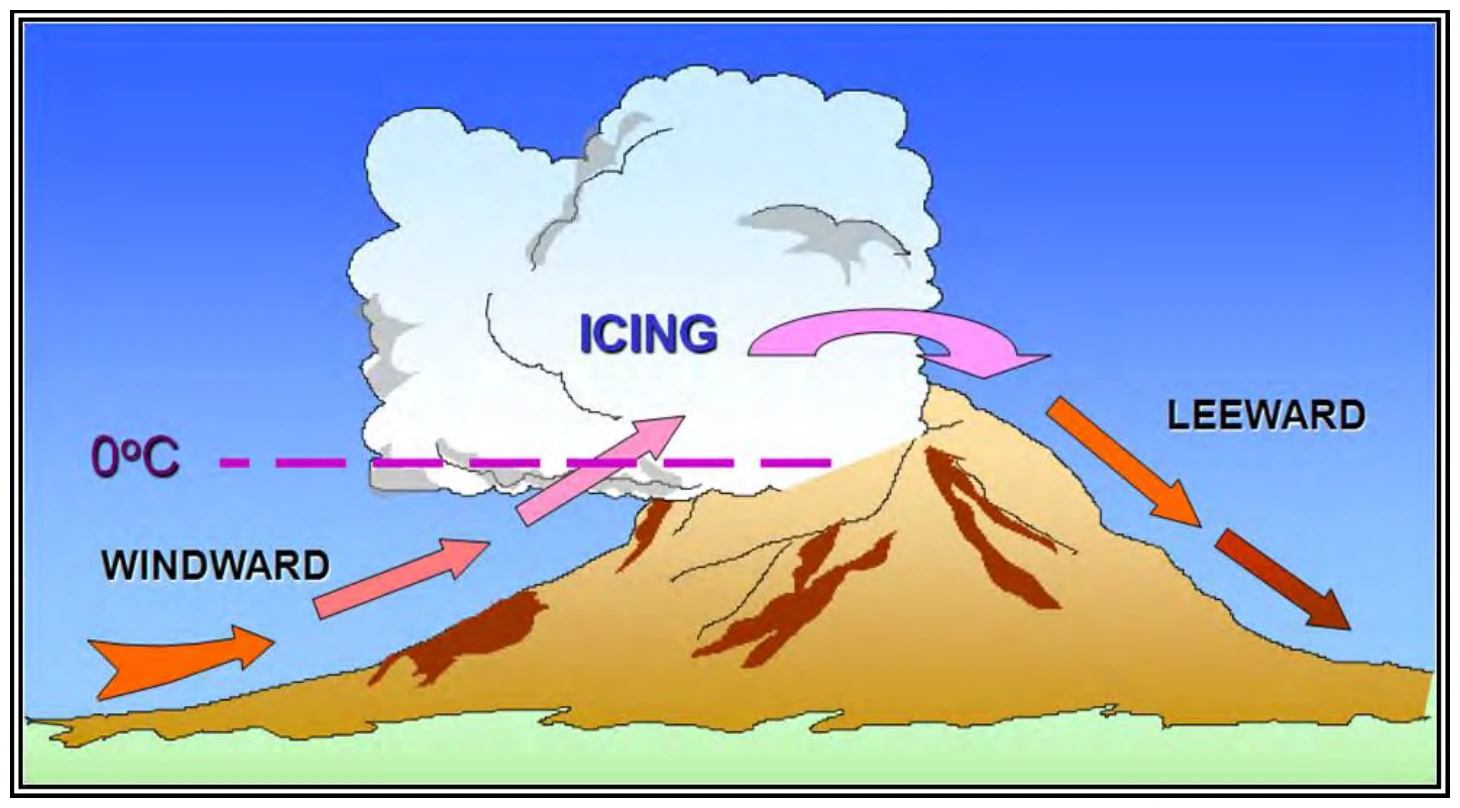
The most severe icing occurs above the crests and on the ridges’ windward side. This zone usually extends to about 5,000 ft above the mountaintops but can extend much higher if cumuliform clouds develop.
Icing with mountains can be especially hazardous because a pilot may be unable to descend to above-freezing temperatures due to terrain elevation. If a pilot approaches a mountain ridge from the windward side, the pilot’s aircraft may be unable to climb above the mountaintops, or even maintain altitude due to severe ice accumulation. The end result may be a crash.
20.3.9 Convective Icing
Thunderstorms produce abundant supercooled liquid water above the freezing level. When temperature in the upward current cools to about -15°C, much of the remaining water vapor deposits as ice crystals; above this level, the amount of supercooled water decreases. However, supercooled water can exist at temperatures as cold as -40°C in the presence of vigorous upward vertical motion, such as in a thunderstorm updraft.
Supercooled water freezes on impact with an aircraft. Clear icing can occur at any altitude above the freezing level, but at high levels, icing may be rime or mixed rime and clear. The abundance of supercooled water makes clear icing very rapid between 0°C and -15°C, and encounters can be frequent in a cluster of cells. Thunderstorm icing can be extremely hazardous.
20.3.10 Icing Hazards
Structural icing degrades an aircraft’s performance. It destroys the smooth flow of air, increasing drag while decreasing the ability of the airfoil to create lift. The actual weight of ice on an airplane is insignificant when compared to the airflow disruption it causes. As power is added to compensate for the additional drag and the nose is lifted to maintain altitude, the angle of attack is increased. This allows the underside of the wings and fuselage to accumulate additional ice.
Wind tunnel and flight tests have shown that frost, snow, and ice accumulations on the leading edge or upper surface of the wing that are no thicker or rougher than a piece of coarse sandpaper can reduce lift by 30 percent and increase drag up to 40 percent. Larger accretions can reduce lift even more and can increase drag by 80 percent or more.
Ice accumulates on every exposed frontal surface of the airplane: wings, propeller, windshield, antennas, vents, intakes, and cowlings. It can build in flight where no heat or boots can reach it. It can cause antennas to vibrate so severely that they break. In moderate-to-severe icing, a light aircraft could be subject to enough ice accumulation or accretion that continued flight is impossible. The airplane may stall at much higher speeds and lower angles of attack than normal. It can roll or pitch uncontrollably, and recovery might be impossible.
Regardless of anti-ice or deice protection offered by the aircraft, a pilot’s first course of action should be to leave the area of visible moisture. This might mean descending to an altitude below the cloud bases, climbing to an altitude that is above the cloud tops, or turning to a different course. If this is not possible, then the pilot should move to an altitude where the temperature is above freezing.
20.4 Engine Icing
20.4.1 Carburetor Icing
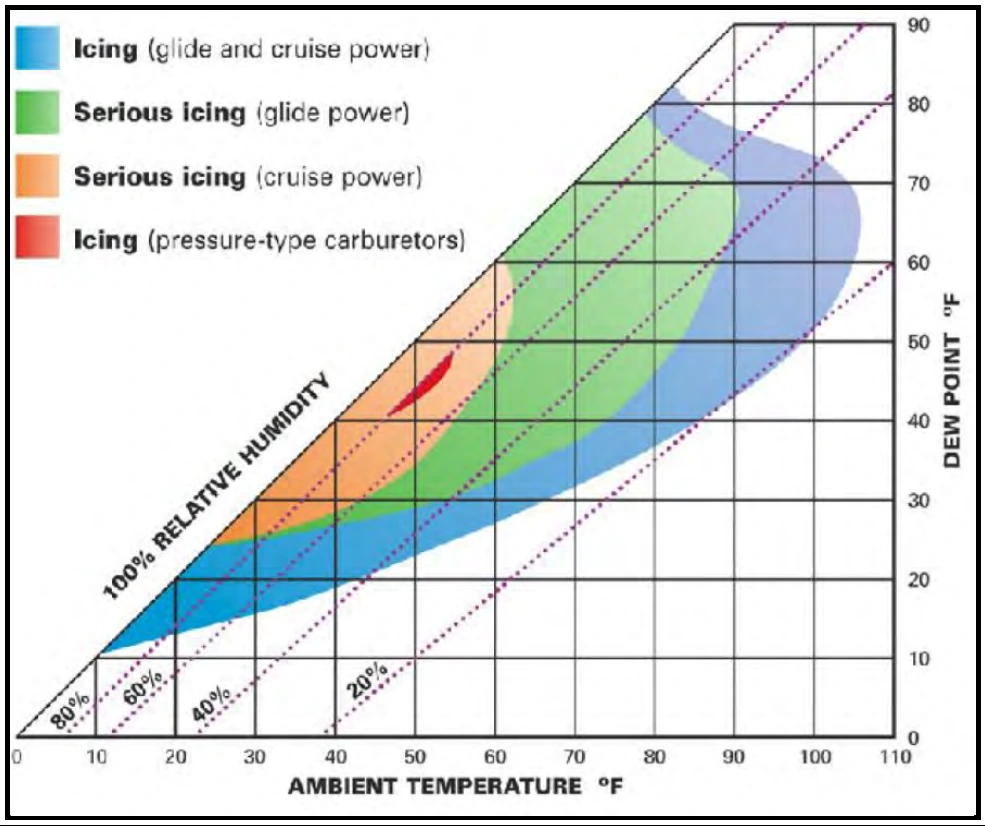
Carburetor ice occurs due to the effect of fuel vaporization and the decrease in air pressure in the venturi, which causes a sharp temperature drop in the carburetor. If water vapor in the air condenses when the carburetor temperature is at or below freezing, ice may form on internal surfaces of the carburetor, including the throttle valve. The reduced air pressure, as well as the vaporization of fuel, contributes to the temperature decrease in the carburetor. Ice generally forms in the vicinity of the throttle valve and in the venturi throat. This restricts the flow of the fuel-air mixture and reduces power. If enough ice builds up, the engine may cease to operate. Carburetor ice is most likely to occur when temperatures are below 70 degrees Fahrenheit (°F) or 21 degrees Celsius (°C) and the relative humidity is above 80 percent. Due to the sudden cooling that takes place in the carburetor, icing can occur even in outside air temperatures as high as 100°F (38°C) and humidity as low as 50 percent. This temperature drop can be as much as 60 to 70 absolute (versus relative) Fahrenheit degrees (70 x 100/180 = 38.89 Celsius degrees) (Remember there are 180 Fahrenheit degrees from freezing to boiling versus 100 degrees for the Celsius scale.) Therefore, an outside air temperature of 100°F (38°C), a temperature drop of an absolute 70 F degrees (38.89 Celsius degrees) results in an air temperature in the carburetor of 30°F (-1°C).
20.4.2 High Ice Water Content (HIWC)
High Ice Water Content (HIWC) is a relatively new icing hazard, at least from the standpoint of research and understanding. HIWC refers to high-altitude ice crystals, which may exist in the tops and anvils of cumulonimbus clouds and thunderstorms. Under certain HIWC conditions, turbine engine performance can be affected, including flameouts. Research into HIWC conditions continues as of the writing of this section.