
Chapter 24
Observations
PIREPs are reported by the pilot (or aircrew), while AIREPs can either be reported by the pilot or generated from sensors onboard the aircraft (automated AIREPs). PIREPs and AIREPs are coded differently. The PIREP format is a U.S.-only format. The AIREP format is used worldwide. Automated AIREPs are common over the United States.
The VAR is a report for aircraft encounters with volcanic ash and/or sulfur dioxide (SO ).
24.5.1 Pilot Weather Reports (PIREP)
Pilots can report any observation, good or bad, to assist other pilots with flight planning and preparation. If conditions were forecasted to occur but not encountered, a pilot can also report the observed condition. This will help the NWS verify forecast products and create more accurate products for the aviation community.
A PIREP is prepared using a prescribed format (see Figure 24-5). Elements for all PIREPs are message type, location, time, altitude/FL, type aircraft, and at least one other element to describe the reported phenomena. The other elements are omitted when no data is reported. All altitude references are mean sea level unless otherwise noted. Distance for visibility is in statute miles and all other distances are in nautical miles. Time is reported in Coordinated Universal Time.
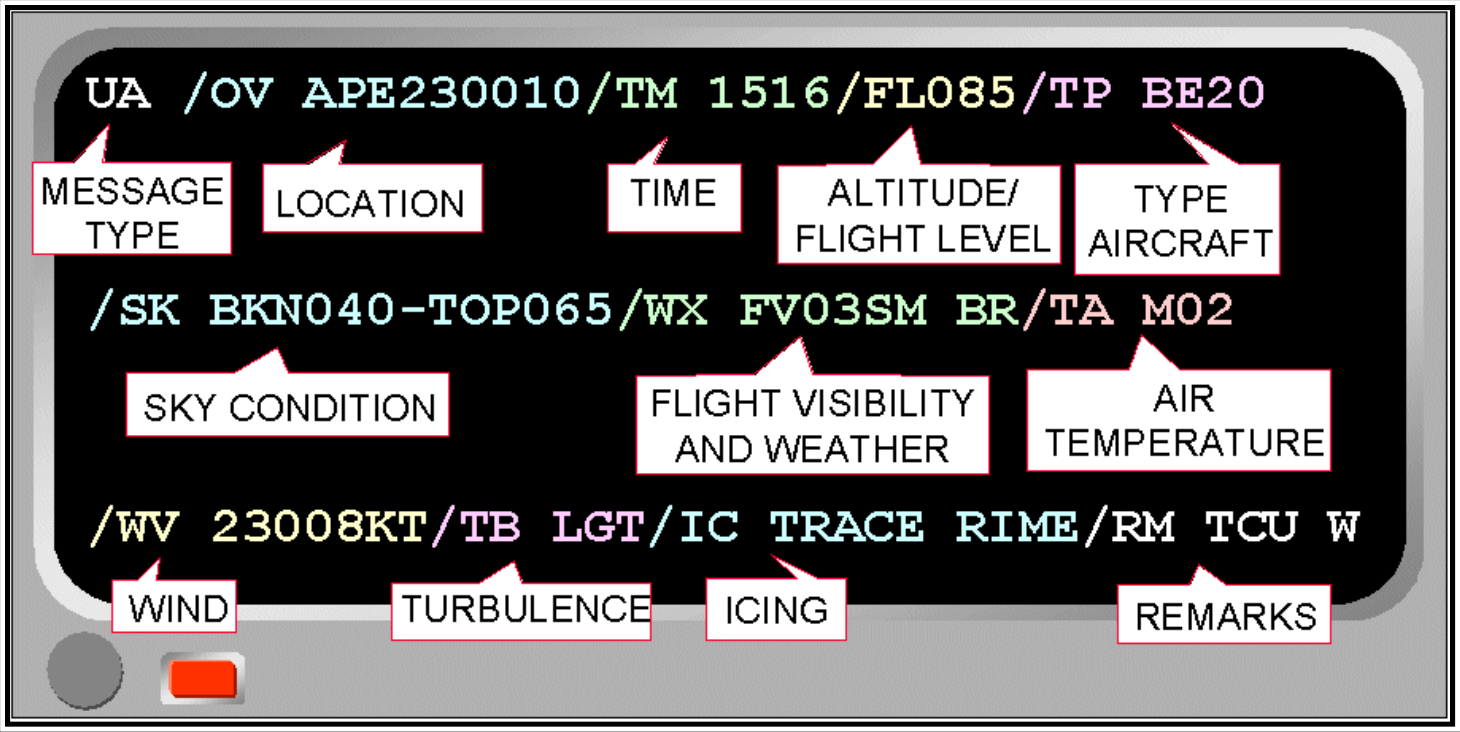
24.5.1.1 Message Type (UUA/UA)
The two types of PIREPs are Urgent (UUA) and Routine (UA).
24.5.1.1.1 Urgent PIREPs
Urgent (UUA) PIREPs contain information about:
- Tornadoes, funnel clouds, and waterspouts;
- Severe or extreme turbulence (including CAT);
- Severe icing;
- Hail;
- LLWS within 2,000 ft of the surface (LLWS PIREPs are classified as UUA if the pilot reports air speed fluctuations of 10 kt or more; or, if air speed fluctuations are not reported but LLWS is reported, the PIREP is classified as UUA);
- Volcanic ash clouds;
- Any other weather phenomena reported that are considered by the air traffic controller or Flight Service specialist receiving the report as being hazardous, or potentially hazardous, to flight operations.
24.5.1.1.2 Routine PIREPs
Routine (UA) PIREPs are issued after receiving a report from a pilot that does not contain any urgent information as listed in Section 24.5.1.1.1.
24.5.1.2 Location (/OV)
The location (/OV) is the position reference where the phenomenon occurred. It is not the location of the aircraft when the report is submitted. Location can be referenced either by geographical position or by route segment. A position reference is preferred by meteorologists to aid forecast precision, monitoring, and verification.
24.5.1.2.1 Geographical Position
Geographical position can be referenced to a VHF Navigational Aid (NAVAID) or an airport, using either the three-letter IATA or four-letter ICAO identifier. If appropriate, the PIREP is encoded using the identifier, then three digits to define a radial, and three digits to define the distance in nautical miles.
Examples:
/OV APE Over the Appleton VHF omni-directional range station (VOR).
/OV KJFK Over John F. Kennedy International Airport, New York, NY.