
Chapter 24
Observations
The METAR and SPECI are the code form used for aviation surface observations (reports) to satisfy World Meteorological Organization (WMO) and ICAO instructions for reporting surface meteorological data. Although the METAR and SPECI code is used worldwide, there are some code differences among countries. Each country is allowed to make modifications to the code for use in their particular country, as long as they notify ICAO. These sections will focus on the METAR/SPECI code as used in the United States.
Traditionally, it was critical for pilots to know how to decode the METAR and SPECI. The majority of current preflight briefing services, including many weather applications, provide the decoded report in a plain language format in addition to the coded report. Table 24-1 provides an example of a decoded METAR. While the decoded version has been welcomed by many pilots, it is still important for all pilots to know how to decode the METAR/SPECI in case the source does not provide a decoded version.

+ KPNS (Pensacola Intl, FL, US)
Temperature: 30.0 °C (86 °F)
Dewpoint: 23.3 °C (74 °F) [RH = 67%]
Pressure 29.92 inHg (1013.3 mb) [Sea level pressure: 1013.2 mb] (altimeter):
Winds: from the N (360 degrees) at 6 mph (5 knots; 2.6 m/s)
Visibility: 10 SM or more (16+ km)
Ceiling: at least 12,000 ft AGL
Clouds: sky clear below 12,000 ft AGL
24.4.1 Aviation Routine Weather Report (METAR)
A METAR includes the airport identifier, time of observation, wind, visibility, Runway Visual Range (RVR), present weather phenomena, sky conditions, temperature, dewpoint, and altimeter setting. Excluding the airport identifier and the time of observation, this information is collectively referred to as the “body” of the report. Coded and/or plain language information elaborating on data in the body may be appended to the end of the METAR as “remarks.” The contents of the remarks section vary with manual, automated, and augmented surface observations. At some designated stations, the METAR may be abridged to include only a few of the mentioned elements. METARs are sometimes referred to as “hourly” reports since they are routinely produced near the top of the hour.
24.4.2 Aviation Selected Special Weather Report (SPECI)
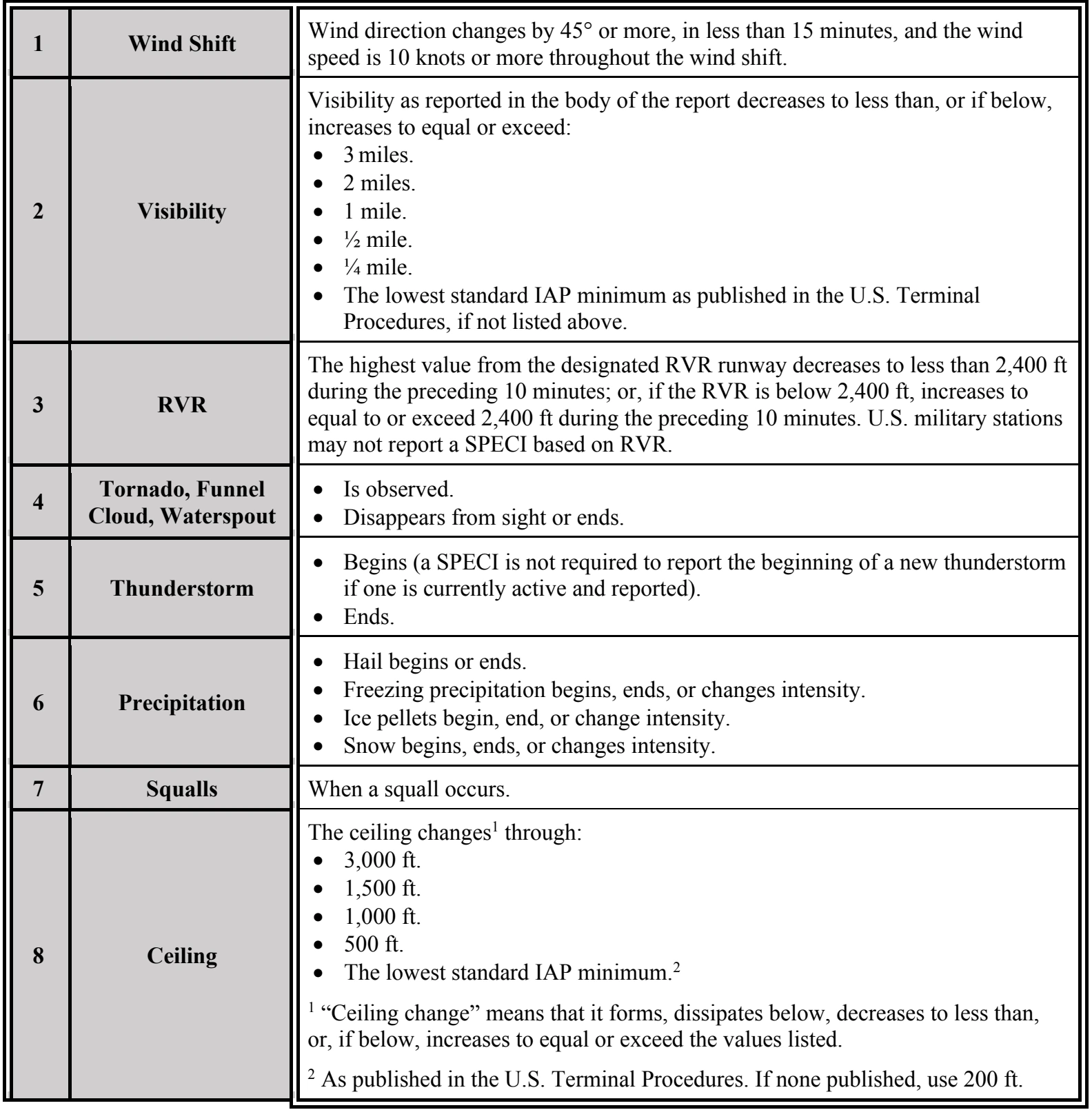
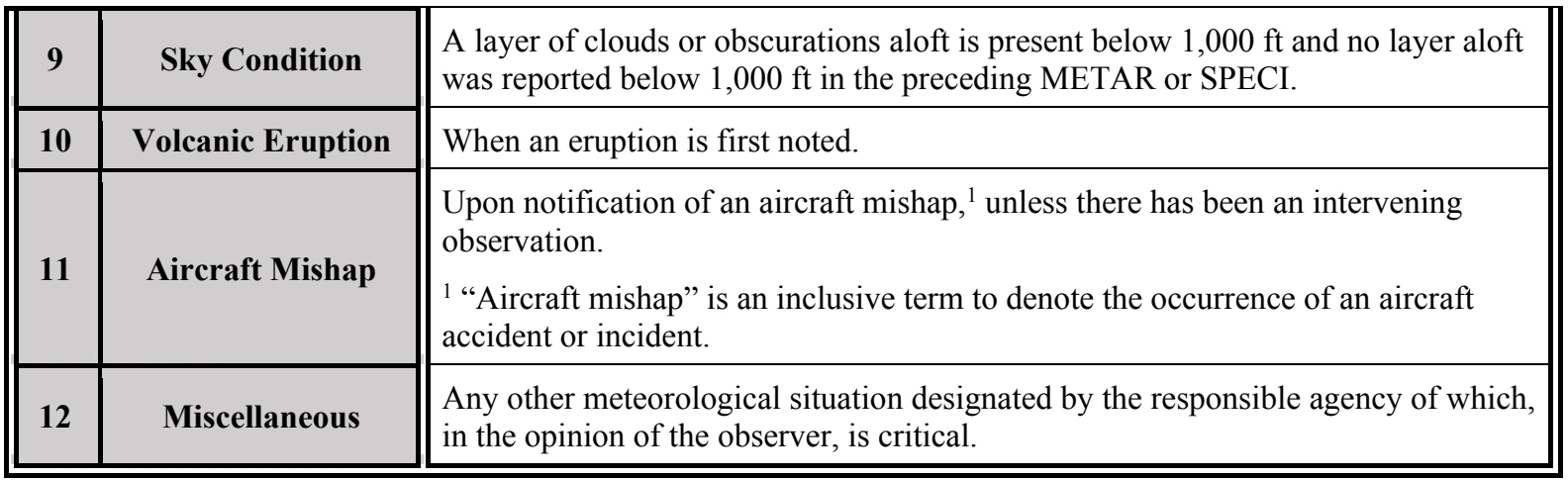
A SPECI is an unscheduled report taken when any of the criteria given in Table 24-2 are observed during the period between hourly reports. SPECIs contain all data elements found in a METAR. All SPECIs are issued as soon as possible when relevant criteria are observed.
Whenever SPECI criteria are met at the time of the routine METAR, a METAR is issued.
24.4.3 METAR/SPECI Format
A U.S. METAR/SPECI has two major sections: the body (consisting of a maximum of 11 groups) and the remarks (consisting of two categories). When an element does not occur, or cannot be observed, the corresponding group is omitted from that particular report. See Figure 24-1 for the format.