
Chapter 4
The Earth’s Atmosphere
Part 2: Weather Theory and Aviation Hazards
4.1 Introduction
The Earth’s atmosphere is a cloud of gas and suspended solids extending from the surface out many thousands of miles, becoming thinner with distance but always held by the Earth’s gravitational pull. The atmosphere is made up of layers surrounding the Earth that holds the air that people breathe, protects us from outer space, and holds moisture (e.g., vapor, clouds, and precipitation), gases, and tiny particles. In short, the atmosphere is the protective bubble that people live in.
This chapter covers the atmosphere’s composition and vertical structure and the standard atmosphere.
4.2 Composition
The Earth’s atmosphere consists of numerous gases (see Table 4-1) with nitrogen, oxygen, argon, and carbon dioxide making up 99.998 percent of all gases. Nitrogen, by far the most common, dilutes oxygen and prevents rapid burning at the Earth’s surface. Living things need it to make proteins. Oxygen is used by all living things and is essential for respiration. Plants use carbon dioxide to make oxygen. Carbon dioxide also acts as a blanket and prevents the escape of heat to outer space.
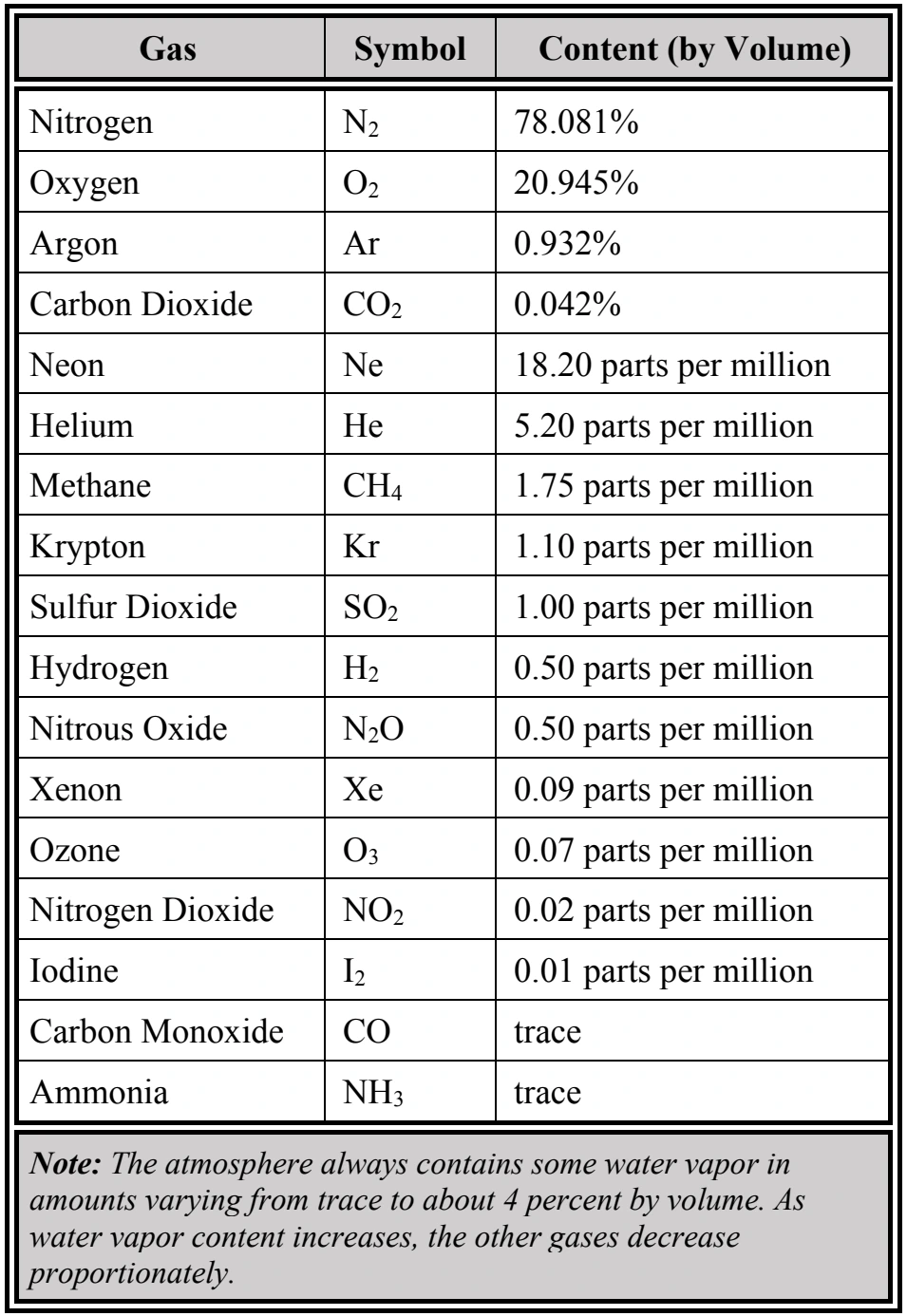
Weather (the state of the atmosphere at any given time and place) strongly influences daily routine as well as general life patterns. Virtually all of our activities are affected by weather, but, of all of our endeavors, perhaps none more so than aviation.
4.2.1 Air Parcel
An air parcel is an imaginary volume of air to which any or all of the basic properties of atmospheric air may be assigned. A parcel is large enough to contain a very large number of molecules, but small enough so that the properties assigned to it are approximately uniform. It is not given precise numerical definition, but a cubic centimeter of air might fit well into most contexts where air parcels are discussed. In meteorology, an air parcel is used as a tool to describe certain atmospheric processes, and air parcels will be referred to in this handbook.
4.3 Vertical Structure
The Earth’s atmosphere is subdivided into five concentric layers (see Figure 4-1) based on the vertical profile of average air temperature changes, chemical composition, movement, and density. Each of the five layers is topped by a pause, where the maximum changes in thermal characteristics, chemical composition, movement, and density occur.
4.3.1 Troposphere
The troposphere begins at the Earth’s surface and extends up to about 11 kilometers (km) (36,000 ft) high. This is where people live. As the gases in this layer decrease with height, the air becomes thinner. Therefore, the temperature in the troposphere also decreases with height. Climbing higher, the temperature drops from about 15 degrees Celsius (°C) [59 degrees Fahrenheit (°F)] to -56.5 °C (-70 °F). Almost all weather occurs in this region.
The vertical depth of the troposphere varies due to temperature variations that are closely associated with latitude and season. It decreases from the Equator to the poles and is higher during summer than in winter. At the Equator, it is around 18–20 km [11–12 miles (mi)] high; at 50° N and 50° S latitude, 9 km (5.6 mi) high; and at the poles, 6 km (3.7 mi) high.
The lowest portion of the troposphere is known as the planetary boundary layer. The height of the boundary layer varies depending on terrain and time of day and is directly affected by surface heating and cooling. It has an important role in transporting heat and moisture into the atmosphere.
The transition boundary between the troposphere and the layer above is called the tropopause. Both the tropopause and the troposphere are known as the lower atmosphere.
4.3.2 Stratosphere
The stratosphere extends from the tropopause up to 50 km (31 mi) above the Earth’s surface. This layer holds 19 percent of the atmosphere’s gases but very little water vapor.
Temperature increases with height as radiation is increasingly absorbed by oxygen molecules, leading to the formation of ozone. The temperature rises from an average -56.6 °C (-70 °F) at the tropopause to a maximum of about -3 °C (27 °F) at the stratopause due to this absorption of ultraviolet radiation. The increasing temperature also makes it a calm layer, with movements of the gases being slow.