
Chapter 5
Heat and Temperature
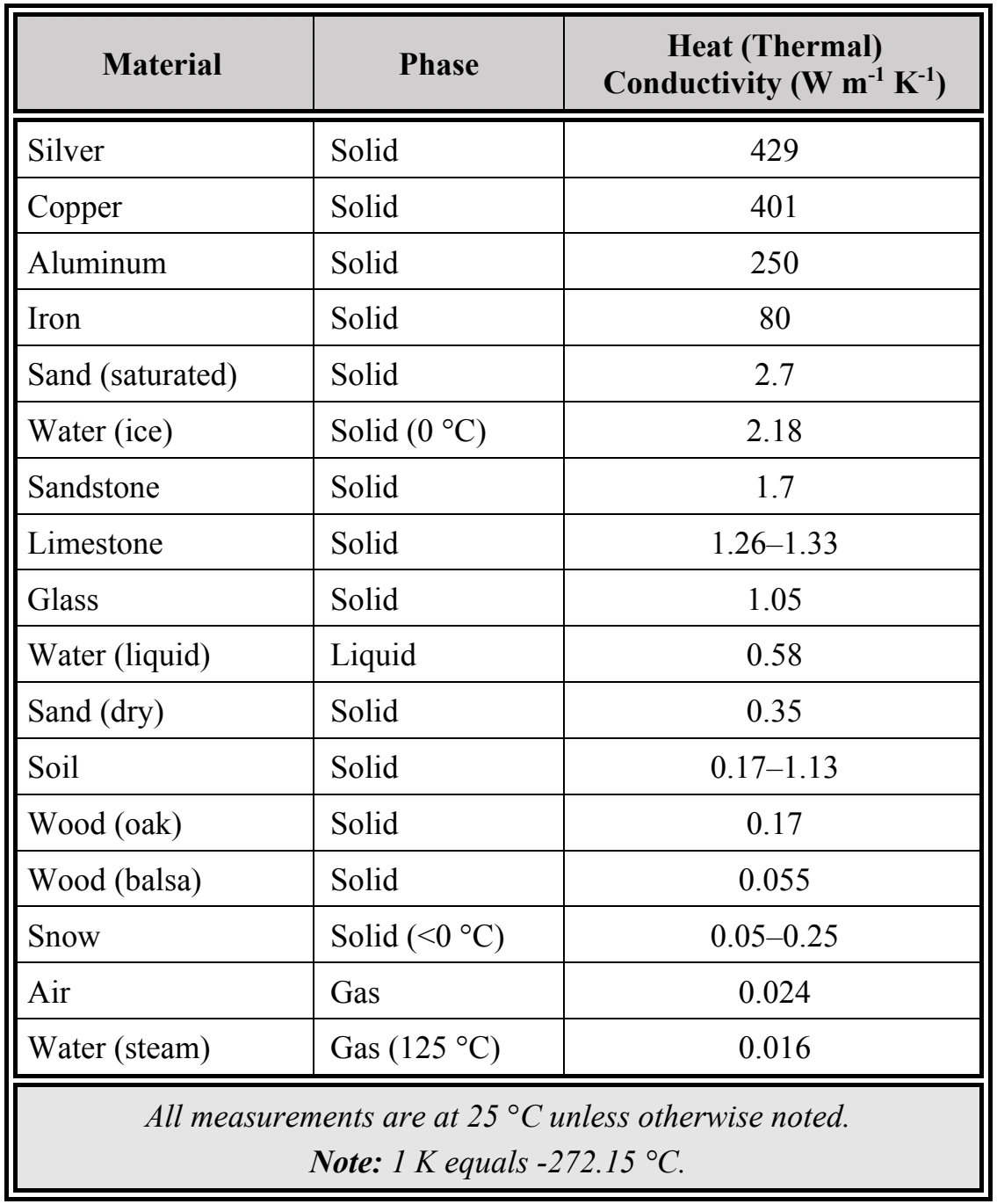
Heat (thermal) conductivity is the property of a substance that indicates its ability to conduct heat as a consequence of molecular motion. Units are watts per meter-kelvin (W m-1 K-1). Table 5-3 provides the heat (thermal) conductivity of various substances. Note that air is a poor thermal conductor.
5.6.3 Convection
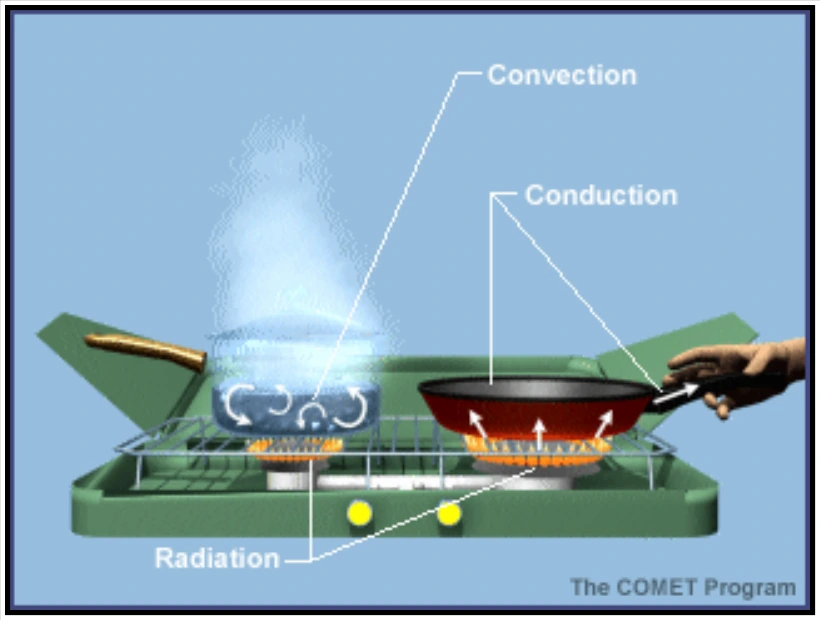
Convection is the transport of heat within a fluid, such as air or water, via motions of the fluid itself. This type of heat flow takes place in liquids and gases because they can move freely and it is possible to set up currents within them. Water boiling in a pot is an example of convection. Because air is a poor thermal conductor, convection plays a vital role in the Earth’s atmospheric heat transfer process. Figure 5-5 illustrates examples of various heat transfer processes.
5.7 Thermal Response
Whether by radiation, conduction, convection, or a combination of these, the temperature response to the input (or output) of some specified quantity of heat varies from one substance to another. Specific heat is defined as the measure of heat energy required to increase the temperature of a unit quantity of a substance by a certain temperature interval. Specific heat capacity is typically expressed in units of joules per gram-kelvin (J g-1 K-1). Thus, two different substances with identical temperature measurements do not necessarily possess the same amount of heat energy. When exposed to the same amount of heat energy, a substance with a low specific heat warms up more than a substance with a higher specific heat. Table 5-4 lists the specific heat capacity of various substances.
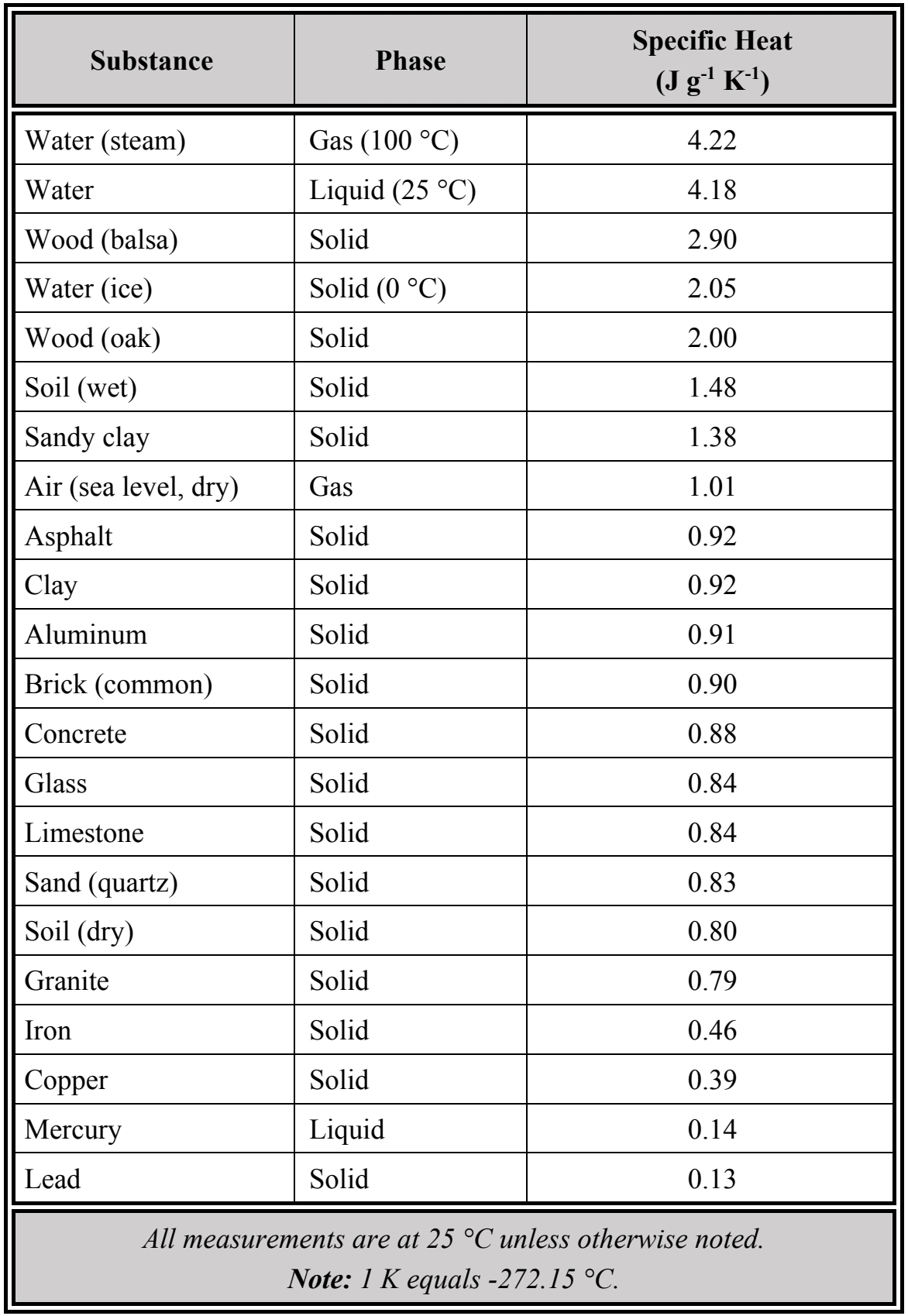
Water has the highest specific heat of any naturally occurring substance. That means it has a much higher capacity for storing heat energy than other substances, such as soil, sand, rock, or air. Water can store large amounts of heat energy while only experiencing a small temperature change.
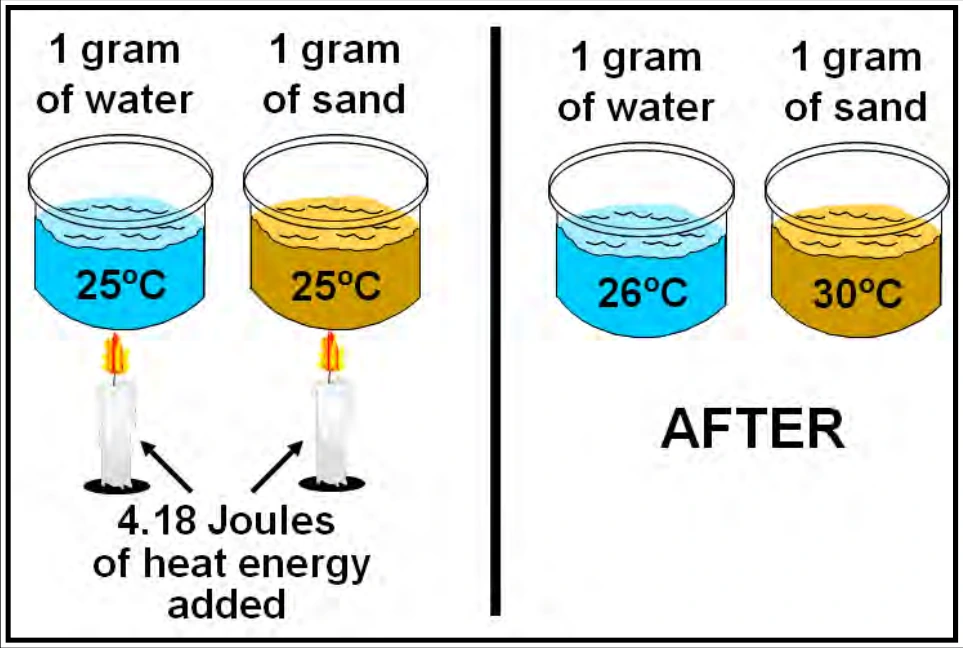
Figure 5-6 compares the specific heat of water and sand. The specific heat of water is more than five times that of quartz sand. Thus, 4.18 J of heat are required to raise the temperature of 1 gram (g) of water by 1 °C, while only 0.83 J are required to raise the temperature of 1 g of quartz sand by 1 °C. This is one reason why beach sand is hotter than water on a sunny, summer afternoon.
The difference in the specific heat of various materials is one of the primary reasons why the temperature of a body of water, such as a lake or the ocean, is less variable with time than the surface temperature of land. Water heats up more slowly than land during the day and during the summer and cools down more slowly at night and during the winter. Thus, a body of water exhibits greater resistance to temperature change (called thermal inertia) than does a land mass.
Heat flow differences are another reason why water bodies warm up and cool down more slowly than land. Incoming solar radiation penetrates water to significant depths but can only heat the top skin layer of soil and rock. Also, since water is a fluid, its heat energy can be circulated through great volumes and depths via convection. Water temperature changes occur to depths of 6 meters (m) (20 ft) or more on a daily basis, and 200 m to 600 m (650 ft to 1950 ft) annually. The process is more problematic over land since heat must be transferred via the slow process of conduction. Land temperature changes occur to depths of only 10 centimeters (cm) [4 inches (in)] on a daily basis and 15 m (50 ft) or less annually.
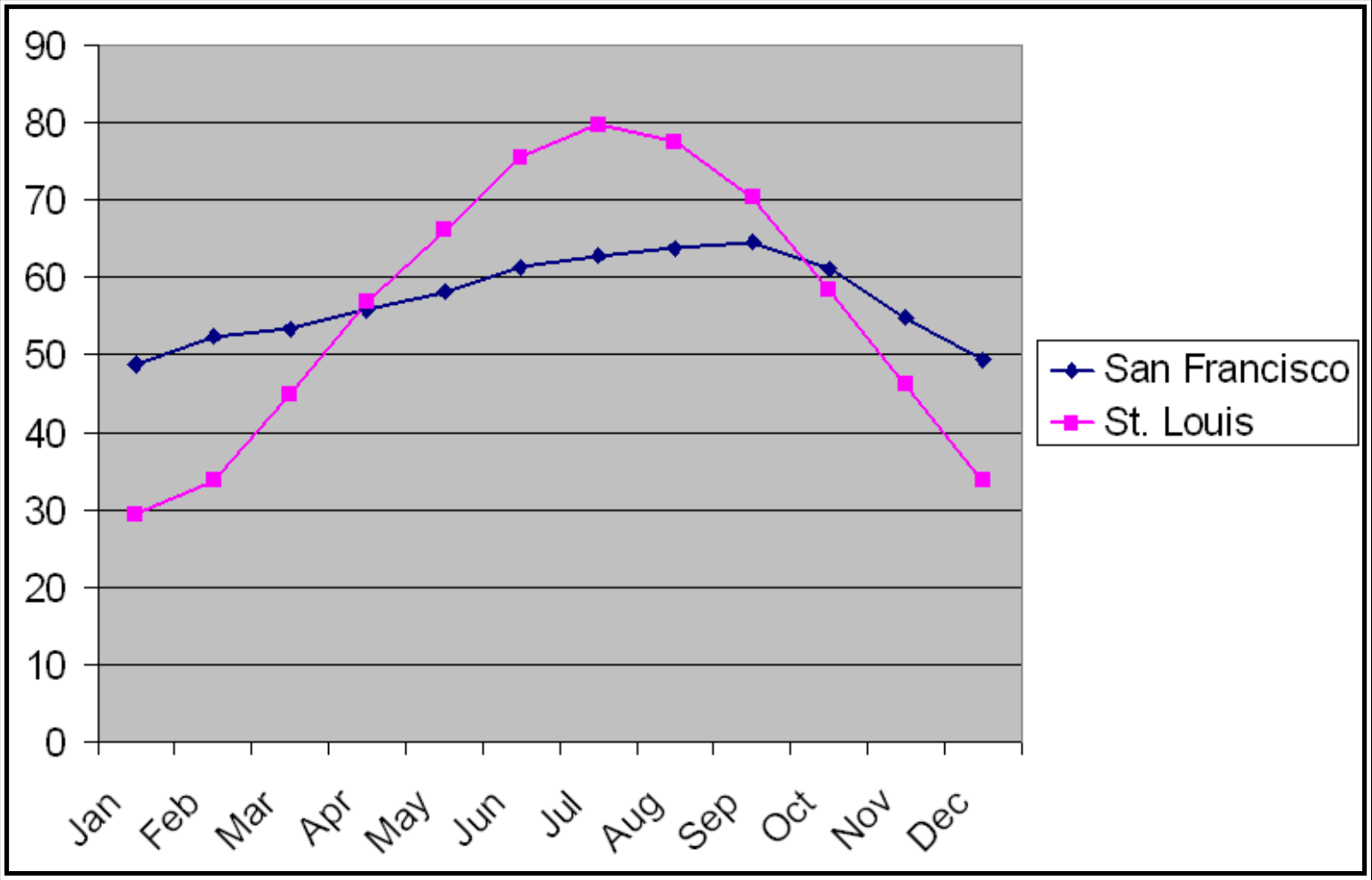
Water is much more resistant to temperature changes than land. It warms up and cools down more slowly than land and helps to moderate nearby air temperature. This is why islands and localities located immediately downwind from the ocean or a large lake (maritime locations) exhibit smaller diurnal and seasonal temperature variations than localities well inland (continental locations). Figure 5-7 illustrates this effect. Although both cities are at approximately the same latitude, the temperature is far less variable in San Francisco (maritime) than St. Louis (continental).
5.8 Temperature Variations with Altitude
A lapse rate of temperature is defined as a decrease in temperature with height. In Figure 4-2, it was stated that the temperature decreases 6.5 °C/km (3.57 °F/1,000 ft) in the standard atmosphere. But since this is an average, the exact value seldom exists. In fact, temperature in the troposphere sometimes remains constant or even increases with height. Caution should be taken when using the standard lapse rate to estimate the freezing level. Quite often the boundary layer is dry adiabatic, and the estimate of freezing level could be in error.
5.8.1 Atmospheric Sounding
An atmospheric sounding, or simply sounding, is a plot of the vertical profile of one or more atmospheric parameters, such as temperature, dewpoint, or wind above a fixed location. Soundings are used extensively by meteorologists to determine the state of the atmosphere.