
Chapter 6
Water Vapor
Precipitation results when tiny condensation particles grow in the atmosphere through collision and coalescence and then fall to the Earth’s surface.
6.2.8 Runoff
Runoff occurs when there is excessive precipitation and the ground is saturated (i.e., cannot absorb any more water). This runoff flows into streams and rivers and eventually back into the sea.
Evaporation of this runoff into the atmosphere begins the hydrologic cycle over again. Some of the water percolates into the soil and into the ground water, only to be drawn into plants again for transpiration to take place.
6.2.9 Infiltration
Infiltration is the movement of water into the ground from the surface.
6.2.10 Groundwater Flow
Groundwater flow is the flow of water underground in aquifers. The water may return to the surface in springs or eventually seep into the oceans.
6.2.11 Plant Uptake
Plant uptake is water taken from the groundwater flow and soil moisture.
6.3 Saturation
Saturation is the maximum possible quantity of water vapor that an air parcel can hold at any given temperature and pressure. The term “saturated air” means an air parcel has all of the water vapor it can hold, while “unsaturated air” means an air parcel can hold more water vapor.
6.4 Relative Humidity
Relative humidity is the ratio, usually expressed as a percentage, of water vapor actually in the air parcel compared to the amount of water vapor the air parcel could hold at a particular temperature and pressure.
While relative humidity is the most common method of describing atmospheric moisture, it is also the most misunderstood. Relative humidity can be confusing because it does not indicate the actual water vapor content of the air, but rather how close the air is to saturation. An air parcel with 100 percent relative humidity is saturated, while an air parcel with relative humidity less than 100 percent is unsaturated.
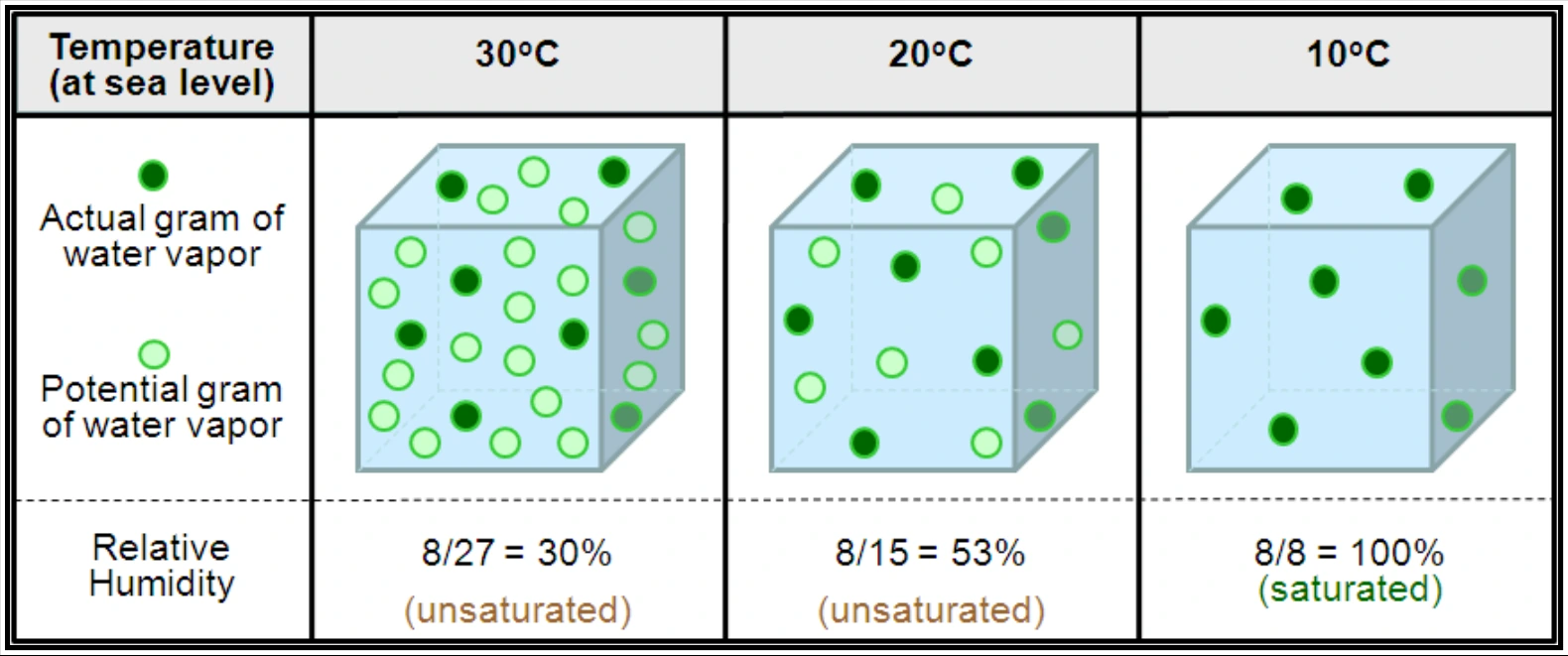
An air parcel’s capacity to hold water vapor (at a constant pressure) is directly related to its temperature. It is possible to change an air parcel’s relative humidity without changing its water vapor content. Figure 6-2 illustrates this concept. An air parcel at sea level at a temperature of 30 °C has the capacity to hold 27 g of water vapor. If it actually held 8 g, its relative humidity would be 30 percent, and it would be unsaturated. However, if the air parcel’s temperature decreases to 20 °C, its water vapor storage capacity decreases to 15 g and its relative humidity rises to 53 percent. At 10 °C, the air parcel’s water vapor storage capacity decreases to equal the amount of water vapor it actually holds (8 g), its relative humidity increases to 100 percent, and it becomes saturated. During this cooling process, the air parcel’s actual water vapor content remained constant, but relative humidity increased with decreasing temperature.
6.5 Dewpoint
Dewpoint is the temperature an air parcel must be cooled at constant pressure and constant water vapor pressure to allow the water vapor in the parcel to condense into water (dew). When this temperature is below 0 °C (32 °F), it is sometimes called the frost point. Lowering an air parcel’s temperature reduces its capacity to hold water vapor.