
Chapter 6
Water Vapor
The difference between an air parcel’s temperature and its dewpoint is the dewpoint depression, or commonly referred to as the spread. Surface aviation weather reports (e.g., METARs/SPECIs) provide observations of both temperature and dewpoint. The temperature greatly affects the air parcel’s ability to hold water vapor, while the dewpoint indicates the actual quantity of water vapor in the parcel. As the spread decreases, relative humidity increases. When the spread decreases to zero, relative humidity is 100 percent, and the air parcel is saturated. Figure 6-3 illustrates the relationship between temperature-dewpoint spread and relative humidity.
Surface temperature-dewpoint spread is important in anticipating fog but has little bearing on precipitation. To support precipitation, air must be saturated through thick layers aloft.
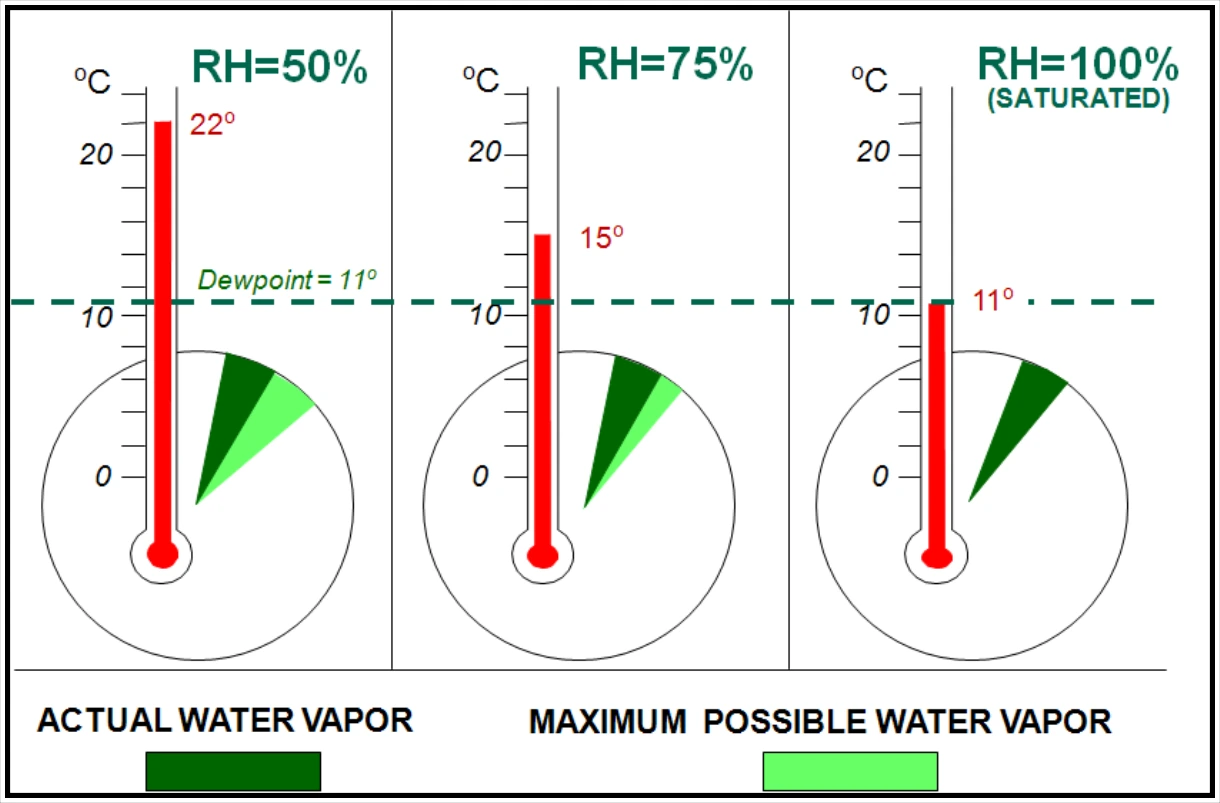
Relative humidity depends on the temperature-dewpoint spread. In Figure 6-3, dewpoint is constant, but temperature decreases from left to right. On the left panel relative humidity is 50 percent, indicating that the air parcel could hold twice as much water vapor as is actually present. As the air parcel cools, the temperature-dewpoint spread decreases while relative humidity increases. When the air parcel’s temperature cools to equal its dewpoint (11 °C), its capacity to hold water vapor is reduced to the amount actually present. The temperature-dewpoint spread is zero, relative humidity is 100 percent, and the air parcel is now saturated.
6.7 Change of Phase
Water changes from one state of matter, e.g., solid, liquid, or vapor, to another at the temperatures and pressures experienced near the surface of the Earth. Interestingly, water is the only substance on Earth that exists naturally in all three phases: as water droplets, ice crystals (visible as clouds), and water vapor.
Water has some unique thermal properties, which make it a powerful heat transport mechanism. It has the highest specific heat capacity of any naturally occurring substance (see Table 5-4). This means that water has a much higher capacity for storing heat energy (with little resulting temperature change) than other substances. These properties make water an ideal heat transport mechanism and have important implications on weather and climate.
6.7.1 Latent Heat
Latent heat is the quantity of heat energy either released or absorbed by a unit mass of a substance when it undergoes a phase transition (change of state). Units are typically expressed in terms of joules per gram (J/g). Figure 6-4 illustrates the latent heat transactions that occur when water undergoes phase transition.
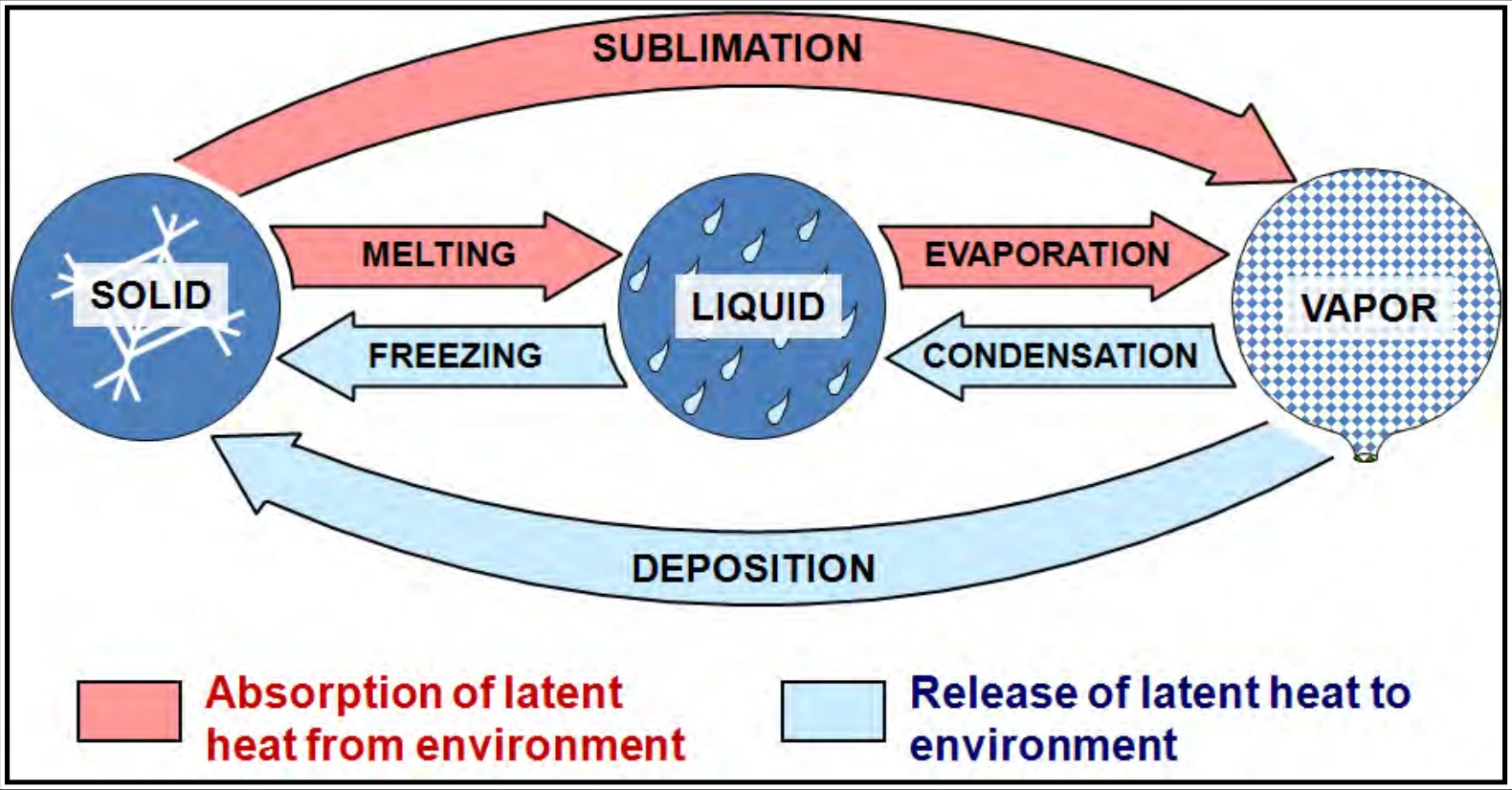
Heat is exchanged between water and its environment during phase transition. Although the temperature of the environment changes in response, the temperature of the water undergoing the phase transition remains constant until the phase change is complete; that is, the available heat, latent heat, is involved exclusively in changing the phase of water and not in changing its temperature. There are six phase transitions, three of which are associated with the absorption of latent heat by water from the environment (melting, evaporation, and sublimation), and three of which are associated with the release of heat energy by water to the environment (freezing, condensation, and deposition).
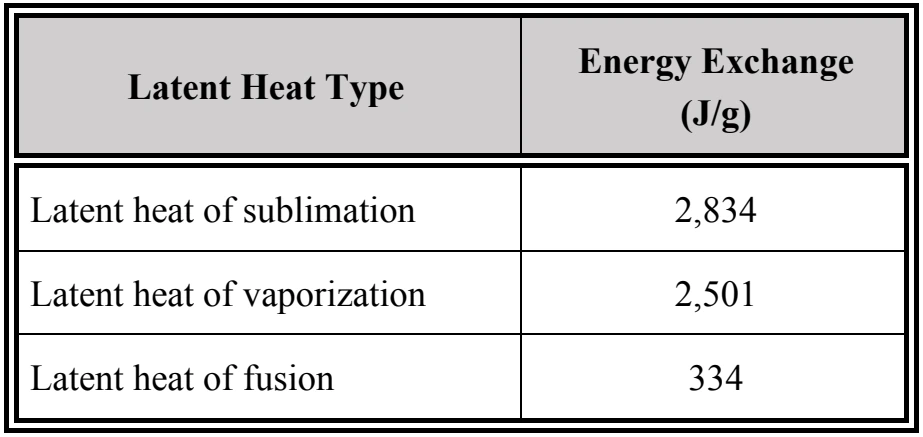
Melting is the phase transition by which a solid is changed to a liquid. During melting, water absorbs 334 J/g due to the latent heat of fusion. Freezing, the reverse process, releases 334 J/g back to the environment.
Evaporation is the phase transition by which a liquid is changed to a vapor. During evaporation, water absorbs 2,501 J/g due to the latent heat of vaporization. Condensation, the reverse process, releases 2,501 J/g back to the environment.
Sublimation is the phase transition by which a solid is changed to a vapor. During sublimation, water absorbs 2,834 J/g due to the latent heat of sublimation. Deposition, the reverse process, releases 2,834 J/g back to the environment. Table 6-1 lists the latent heat exchanges of water.
The amount of energy associated with latent heat exchange should not be understated. An average hurricane releases 52 million trillion (5.2 x 10¹⁹) joules per day as water vapor condenses into clouds and precipitation. This is equivalent to about 40 times the total worldwide energy consumption per day in 2005!