Chapter 7
Earth-Atmosphere Heat Imbalances
7.1 Introduction
Weather is not a capricious act of nature but, rather, the atmosphere’s response to unequal rates of radiational heating and cooling across the surface of the Earth and within its atmosphere. The absorption of incoming solar radiation causes heating, while the emission of outgoing terrestrial radiation causes cooling. However, imbalances in the rate of heating and cooling create temperature gradients.2 Atmospheric circulations and weather are the atmosphere’s never-ending attempt to redistribute this heat and achieve equilibrium. This chapter provides a background on the interaction between the Earth and the atmosphere for a better understanding of the weather that will affect flight operations.
7.2 The Earth-Atmosphere Energy Balance
The Earth-atmosphere energy balance is the balance between incoming energy from the Sun (solar radiation) and outgoing energy from the Earth (terrestrial radiation), as seen in Figure 7-1. When solar radiation reaches the Earth, some is reflected back to space by air (eight percent), clouds (17 percent), or the surface (six percent). Some is absorbed by water vapor/dust/ozone (19 percent) or by clouds (four percent). The remainder is absorbed by the Earth’s surface (46 percent).
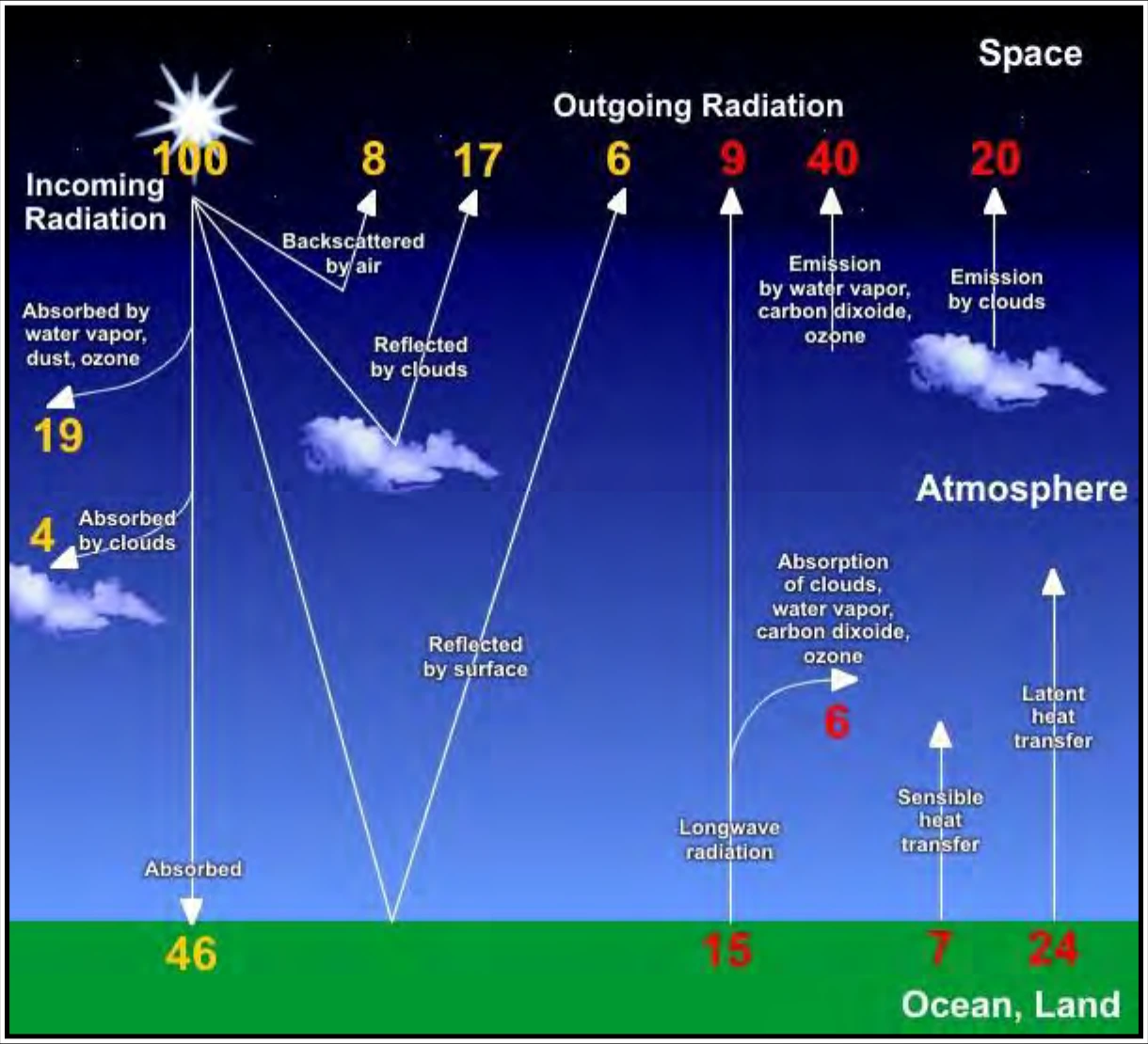
In Figure 7-1, 100 units of incoming radiation from the Sun is balanced by 100 units of outgoing radiation from the Earth.
However, since the Earth is much cooler than the Sun, its radiating energy is much weaker (long wavelength) infrared energy. Indirectly, this energy can be seen radiating into the atmosphere as heat (e.g., rising from a hot road, creating shimmers on hot sunny days). The Earth-atmosphere energy balance is achieved as the energy received from the Sun (solar radiation) balances the energy lost back into space by the Earth (terrestrial radiation). In this way, the Earth maintains a stable average temperature.
The absorption of infrared radiation trying to escape from the Earth back to space is particularly important to the global energy balance. Energy absorption by the atmosphere stores more energy near its surface than it would if there was no atmosphere. The average surface temperature of the Moon, which has no atmosphere, is -18 °C (0 °F). By contrast, the average surface temperature of the Earth is 15 °C (59 °F). This heating effect is called the greenhouse effect.
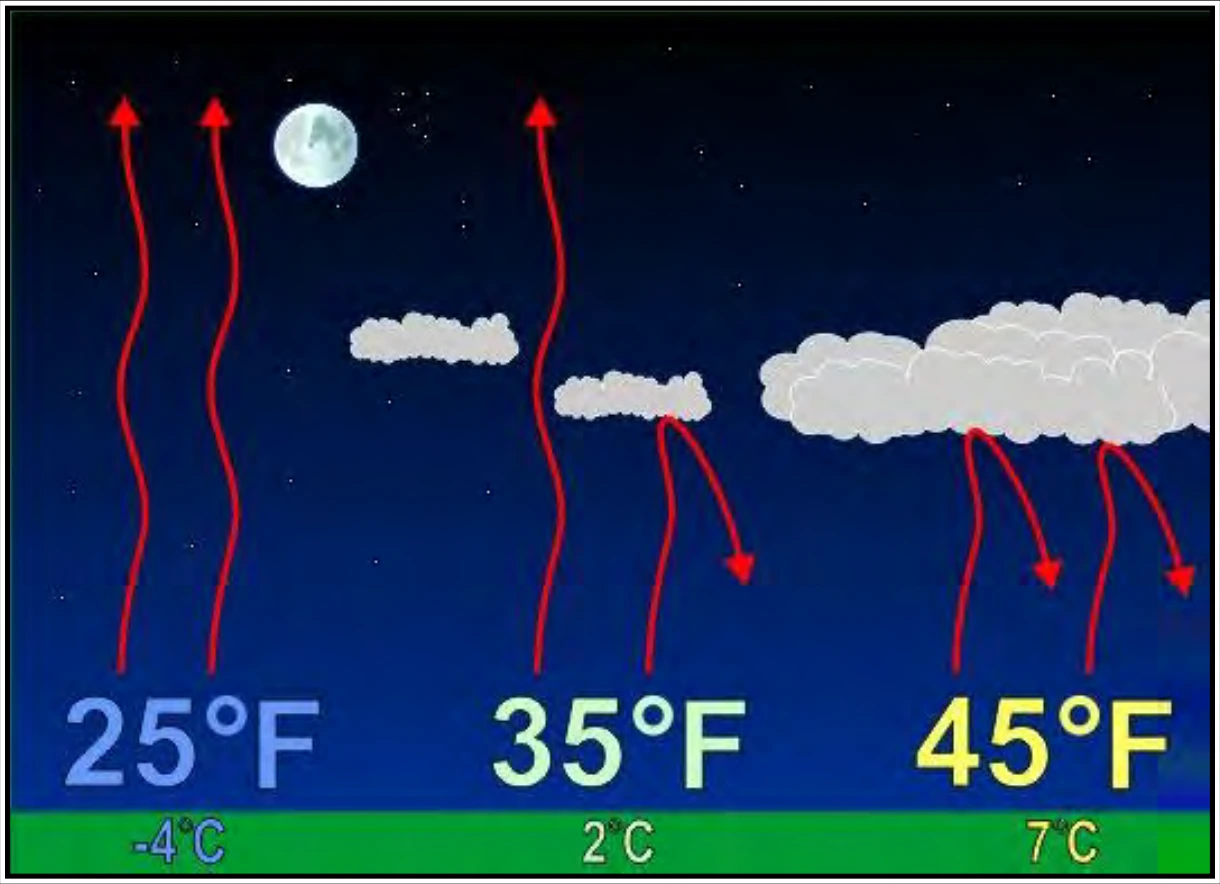
Greenhouse warming is enhanced during nights when the sky is overcast (see Figure 7-2). Heat energy from the Earth can be trapped by clouds, leading to higher temperatures as compared to nights with clear skies. The air is not allowed to cool as much with overcast skies. Under partly cloudy skies, some heat is allowed to escape, and some remains trapped. Clear skies allow for the most cooling to take place.
7.3 Heat Imbalances Between Earth’s Surface and the Atmosphere
The Earth-atmosphere energy balance numbers (see Figure 7-1) indicate that both sensible heat (seven percent) and latent heat (24 percent) processes transfer heat from the Earth’s surface into its atmosphere. Both processes are necessary to prevent the Earth’s surface from continually heating up and the atmosphere from continually cooling down.
7.3.1 Sensible Heating
Sensible heating involves both conduction and convection. It occurs due to differences in air density. Warm air is less dense than cool air.
On warm sunny days, the Earth’s surface is heated by incoming solar radiation or insolation. However, the heating is somewhat uneven because certain areas of the Earth’s surface absorb more heat from the Sun than others. Heat is conducted from the relatively warm ground to the cooler overlying air, which warms a shallow layer of air near the ground. The heated air expands, becomes less dense than the surrounding cooler air, and rises. Through this process, a large bubble of warm air called a thermal rises and transfers heat energy upwards (see Figure 7-3). Cooler, denser air sinks toward the ground to replace the rising air. This cooler air becomes heated in turn, rises, and repeats the cycle.
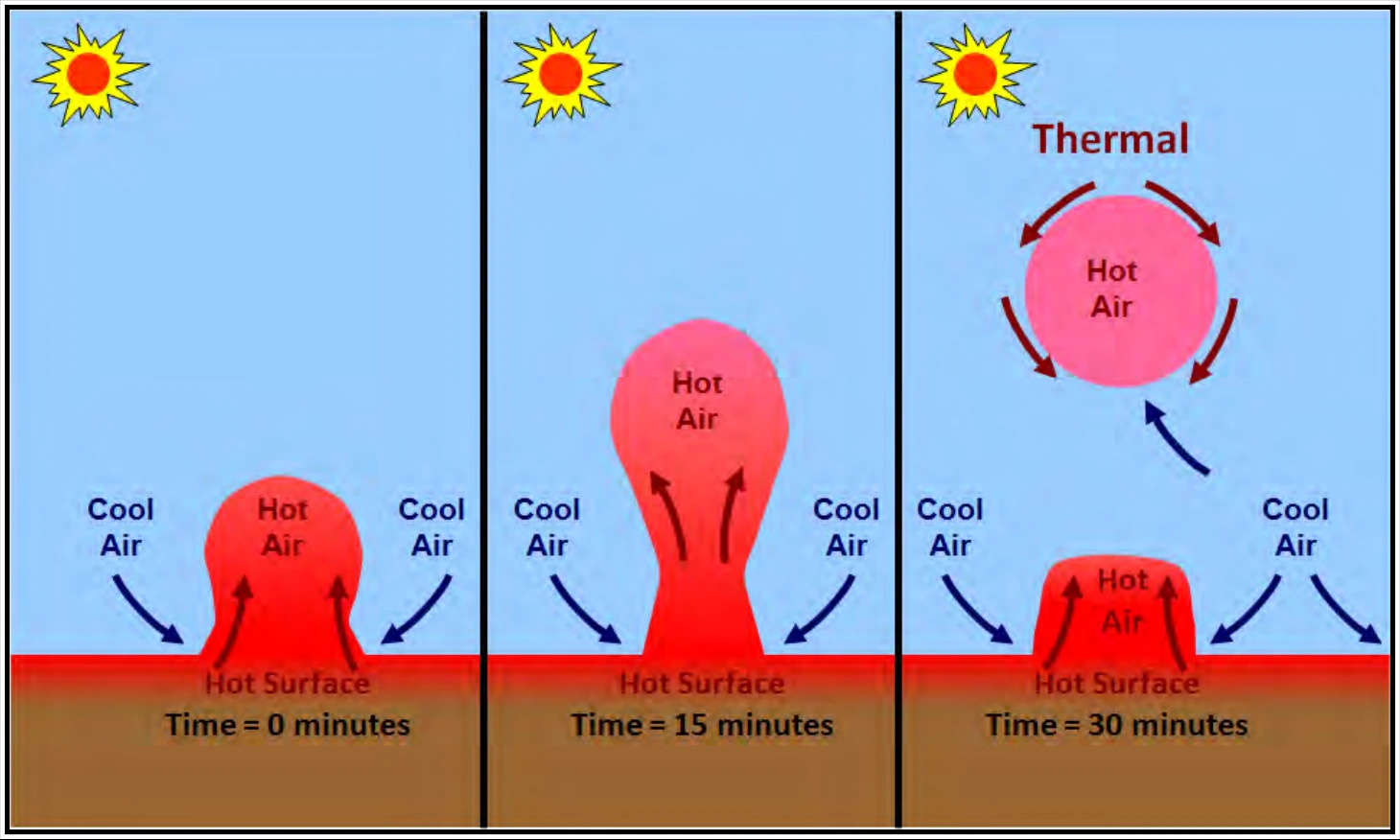
In this manner, convection transports heat from the Earth’s surface into the atmosphere. Because air is a poor conductor of heat (see Table 5-3), convection is much more important than conduction as a heat transport mechanism within the atmosphere.