
Chapter 9
Global Circulations and Jet Streams
9.1 Introduction
Global circulations explain how air and storm systems, which have potential impacts on aircraft operations, travel over the Earth’s surface. Jet streams are relatively narrow bands of strong wind in the upper levels of the atmosphere. This chapter will discuss global circulations and jet streams.
9.2 Non-Rotating Earth Circulation System
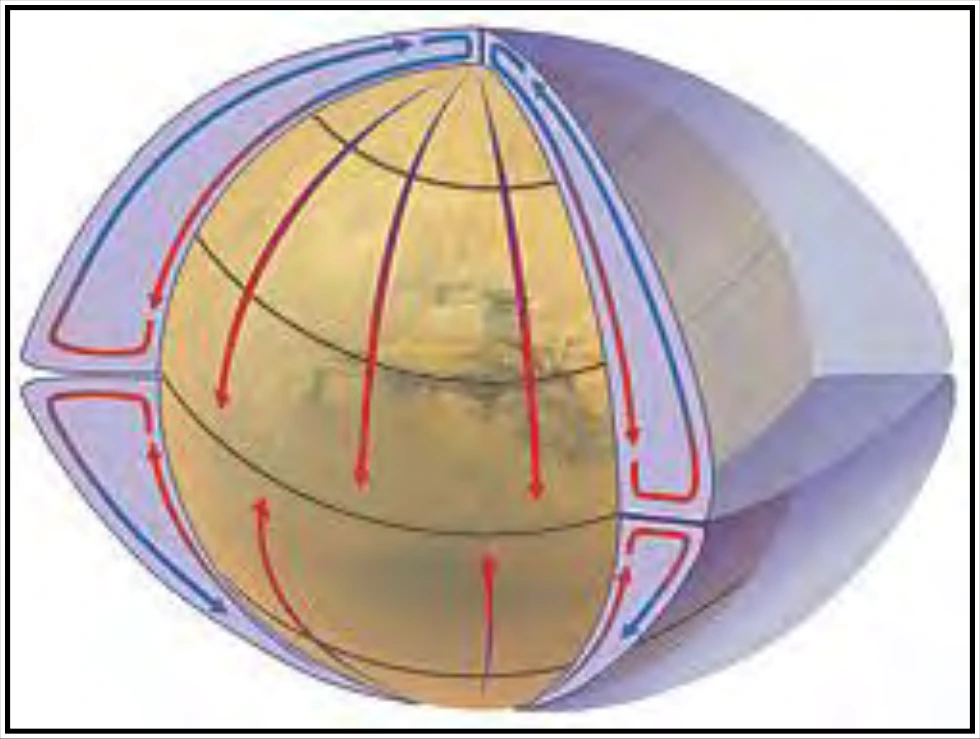
The global circulation would be simple if the Earth did not rotate, the rotation was not tilted relative to the Sun, and the Earth had no water.
Without those factors, the ground and atmosphere directly beneath the Sun would be subject to more of the Sun’s heat than anywhere else on the planet. The result would be the Equator becoming very hot, with the hot air rising into the upper atmosphere.
That hot air would then move toward the poles, where it would become very cold and sink, returning to the Equator (see Figure 9-1). One large area of high pressure would be at each of the poles, with a large belt of low pressure around the Equator.
9.3 Rotating Earth Circulation System
However, since the Earth rotates, the axis is tilted, and there is more land mass in the Northern Hemisphere than in the Southern Hemisphere, the actual global pattern is much more complicated.
Instead of one large circulation between the poles and the Equator, there are three circulations (see Figure 9-2):
- Hadley cell—Low-latitude air movement toward the Equator that, with heating, rises vertically with poleward movement in the upper atmosphere. This forms a convection cell that dominates tropical and subtropical climates.
- Ferrel cell—A mid-latitude mean atmospheric circulation cell for weather, named by William Ferrel in the 19th century. In this cell, the air flows poleward and eastward near the surface, and equatorward and westward at higher levels.
- Polar cell—Air rises, diverges, and travels toward the poles. Once over the poles, the air sinks, forming the polar highs. At the surface, air diverges outward from the polar highs. Surface winds in the polar cell are easterly (polar easterlies).
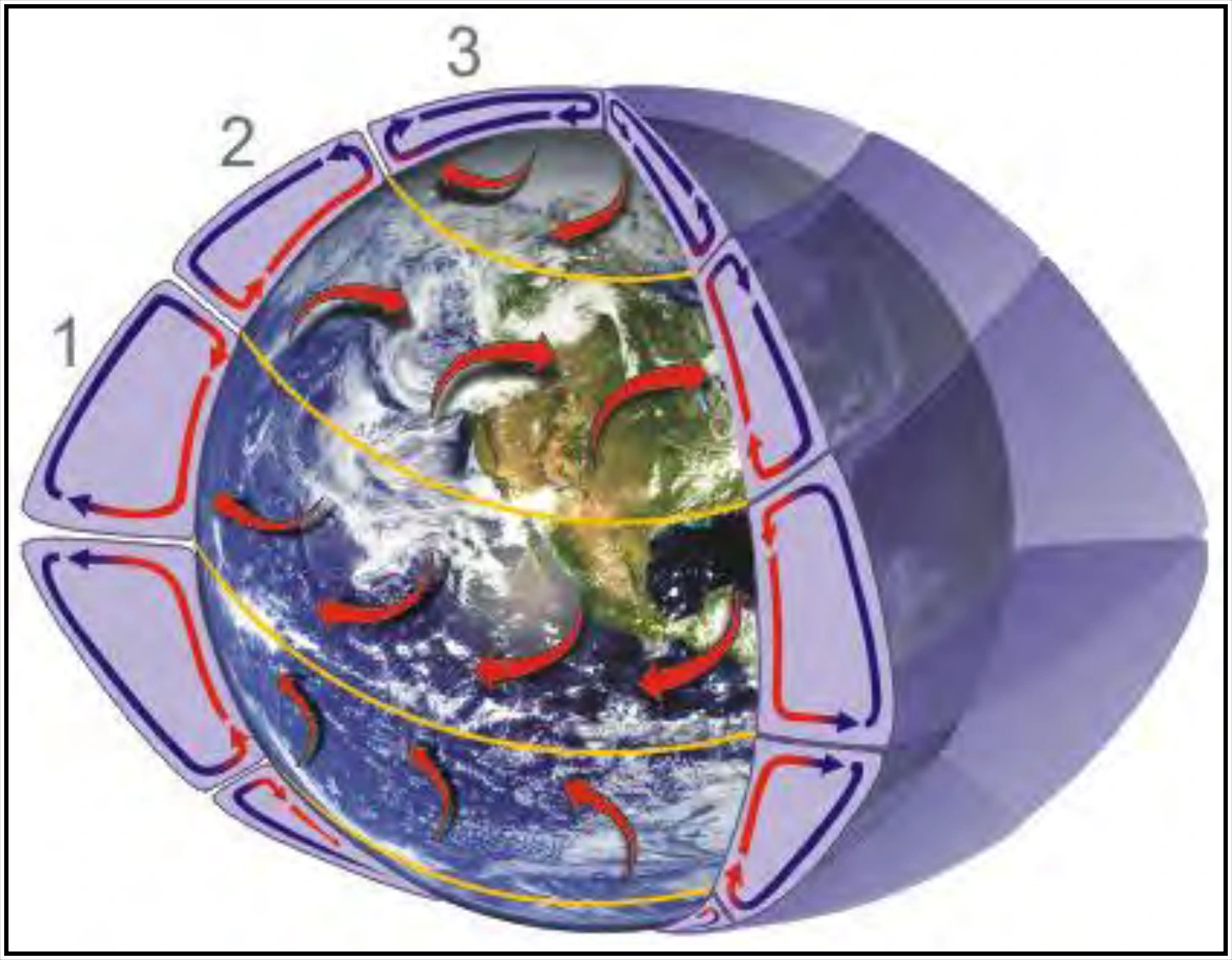
Between each of these circulation cells are bands of high and low pressure at the surface. The high-pressure band is located about 30° N/S latitude and at each pole. Low-pressure bands are found at the Equator and 50° to 60° N/S latitude.
Usually, fair and dry/hot weather is associated with high pressure, and rainy and stormy weather is associated with low pressure. The results of these circulations become evident on a globe. Consider the number of deserts located along the 30° N/S latitude around the world compared to the region between 50°–60° N/S latitude. The higher latitudes, especially near the west coast of continents, tend to have more precipitation due to more storms moving around the Earth at these latitudes.
9.4 Jet Streams
Jet streams are relatively narrow bands of strong wind in the upper levels of the atmosphere. The winds blow from west to east in jet streams, but the flow often meanders southward and northward in waves. Jet streams follow the boundaries between hot and cold air. Since these hot and cold air boundaries are most pronounced in winter, jet streams are the strongest for both the Northern and Southern Hemisphere winters.
9.4.1 Direction of Wind Flow
Why do the jet stream winds blow from west to east? As stated in the previous section, if the Earth was not rotating, the warm air would rise at the Equator and move toward both the poles. The Earth’s rotation divides this circulation into three cells. Likewise, the Earth’s rotation is responsible for the jet stream.
The motion of the air is not directly north and south, but rather is affected by the momentum the air has as it moves away from the Equator and how fast a location on or above the Earth moves relative to the Earth’s axis.
An object’s speed relative to the Earth’s axis depends on its location. Someone standing on the Equator is moving much faster than someone standing on a 45-degree latitude line. In Figure 9-3, the person at the position on the Equator arrives at the yellow line sooner than the other two. Someone standing on a pole is not moving at all (except that person would be slowly spinning). The speed of the rotation is great enough to cause a person to weigh 1 pound (lb) less at the Equator than they would at the North or South Pole.