
Chapter 1
Introduction to the Helicopter
- Cyclic
- Collective
- Antitorque pedals
- Throttle
Cyclic
The cyclic control is usually located between the pilot’s legs and is commonly called the “cyclic stick” or simply “cyclic.” On most helicopters, the cyclic is similar to a joystick; however, Robinson helicopters have unique T-bar cyclic control systems. A few helicopters have cyclic controls that descend into the cockpit from overhead while others use side cyclic controls.
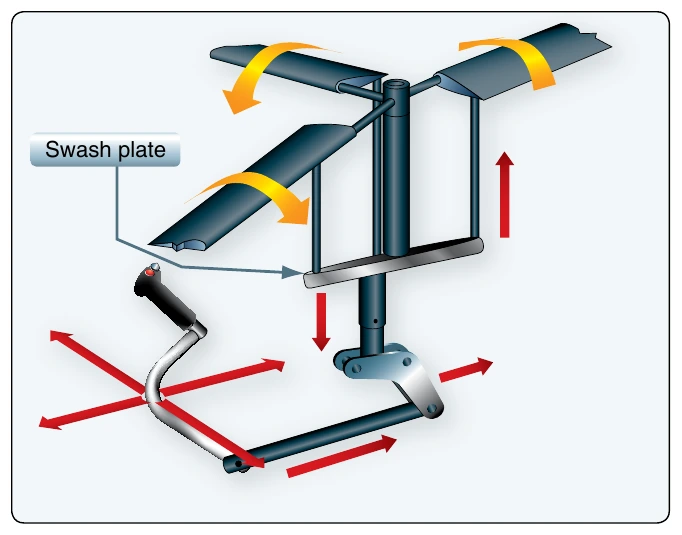
The control is called the cyclic because it can vary the pitch of the rotor blades throughout each revolution of the main rotor system (i.e., through each cycle of rotation) to develop unequal lift (thrust). The result is to tilt the rotor disk in a particular direction, resulting in the helicopter moving in that direction. If the pilot pushes the cyclic forward, the rotor disk tilts forward, and the rotor produces a thrust in the forward direction. If the pilot pushes the cyclic to the side, the rotor disk tilts to that side and produces thrust in that direction, causing the helicopter to hover sideways. [Figure 1-10]
Collective
The collective pitch control, or collective, is located on the left side of the pilot’s seat with a pilot-selected variable friction control to prevent inadvertent movement. The collective changes the pitch angle of all the main rotor blades collectively (i.e., all at the same time) and independently of their positions. Therefore, if a collective input is made, all the blades change equally, increasing or decreasing total lift or thrust, with the result of the helicopter increasing or decreasing in altitude or airspeed.
Antitorque Pedals
The antitorque pedals are located in the same position as the rudder pedals in a fixed-wing aircraft and serve a similar purpose, namely to control the direction in which the nose of the aircraft is pointed. Application of the pedal in a given direction changes the pitch of the tail rotor blades, increasing or reducing the thrust produced by the tail rotor, causing the nose to yaw in the direction of the applied pedal. The pedals mechanically change the pitch of the tail rotor, altering the amount of thrust produced.
Throttle
Helicopter rotors are designed to operate at a specific rpm.
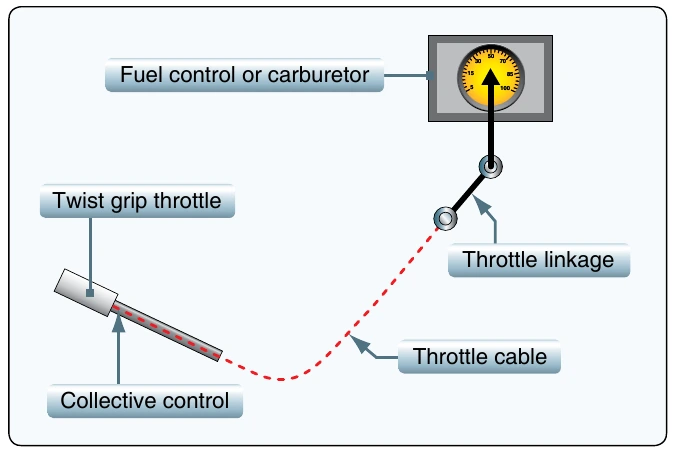
The throttle controls the power produced by the engine, which is connected to the rotor by a transmission. The purpose of the throttle is to maintain enough engine power to keep the rotor rpm within allowable limits to produce enough lift for flight. In single-engine helicopters, if so equipped, the throttle control is typically a twist grip mounted on the collective control, but it can also be a lever mechanism in fully governed systems. Multi-engine helicopters generally have a power lever or mode switch for each engine. [Figure 1-11] Helicopter flight controls are discussed in greater detail throughout Chapter 4, Helicopter Components, Sections and Systems.
Flight Conditions
There are two basic flight conditions for a helicopter: hover and forward flight. Hovering is the most challenging part of flying a helicopter. This is because a helicopter generates its own gusty air while in a hover, which acts against the fuselage and flight control surfaces. The end result is the need for constant control inputs and corrections by the pilot to keep the helicopter where it is required to be. Despite the complexity of the task, the control inputs in a hover are simple. The cyclic is used to eliminate drift in the horizontal direction that is to control forward and back, right and left. The collective is used to maintain altitude. The pedals are used to control nose direction or heading. It is the interaction of these controls that makes hovering so difficult, since an adjustment in any one control requires an adjustment of the other two, creating a cycle of constant correction.
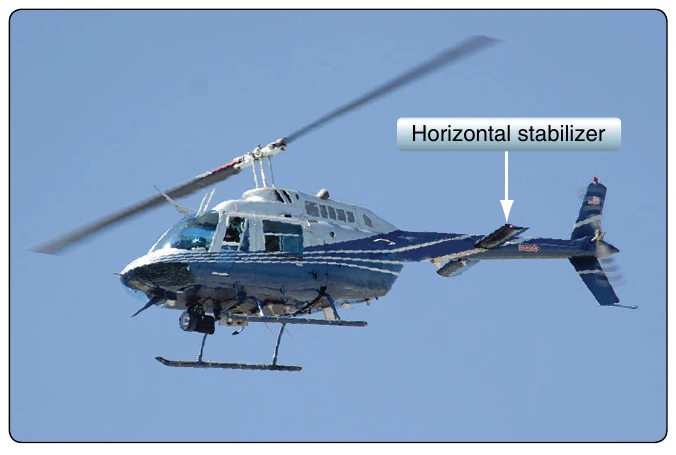
Displacing the cyclic forward initially causes the nose to pitch down, with a resultant increase in airspeed and loss of altitude. Aft cyclic initially causes the nose to pitch up, slowing the helicopter and causing it to climb; however, as the helicopter reaches a state of equilibrium, the horizontal stabilizer helps level the helicopter to minimize drag, unlike an airplane. [Figure 1-12] Therefore, the helicopter has very little pitch deflection up or down when the helicopter is stable in a flight mode. The variation from absolutely level depends on the particular helicopter and the horizontal stabilizer function.
Increasing collective (power) while maintaining a constant airspeed induces a climb while decreasing collective causes a descent. Coordinating these two inputs, down collective plus aft cyclic or up collective plus forward cyclic, results in airspeed changes while maintaining a constant altitude.
The pedals serve the same function in both a helicopter and a fixed-wing aircraft, to maintain balanced flight. This is done by applying pedal input in whichever direction is necessary to center the ball in the turn and bank indicator. Flight maneuvers are discussed in greater detail throughout Chapter 9, Basic Flight Maneuvers.