
Chapter 11
Helicopter Emergencies and Hazards
Upon reaching the intended touchdown area and at the appropriate landing gear height, reduce the throttle as necessary to overcome the yaw effect if the nose of the helicopter remains to the right of the landing heading. The amount of throttle reduction will vary based on power applied and winds. The higher the power setting used to cushion the landing, the more the throttle reduction will be. A coordinated throttle reduction and increased collective will result in a very smooth touchdown with some forward groundspeed. If the nose of the helicopter is to the left of the landing heading, a slight increase in collective or aft cyclic may be used to align the nose for touchdown. The decision to land or go around has to be made prior to any throttle reduction. Using airspeeds slightly above translational lift may be helpful to ensure that the nose does not continue yawing to the right. If a go-around is required, increasing the collective too much or too rapidly with airspeeds below translational lift may cause a rapid spinning to the right.
Once the helicopter has landed and is sliding/rolling to a stop, the heading can be controlled with a combination of collective, cyclic and throttle. To turn the nose to the right, raise the collective or apply aft cyclic. The throttle may be increased as well if it is not in the full open position. To turn the nose to the left, lower the collective or apply forward cyclic. The throttle may be decreased as well if it is not already at flight idle.
Loss of Tail Rotor Effectiveness (LTE)
Loss of tail rotor effectiveness (LTE) or an unanticipated yaw is defined as an uncommanded, rapid yaw towards the advancing blade which does not subside of its own accord. It can result in the loss of the aircraft if left unchecked. It is very important for pilots to understand that LTE is caused by an aerodynamic interaction between the main rotor and tail rotor and not caused from a mechanical failure. Some helicopter types are more likely to encounter LTE due to the normal certification thrust produced by having a tail rotor that, although meeting certification standards, is not always able to produce the additional thrust demanded by the pilot.
A helicopter is a collection of compromises. Compare the size of an airplane propeller to that of a tail rotor. Then, consider the horsepower required to run the propeller. For example, a Cessna 172P is equipped with a 160-horsepower (HP) engine. A Robinson R-44 with a comparably sized tail rotor is rated for a maximum of 245 HP. If you assume the tail rotor consumes 50 HP, only 195 HP remains to drive the main rotor. If the pilot were to apply enough collective to require 215 HP from the engine, and enough left pedal to require 50 HP for the tail rotor, the resulting engine overload would lead to one of two outcomes: slow down (reduction in rpm) or premature failure. In either outcome, antitorque would be insufficient and total lift might be less than needed to remain airborne.
Every helicopter design requires some type of antitorque system to counteract main rotor torque and prevent spinning once the helicopter lifts off the ground. A helicopter is heavy, and the powerplant places a high demand on fuel. Weight penalizes performance, but all helicopters must have an antitorque system, which adds weight. Therefore, the tail rotor is certified for normal flight conditions. Environmental forces can overwhelm any aircraft, rendering the inherently unstable helicopter especially vulnerable.
As with any aerodynamic condition, it is very important for pilots to not only to understand the definition of LTE, but more importantly, how and why it happens, how to avoid it, and lastly, how to correct it once it is encountered. We must first understand the capabilities of the aircraft or even better what it is not capable of doing. For example, if you were flying a helicopter with a maximum gross weight of 5,200 lb, would you knowingly try to take on fuel, baggage and passengers causing the weight to be 5,500 lb? A wise professional pilot should not ever exceed the certificated maximum gross weight or performance flight weight for any aircraft. The manuals are written for safety and reliability. The limitations and emergency procedures are stressed because lapses in procedures or exceeding limitations can result in aircraft damage or human fatalities. At the very least, exceeding limitations will increase the costs of maintenance and ownership of any aircraft and especially helicopters.
Overloaded parts may fail before their designed lifetime. There are no extra parts in helicopters. The respect and discipline pilots exercise in following flight manuals should also be applied to understanding aerodynamic conditions. If flight envelopes are exceeded, the end results can be catastrophic.
LTE is an aerodynamic condition and is the result of a control margin deficiency in the tail rotor. It can affect all single-rotor helicopters that utilize a tail rotor. The design of main and tail rotor blades and the tail boom assembly can affect the characteristics and susceptibility of LTE but will not nullify the phenomenon entirely. Translational lift is obtained by any amount of clean air through the main rotor disk. Chapter 2, Aerodynamics of Flight, discusses translational lift with respect to the main rotor blade, explaining that the more clean air there is going through the rotor disk, the more efficient it becomes. The same holds true for the tail rotor. As the tail rotor works in less turbulent air, it reaches a point of translational thrust. At this point, the tail rotor becomes aerodynamically efficient and the improved efficiency produces more antitorque thrust. The pilot can determine when the tail rotor has reached translational thrust. As more antitorque thrust is produced, the nose of the helicopter yaws to the left (opposite direction of the tail rotor thrust), forcing the pilot to correct with right pedal application (actually decreasing the left pedal). This, in turn, decreases the AOA in the tail rotor blades. Pilots should be aware of the characteristics of the helicopter they fly and be particularly aware of the amount of tail rotor pedal typically required for different flight conditions.
LTE is a condition that occurs when the flow of air through a tail rotor is altered in some way, by altering the angle or speed at which the air passes through the rotating blades of the tail rotor disk. As discussed in the previous paragraph, an effective tail rotor relies on a stable and relatively undisturbed airflow in order to provide a steady and constant antitorque reaction. The pitch and AOA of the individual blades will determine the thrust. A change to either of these alters the amount of thrust generated. A pilot’s yaw pedal input causes a thrust reaction from the tail rotor. Altering the amount of thrust delivered for the same yaw input creates an imbalance. Taking this imbalance to the extreme will result in the loss of effective control in the yawing plane, and LTE will occur.
This alteration of tail rotor thrust can be affected by numerous external factors. The main factors contributing to LTE are:
- Airflow and downdraft generated by the main rotor blades interfering with the airflow entering the tail rotor assembly.
- Main blade vortices developed at the main blade tips entering the tail rotor disk.
- Turbulence and other natural phenomena affecting the airflow surrounding the tail rotor.
- A high-power setting, hence large main rotor pitch angle, induces considerable main rotor blade downwash and hence more turbulence than when the helicopter is in a low power condition.
- A slow forward airspeed, typically at speeds where translational lift and translational thrust are in the process of change and airflow around the tail rotor will vary in direction and speed.
- The airflow relative to the helicopter;
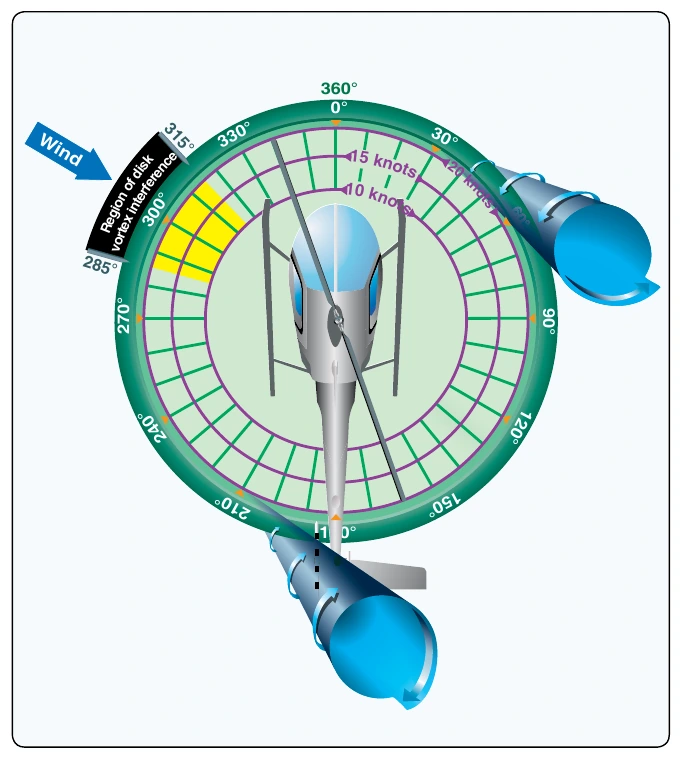
- Worst case—relative wind within ±15° of the 10 o’clock position, generating vortices that can blow directly into the tail rotor. This is dictated by the characteristics of the helicopters aerodynamics of tailboom position, tail rotor size and position relative to the main rotor and vertical stabilizer, size and shape. [Figure 11-9]
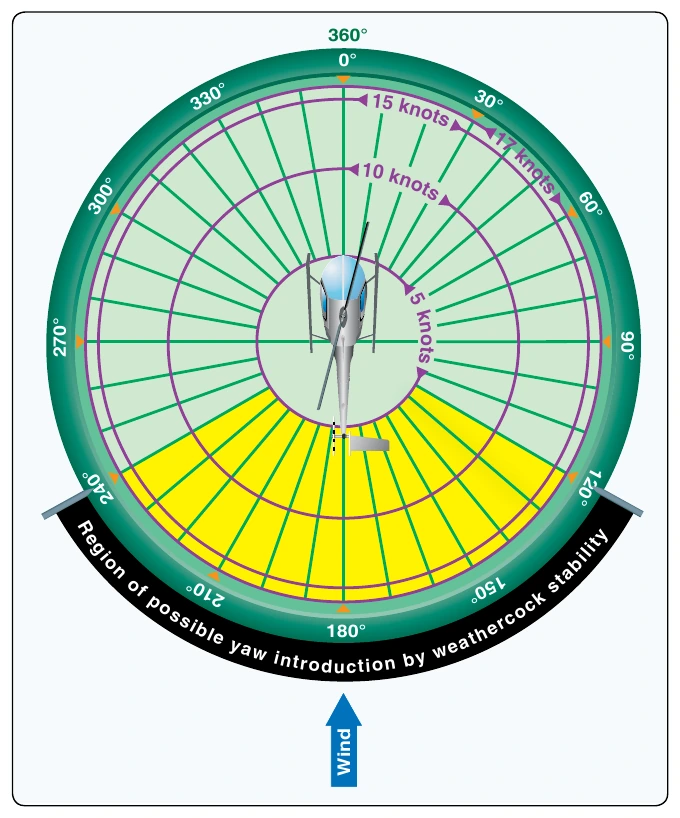
- Weathercock stability—tailwinds from 120° to 240° [Figure 11-10], such as left crosswinds, causing high pilot workload.
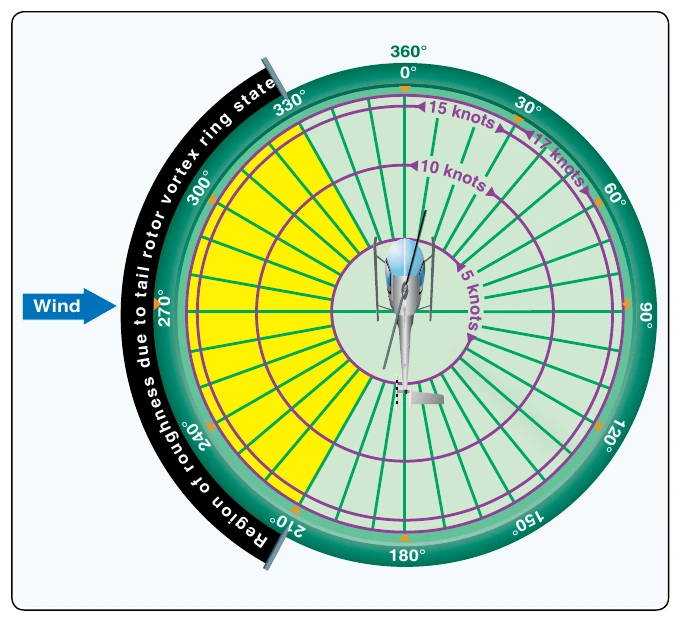
- Tail rotor vortex ring state (210° to 330°). [Figure 11-11] Winds within this region will result in the development of the vortex ring state of the tail rotor.
- Combinations (a, b,
- of these factors in a particular situation can easily require more antitorque than the helicopter can generate and in a particular environment LTE can be the result.
Certain flight activities lend themselves to being at higher risk of LTE than others. For example, power line and pipeline patrol sectors, low speed aerial filming/photography as well as in the Police and Helicopter Emergency Medical Services (EMS) environments can find themselves in low-and-slow situations over geographical areas where the exact wind speed and direction are hard to determine.
Unfortunately, the aerodynamic conditions that a helicopter is susceptible to are not explainable in black and white terms. LTE is no exception. There are a number of contributing factors, but what is more important in preventing LTE is to note them, and then to associate them with situations that should be avoided. Whenever possible, pilots should learn to avoid the following combinations:
- Low and slow flight outside of ground effect.
- Winds from ±15º of the 10 o’clock position and probably on around to 5 o’clock position [Figure 11-9]
- Tailwinds that may alter the onset of translational lift and translational thrust, and hence induce high power demands and demand more anti-torque (left pedal) than the tail rotor can produce.
- Low speed downwind turns.
- Large changes of power at low airspeeds.
- Low speed flight in the proximity of physical obstructions that may alter a smooth airflow to both the main rotor and tail rotor.