
Chapter 11
Helicopter Emergencies and Hazards
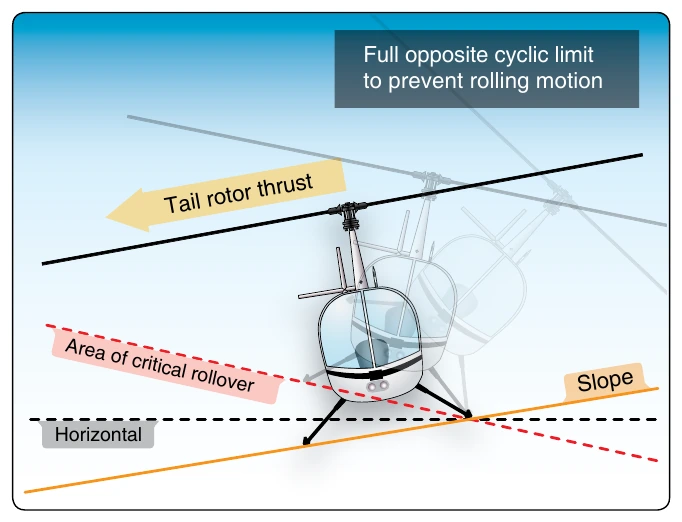
Under normal conditions on a slope, the collective should not be pulled suddenly to get airborne because a large and abrupt rolling moment in the opposite direction could occur. Excessive application of collective can result in the upslope skid or wheel rising sufficiently to exceed lateral cyclic control limits. This movement may be uncontrollable. If the helicopter develops a roll rate with one skid or wheel on the ground, the helicopter can roll over on its side.
Precautions
To help avoid dynamic rollover:
- Always practice hovering autorotations into the wind, and be wary when the wind is gusty or greater than 10 knots.
- Use extreme caution when hovering close to fences, sprinklers, bushes, runway/taxi lights, tiedown cables, deck nets, or other obstacles that could catch a skid or wheel. Aircraft parked on hot asphalt overnight might find the landing gear sunk in and stuck as the ramp cooled during the evening.
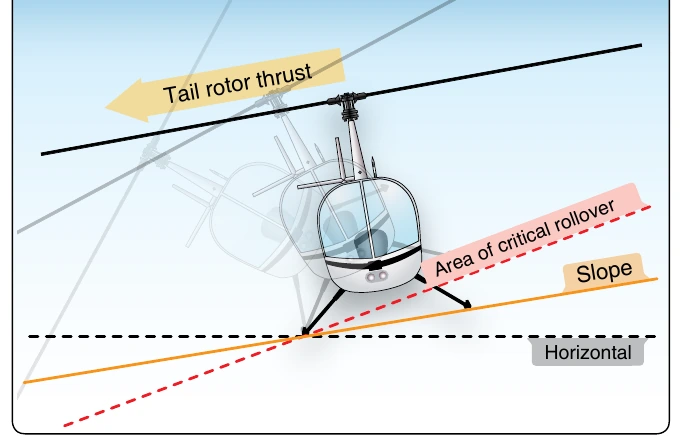
- Always use a two-step lift-off. Pull in just enough collective pitch control to be light on the skids or landing wheels and feel for equilibrium, then gently lift the helicopter into the air.
- Hover high enough to have adequate skid or landing wheel clearance from any obstacles when practicing hovering maneuvers close to the ground, especially when practicing sideways or rearward flight.
- Remember that when the wind is coming from the upslope direction, less lateral cyclic control is available.
- Avoid tailwind conditions when conducting slope operations.
- Remember that less lateral cyclic control is available due to the translating tendency of the tail rotor when the left skid or landing wheel is upslope. (This is true for counterclockwise rotor disks.)
- Keep in mind that the lateral cyclic requirement changes when passengers or cargo are loaded or unloaded.
- Be aware that if the helicopter utilizes interconnecting fuel lines that allow fuel to automatically transfer from one side of the helicopter to the other, the gravitational flow of fuel to the downslope tank could change the CG, resulting in a different amount of cyclic control application to obtain the same lateral result.
- Do not allow the cyclic limits to be reached. If the cyclic control limit is reached, further lowering of the collective may cause mast bumping. If this occurs, return to a hover and select a landing point with a lesser degree of slope.
- During a takeoff from a slope, begin by leveling the main rotor disk with the horizon or very slightly into the slope to ensure vertical lift and only enough lateral thrust to prevent sliding on the slope. If the upslope skid or wheel starts to leave the ground before the downslope skid or wheel, smoothly and gently lower the collective and check to see if the downslope skid or wheel is caught on something. Under these conditions, vertical ascent is the only acceptable method of lift-off.
- Be aware that dynamic rollover can be experienced during flight operations on a floating platform if the platform is pitching/rolling while attempting to land or takeoff. Generally, the pilot operating on floating platforms (barges, ships, etc.) observes a cycle of seven during which the waves increase and then decrease to a minimum. It is that time of minimum wave motion that the pilot needs to use for the moment of landing or takeoff on floating platforms. Pilots operating from floating platforms should also exercise great caution concerning cranes, masts, nearby boats (tugs) and nets.
Low-G Conditions and Mast Bumping
“G” is an abbreviation for acceleration due to the earth’s gravity. A person standing on the ground or sitting in an aircraft in level flight is experiencing one G. An aircraft in a tight, banked turn with the pilot being pressed into the seat is experiencing more than one G or high-G conditions. A person beginning a downward ride in an elevator or riding down a steep track on a roller coaster is experiencing less than one G or low-G conditions. The best way for a pilot to recognize low G is a weightless feeling similar to the start of a downward elevator ride.
Helicopters rely on positive G to provide much or all of their response to pilot control inputs. The pilot uses the cyclic to tilt the rotor disk, and, at one G, the rotor is producing thrust equal to aircraft weight. The tilting of the thrust vector provides a moment about the center of gravity to pitch or roll the fuselage. In a low-G condition, the thrust and consequently the control authority are greatly reduced.
Although their control ability is reduced, multi-bladed (three or more blades) helicopters can generate some moment about the fuselage independent of thrust due to the rotor hub design with the blade attachment offset from the center of rotation. However, helicopters with two-bladed teetering rotors rely entirely on the tilt of the thrust vector for control. Therefore, low-G conditions can be catastrophic for two-bladed helicopters.
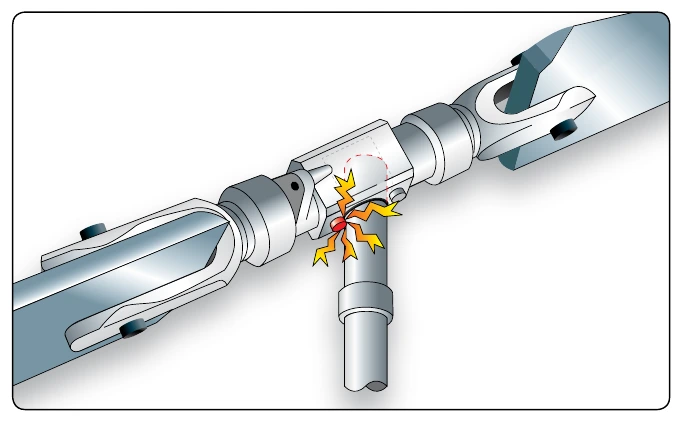
At lower speeds, such as initiation of a takeoff from hover or the traditional recovery from vortex ring state, forward cyclic maneuvers do not cause low G and are safe to perform. However, an abrupt forward cyclic input or pushover in a two-bladed helicopter can be dangerous and must be avoided, particularly at higher speeds. During a pushover from moderate or high airspeed, as the helicopter noses over, it enters a low-G condition. Thrust is reduced, and the pilot has lost control of fuselage attitude but may not immediately realize it. Tail rotor thrust or other aerodynamic factors will often induce a roll. The pilot still has control of the rotor disk, and may instinctively try to correct the roll, but the fuselage does not respond due to the lack of thrust. If the fuselage is rolling right, and the pilot puts in left cyclic to correct, the combination of fuselage angle to the right and rotor disk angle to the left becomes quite large and may exceed the clearances built into the rotor hub. This results in the hub contacting the rotor mast, which is known as mast bumping. [Figure 11-8] Low-G mast bumping has been the cause of numerous military and civilian fatal accidents. It was initially encountered during nap-of-the-earth flying, a very low-altitude tactical flight technique used by the military where the aircraft flies following the contours of the geographical terrain. The accident sequence may be extremely rapid, and the energy and inertia in the rotor system can sever the mast or allow rotor blades to strike the tail or other portions of the helicopter.
Turbulence, especially severe downdrafts, can also cause a low-G condition and, when combined with high airspeed, may lead to mast bumping. Typically, helicopters handle turbulence better than a light airplane due to smaller surface area of the rotor blades. During flight in turbulence, momentary excursions in airspeed, altitude, and attitude are to be expected. Pilots should respond with smooth, gentle control inputs and avoid overcontrolling. Most importantly, pilots should slow down, as mast bumping is less likely at lower airspeeds.
Pilots can avoid mast bumping accidents as follows:
- Avoid abrupt forward cyclic inputs in two-bladed helicopters. Airplane pilots may find this a difficult habit to break because pushing the nose down is an accepted collision avoidance maneuver in an airplane. Helicopter pilots would accomplish the same rapid descent by lowering the collective, and airplane pilots should train to make this instinctual.
- Recognize the weightless feeling associated with the onset of low G and quickly take corrective action before the situation becomes critical.
- Recognize that uncommanded right roll for helicopters with main rotors which rotate counter-clockwise when viewed from above indicates that loss of control is imminent, and immediate corrective action must be taken.
- Recover from a low-G situation by first gently applying aft cyclic to restore normal G before attempting to correct any roll.
- If turbulence is expected or encountered, reduce power and use a slower than normal cruise speed. Turbulence (where high rotor flapping angles are already present), and higher airspeeds (where the controls are more sensitive) both increase susceptibility to low-G conditions.
- Use a flight simulator to learn to recognize and experience low G conditions that result in mast bumping, its correct recovery technique, and the consequences of using incorrect recovery actions. Refer to Chapter 14, Simulation.
Multi-bladed rotors may experience a phenomenon similar to mast bumping known as droop stop pounding if flapping clearances are exceeded, but because they retain some control authority at low G, occurrences are less common than for teetering rotors.
Low Rotor RPM and Rotor Stall
Rotor rpm is a critically important parameter for all helicopter operations. Just as airplanes will not fly below a certain airspeed, helicopters will not fly below a certain rotor rpm. Safe rotor rpm ranges are marked on the helicopter’s tachometer and specified in the RFM. If the pilot allows the rotor rpm to fall below the safe operating range, the helicopter is in a low rpm situation. If the rotor rpm continues to fall, the rotor will eventually stall.
Rotor stall should not be confused with retreating blade stall, which occurs at high forward speeds and over a small portion of the retreating blade tip. Retreating blade stall causes vibration and control problems, but the rotor is still very capable of providing sufficient lift to support the weight of the helicopter. Rotor stall, however, can occur at any airspeed, and the rotor quickly stops producing enough lift to support the helicopter, causing it to lose lift and descend rapidly.