
Chapter 12
Night Operations
Introduction
Pilots rely more on vision than on any other sense to orient themselves in flight. The following visual factors contribute to flying performance: good depth perception for safe landings, good visual acuity to identify terrain features and obstacles in the flightpath, and good color vision. Although vision is the most accurate and reliable sense, visual cues can be misleading, contributing to incidents occurring within the flight environment. Pilots should be aware of and know how to compensate effectively for the following:
- Physical deficiency or self-imposed stress, such as smoking, which limits night-vision capability
- Visual cue deficiencies
- Limitations in visual acuity, dark adaptation, and color and depth perception
For example, at night, the unaided eye has degraded visual acuity. For more information on night operations, reference Chapter 17, Aeromedical Factors, of the Pilot’s Handbook of Aeronautical Knowledge (FAA-H-8083-25, as revised).
Visual Deficiencies
Night Myopia
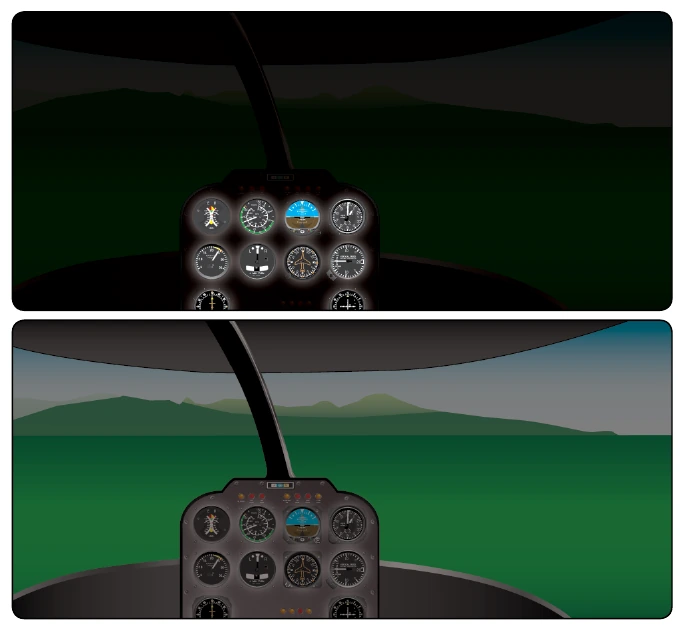
At night, blue wavelengths of light prevail in the visible portion of the spectrum. Therefore, slightly nearsighted (myopic) individuals viewing blue-green light at night may experience blurred vision. Even pilots with perfect vision find that image sharpness decreases as pupil diameter increases. For individuals with mild refractive errors, these factors combine to make vision unacceptably blurred unless they wear corrective glasses. Another factor to consider is “dark focus.” When light levels decrease, the focusing mechanism of the eye may move toward a resting position and make the eye more myopic. These factors become important when pilots rely on terrain features during unaided night flights. Practicing good light discipline is very important and helps pilots to retain their night adaptation. Keeping the cockpit lighting on dim allows the pilot to better identify outside details, unmarked hazards such as towers less than 200' AGL, and unimproved landing sites with no hazard lighting.
A simple exercise that shows the effect of high versus low light contrast would be to go out to a very dark road and turn the dash board lights down very low or off and let your eyes adjust to the ambient light level. Then, turn the dash board lights up and note how the outside features disappear. The same concept applies to cockpit lighting and being able to see the surrounding terrain and obstacles. [Figure 12-1] Special corrective lenses can be prescribed to pilots who experience night myopia.
The eye automatically adjusts for the light level experienced. During night flight, the cockpit and instrument lights should be as dim as possible. The eye can then adjust for the outside lighting conditions (ambient lighting) to see outside. The dimmer the inside lighting is, the better you can see outside.
Hyperopia
Hyperopia is also caused by an error in refraction. In a hyperopic state, when a pilot views a near image, the actual focal point of the eye is behind the retinal plane (wall), causing blurred vision. Objects that are nearby are not seen clearly; only more distant objects are in focus. This problem, is referred to as farsightedness.
Astigmatism
An unequal curvature of the cornea or lens of the eye causes this condition. A ray of light is spread over a diffused area in one meridian. In normal vision, a ray of light is sharply focused on the retina. Astigmatism is the inability to focus different meridians simultaneously. If, for example, astigmatic individuals focus on power poles (vertical), the wires (horizontal) are out of focus for most of them. [Figure 12-2]
Presbyopia
This condition is part of the normal aging process, which causes the lens to harden. Beginning in the early teens, the human eye gradually loses the ability to accommodate for and focus on nearby objects. When people are about 40 years old, their eyes are unable to focus at normal reading distances without reading glasses. Reduced illumination interferes with focus depth and accommodation ability. Hardening of the lens may also result in clouding of the lens (cataract formation). Aviators with early cataracts may see a standard eye chart clearly under normal daylight but have difficulty seeing under bright light conditions. This problem is due to light scattering as it enters the eye. This glare sensitivity is disabling under certain circumstances. Glare disability, related to contrast sensitivity, is the ability to detect objects against varying shades of backgrounds. Other visual functions decline with age and affect the aircrew member’s performance:
- Dynamic acuity
- Recovery from glare
- Function under low illumination
- Information processing
Vision in Flight
The visual sense is especially important in collision avoidance and depth perception. Due to the structure of the human eye, illusions and blindspots occur. The more pilots understand the eye and how it functions, the easier it is to compensate for these illusions and blindspots. Figure 12-3 shows the basic anatomy of the human eye and how it is like a camera. A camera is able to focus on near and far objects by changing the distance between the lens and the film. With the eye on the other hand, objects can be seen clearly at various distances because the shape of its lens is changed automatically by small muscles.