
Chapter 13
Effective Aeronautical Decision-Making
Introduction
The accident rate for helicopters has traditionally been higher than the accident rate of fixed-wing aircraft, probably due to the helicopter’s unique capabilities to fly and land in more diverse situations than fixed-wing aircraft and pilot attempts to fly the helicopter beyond the limits of his or her abilities or beyond the capabilities of the helicopter. With no significant improvement in helicopter accident rates for the last 20 years, the Federal Aviation Administration (FAA) has joined with various members of the helicopter community to improve the safety of helicopter operations.
According to National Transportation Safety Board (NTSB) statistics, approximately 80 percent of all aviation accidents are caused by pilot error, the human factor. Many of these accidents are the result of the failure of instructors to incorporate single-pilot resource management (SRM) and risk management into flight training instruction of aeronautical decision-making (ADM).
SRM is defined as the art of managing all the resources (both on board the aircraft and from outside sources) available to a pilot prior to and during flight to ensure a successful flight. When properly applied, SRM is a key component of ADM. Additional discussion includes integral topics such as, the concepts of risk management, workload or task management, situational awareness, controlled flight into terrain (CFIT) awareness, and automation management.
ADM is all about learning how to gather information, analyze it, and make decisions. It helps the pilot accurately assess and manage risk and make accurate and timely decisions. Although the flight is coordinated by a single person, the use of available resources, such as air traffic control (ATC) and flight service stations (FSS)/automated flight service stations (AFSS), replicates the principles of crew resource management (CRM) (see page 14-7).
References on SRM and ADM include:
- FAA-H-8083-2, Risk Management Handbook.
- Aeronautical Information Manual (AIM).
- Advisory Circular (AC) 60-22, Aeronautical Decision Making, which provides background information about ADM training in the general aviation (GA) environment.
- FAA-H-8083-25, Pilot’s Handbook of Aeronautical Knowledge.
Aeronautical Decision-Making (ADM)
Making good choices sounds easy enough. However, there are a multitude of factors that come into play when these choices, and subsequent decisions, are made in the aeronautical world. Many tools are available for pilots to become more self-aware and assess the options available, along with the impact of their decision. Yet, with all the available resources, accident rates are not being reduced. Poor decisions continue to be made, frequently resulting in lives being lost and/or aircraft damaged or destroyed. The Risk Management Handbook discusses ADM and SRM in detail and should be thoroughly read and understood.
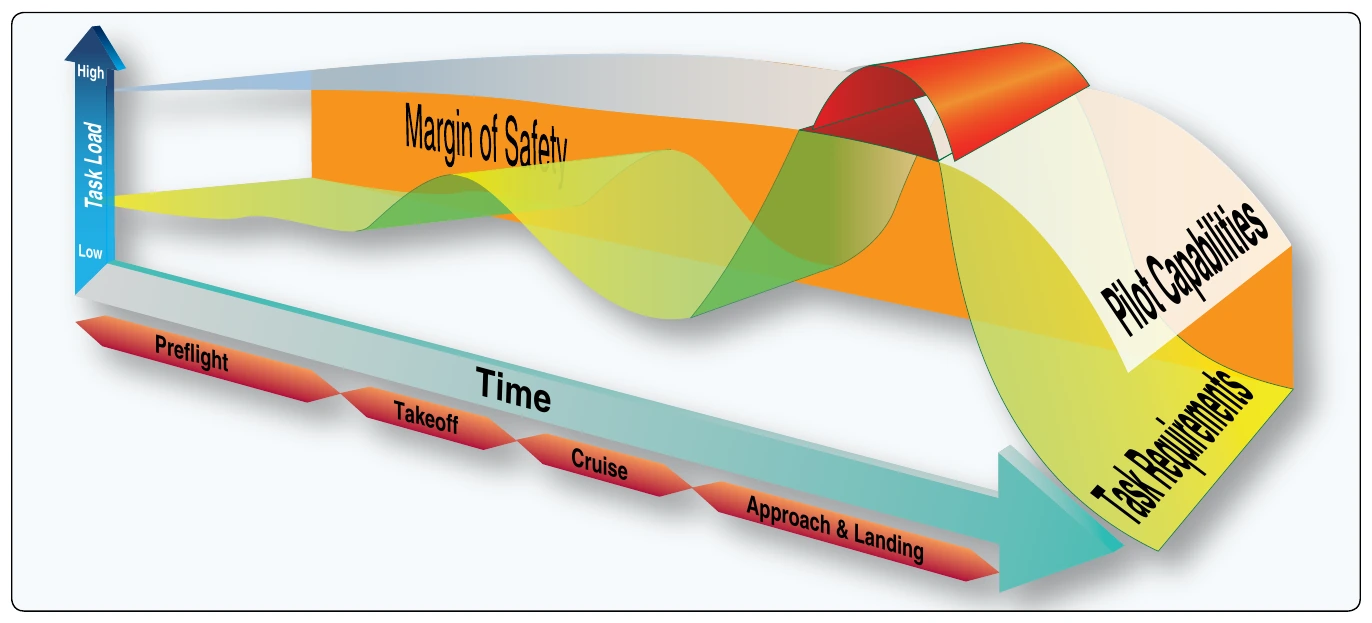
While progress is continually being made in the advancement of pilot training methods, aircraft equipment and systems, and services for pilots, accidents still occur. Historically, the term “pilot error” has been used to describe the causes of these accidents. Pilot error means an action or decision made by the pilot was the cause of, or a contributing factor that led to, the accident. This definition also includes the pilot’s failure to make a decision or take action. From a broader perspective, the phrase “human factors related” more aptly describes these accidents since it is usually not a single decision that leads to an accident, but a chain of events triggered by a number of factors. [Figure 13-1]
The poor judgment chain, sometimes referred to as the “error chain,” is a term used to describe this concept of contributing factors in a human factors related accident. Breaking one link in the chain is often the only event necessary to change the outcome of the sequence of events. The following is an example of the type of scenario illustrating the poor judgment chain.
Scenario
A Helicopter Air Ambulance (HAA) pilot is nearing the end of his shift when he receives a request for a patient pickup at a roadside vehicle accident. The pilot has started to feel the onset of a cold; his thoughts are on getting home and getting a good night’s sleep. After receiving the request, the pilot checks the accident location and required flightpath to determine if he has time to complete the flight to the scene, then on to the hospital before his shift expires. The pilot checks the weather and determines that, although thunderstorms are approaching, the flight can be completed prior to their arrival.
The pilot and on-board medical crews depart the home location and arrive overhead, at the scene of the vehicular accident. The pilot is not comfortable with the selected landing area due to tall trees in all quadrants of the confined area. The pilot searches for a secondary landing area. Unable to find one nearby, the pilot then returns to the initial landing area and decides he can make it work.
After successfully landing the aircraft, he is told that there will be a delay before the patient is loaded because more time is needed to extricate the patient from the wreckage. Knowing his shift is nearly over, the pilot begins to feel pressured to “hurry up” or he will require an extension for his duty day.
After 30 minutes, the patient is loaded, and the pilot ensures everyone is secure. He notes that the storm is now nearby and that winds have picked up considerably. The pilot thinks, “No turning back now, the patient is on board and I’m running out of time.” The pilot knows he must take off almost vertically to clear the obstacles and chooses his departure path based on the observed wind during landing. Moments later, prior to clearing the obstacles, the aircraft begins an uncontrollable spin and augers back to the ground, seriously injuring all on board and destroying the aircraft.
What could the pilot have done differently to break this error chain? More important—what would you have done differently? By discussing the events that led to this accident, you should develop an understanding of how a series of judgmental errors contributed to the final outcome of this flight.
For example, the pilot’s decision to fly the aircraft knowing that the effects of an illness were present was the initial contributing factor. The pilot was aware of his illness, but, was he aware of the impact of the symptoms—fatigue, general uneasy feeling due to a slight fever, perhaps?