
Chapter 13
Effective Aeronautical Decision-Making
Implementing the Decision and Evaluating the Outcome
Although a decision may be reached and a course of action implemented, the decision-making process is not complete. It is important to think ahead and determine how the decision could affect other phases of the flight. As the flight progresses, a pilot must continue to evaluate the outcome of the decision to ensure that it is producing the desired result.
As the pilot made the turn to the downwind, the airspeed dropped nearly to zero, and the helicopter became very difficult to control. (At this point, the pilot must increase airspeed in order to maintain translational lift.) Since the CG was aft of limits, she needed to apply more forward cyclic than usual. As she approached the landing zone with a high rate of descent, she realized that she would be in a potential vortex ring state situation if she tried to trade airspeed for altitude and lost effective translational lift (ETL). Therefore, it did not appear that she would be able to terminate the approach in a hover. The pilot decided to make the shallowest approach possible and perform a run-on landing.
Pilots sometimes have trouble not because of deficient basic skills or system knowledge, but because of faulty decision-making skills. Although aeronautical decisions may appear to be simple or routine, each individual decision in aviation often defines the options available for the next decision the pilot must make, and the options (good or bad) it provides.
Therefore, a poor decision early in a flight can compromise the safety of the flight at a later time. It is important to make appropriate and decisive choices because good decision-making early in an emergency provide greater latitude for later options.
Decision-Making Models
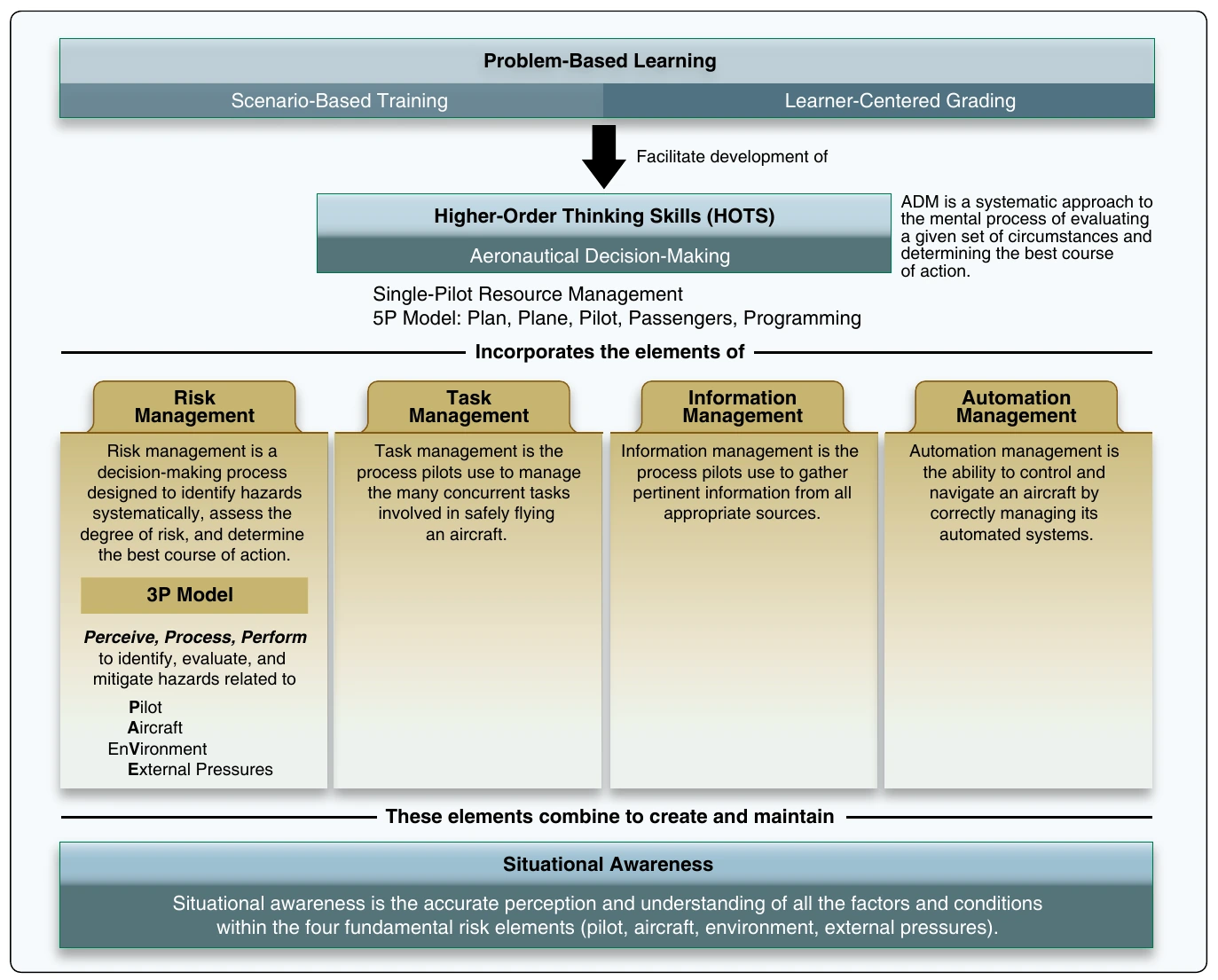
The decision-making process normally consists of several steps before a pilot chooses a course of action. A variety of structured frameworks for decision-making provide assistance in organizing the decision process. These models include but are not limited to the 5P (Plan, Plane, Pilot, Passengers, Programming), the OODA Loop (Observation, Orientation, Decision, Action), and the DECIDE (Detect, Estimate, Choose, Identify, Do, and Evaluate) models. [Figure 13-2] All these models and their variations are discussed in detail in the Pilot’s Handbook of Aeronautical Knowledge section covering aeronautical decision-making.
Whichever model is used, the pilot learns how to define the problem, choose a course of action, implement the decision, and evaluate the outcome. Remember, there is no one right answer in this process: a pilot analyzes the situation in light of experience level, personal minimums, and current physical and mental readiness levels, and then makes a decision.
Pilot Self-Assessment
The pilot in command (PIC) of an aircraft is directly responsible for and is the final authority for the operation of that aircraft. The list of PIC responsibilities is long, and nothing should be overlooked. To exercise those responsibilities effectively and make effective decisions regarding the outcome of a flight, a pilot must have an understanding of personal limitations. Pilot performance from planning the flight to execution of the flight is affected by many factors, such as health, experience, knowledge, skill level, and attitude.
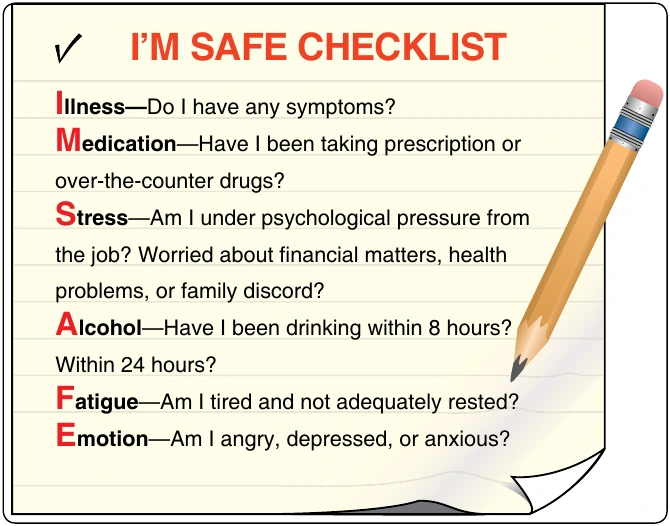
Exercising good judgment begins prior to taking the controls of an aircraft. Often, pilots thoroughly check their aircraft to determine airworthiness, yet do not evaluate their own fitness for flight. Just as a checklist is used when preflighting an aircraft, a personal checklist based on such factors as experience, currency, and comfort level can help determine if a pilot is prepared for a particular flight. Specifying when refresher training should be accomplished and designating weather minimums, which may be higher than those listed in Title 14 of the Code of Federal Regulations (14 CFR) part 91, are elements that may be included on a personal checklist. Over confidence can kill just as fast as inexperience. In addition to a review of personal limitations, a pilot should use the I’M SAFE checklist to further evaluate fitness for flight. [Figure 13-3]
Curiosity: Healthy or Harmful?
The roots of aviation are firmly based on curiosity. Where would we be today had it not been for the dreams of Leonardo da Vinci, the Wright Brothers, and Igor Sikorsky? They all were infatuated with flight, a curiosity that led to the origins of aviation. The tale of aviation is full of firsts: first flight, first helicopter, first trans-Atlantic flight, and so on. But, along the way there were many setbacks, fatalities, and lessons learned.
Today, we continue to learn and investigate the limits of aviation. We’ve been to the moon, and soon beyond. Our curiosity will continue to drive us to search for the next challenge.
However, curiosity can also have catastrophic consequences. Despite over 100 years of aviation practice, we still see accidents that are caused by impaired judgment formed from curious behavior. Pilots commonly seek to determine the limits of their ability as well as the limits of the aircraft. Unfortunately, too often this leads to mishaps with deadly results. Inquisitive behavior must be harnessed and displayed within personal and material limits.
Deadly curiosity may not seem as obvious to some as it is to others. Simple thoughts such as, “Is visibility really as bad as what the ATIS is reporting?” or “Will the 20-minute fuel light really indicate only 20 minutes worth of fuel?” can lead to poor decisions and disastrous outcomes.
Some aviators blatantly violate rules and aircraft limitations without thinking through the consequences. “What indications and change in flight characteristics will I see if I fly this helicopter above its maximum gross weight?” or “I’ve heard this helicopter can do aerobatic flight. Why is it prohibited?” are examples of extremely harmful curiosity. Even more astounding is their ignoring to the fact that the damage potentially done to the aircraft will probably manifest later in the aircraft’s life, affecting other crews. Spontaneous excursions in aviation can be deadly.
Curiosity is natural and promotes learning. Airmen should abide by established procedures until proper and complete hazard assessment and risk management can be completed.