
Chapter 13
Effective Aeronautical Decision-Making
Next, a poor decision to continue towards the Class C airspace was made. The pilot could have turned away from the Class C airspace, removing himself from the situation until the frequencies were entered and contact established. Remember, when possible, choose an option that gives more time to determine a course of action. Proper resource management could have negated this airspace violation.
The example also demonstrates the need to have a thorough understanding of all the equipment and systems in the aircraft. As is often the case, the technology available today is seldom used to its maximum capability. It is necessary to become as familiar as possible with this equipment to utilize all resources fully. For example, advanced navigation and autopilot systems are valuable resources. However, if pilots do not fully understand how to use this equipment, or they rely on it so much they become complacent, the equipment can become a detriment to safe flight.
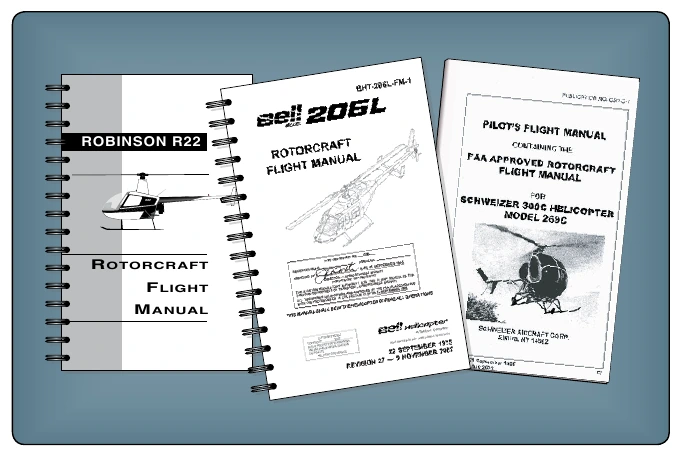
Another internal resource is the Rotorcraft Flight Manual (RFM). [Figure 13-4] The RFM:
- Must be on board the aircraft.
- Is indispensable for accurate flight planning.
- Plays a vital role in the resolution of inflight equipment malfunctions.
Other valuable flight deck resources include current aeronautical charts and publications, such as the Airport/Facility Directory (A/FD).
As stated previously, passengers can also be a valuable resource. Passengers can help watch for traffic and may be able to provide information in an irregular situation, especially if they are familiar with flying. Crew briefs to passengers should always include some basic helicopter terminology. For example, explain that in the event you ask them if you are clear to hover to the right, their response should be either “yes, you are clear to hover to the right” or “no you are not clear.” A simple yes or no answer can be ambiguous. A strange smell or sound may alert a passenger to a potential problem. As PIC, a pilot should brief passengers before the flight to make sure that they are comfortable voicing any concerns.
Instruction that integrates Single-Pilot Resource Management into flight training teaches aspiring pilots how to be more aware of potential risks in flying, how to identify those risks clearly, and how to manage them successfully. The importance of integrating available resources and learning effective SRM skills cannot be overemphasized. Ignoring safety issues can have fatal results.
Risk Management
Risk management is a formalized way of dealing with hazards. It is the logical process of weighing the potential cost of risks from hazards against the possible benefits of allowing those risks from hazards to stand unmitigated. It is a decision-making process designed to identify hazards systematically, assess the degree of risk, and determine the best course of action. Once risks are identified, they must be assessed. The risk assessment determines the degree of risk (negligible, low, medium, or high) and whether the degree of risk is worth the outcome of the planned activity. If the degree of risk is “acceptable,” the planned activity may then be undertaken. Once the planned activity is started, consideration must then be given whether to continue. Pilots must have preplanned, viable alternatives available in the event the original flight cannot be accomplished as planned.
Two defining elements of risk management are hazard and risk.
- A hazard is a present condition, event, object, or circumstance that could lead to or contribute to an unplanned or undesired event, such as an accident. It is a source of danger. For example, binding in the antitorque pedals represents a hazard.
- Risk is the future impact of a hazard that is not controlled or eliminated. It is the possibility of loss or injury. The level of risk is measured by the number of people or resources affected (exposure), the extent of possible loss (severity), and the likelihood of loss (probability).
A hazard can be a real or perceived condition, event, or circumstance that a pilot encounters. Learning how to identify hazards, assess the degree of risk they pose, and determine the best course of action is an important element of a safe flight.
Four Risk Elements
During each flight, decisions must be made regarding events that involve interactions between the four risk elements—the PIC, the aircraft, the environment, and the operation. The decision-making process involves an evaluation of each of these risk elements to achieve an accurate perception of the flight situation. [Figure 13-5]
One of the most important decisions that a PIC must make is the go/no-go decision. Evaluating each of these risk elements can help a pilot decide whether a flight should be conducted or continued. In the following situations, the four risk elements and how they affect decision-making are evaluated.
Pilot—A pilot must continually make decisions about personal competency, condition of health, mental and emotional state, level of fatigue, and many other variables. A situation to consider: a pilot is called early in the morning to make a long flight. With only a few hours of sleep and congestion that indicates the possible onset of a cold, is that pilot safe to fly?
Aircraft—A pilot frequently bases decisions to fly on personal evaluations of the aircraft, such as its powerplant, performance, equipment, fuel state, or airworthiness. A situation to consider: en route to an oil rig an hour’s flight from shore, having just passed the shoreline, the pilot notices the oil temperature at the high end of the caution range. Should the pilot continue out to sea or return to the nearest suitable heliport/airport?
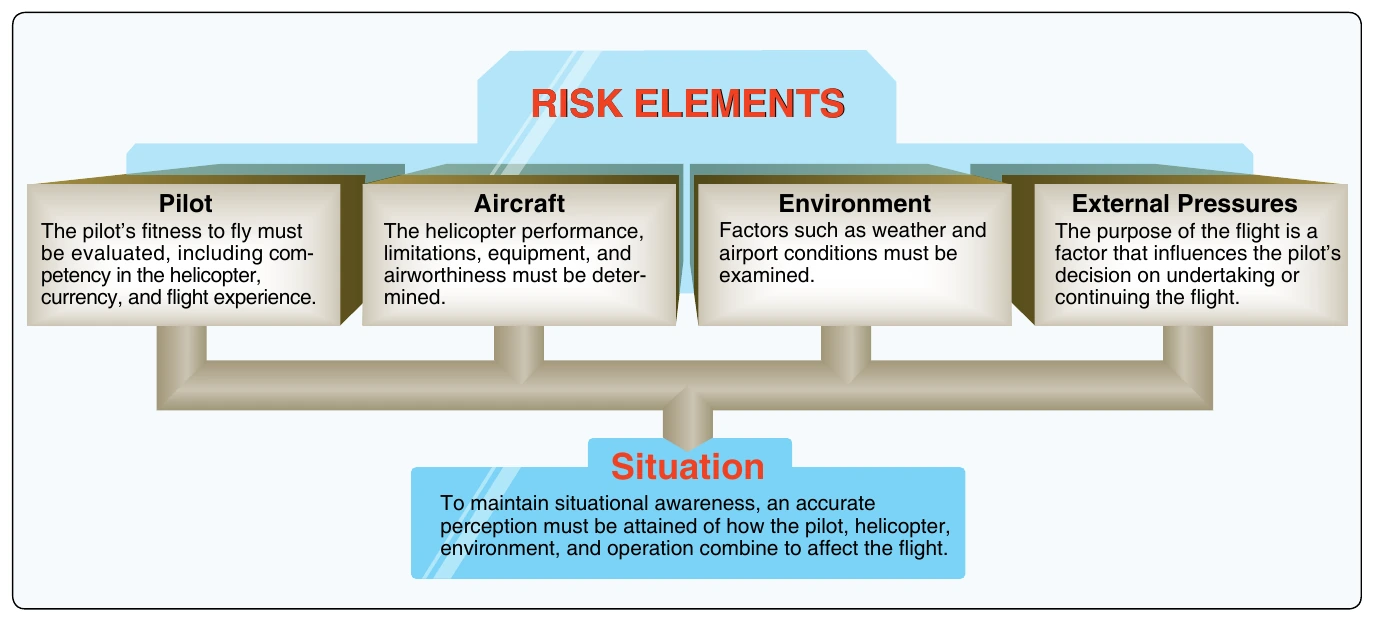
Environment—This encompasses many elements unrelated to the pilot or aircraft. It can include such factors as weather, ATC, navigational aids (NAVAID), terrain, takeoff and landing areas, and surrounding obstacles. Weather is one element that can change drastically over time and distance. A situation to consider: a pilot is ferrying a helicopter cross-country and encounters unexpected low clouds and rain in an area of rising terrain. Does the pilot try to stay under them and scud run, or turn around, stay in the clear, and obtain current weather information?