
Chapter 13
Effective Aeronautical Decision-Making
External Pressures—The interaction between the pilot, the aircraft, and the environment is greatly influenced by the purpose of each flight operation. A pilot must evaluate the three previous areas to decide on the desirability of undertaking or continuing the flight as planned. It is worth asking why the flight is being made, how critical it is to maintain the schedule, and if the trip is worth the risks. A situation to consider: a pilot is tasked to take some technicians into rugged mountains for a routine survey in marginal weather. Would it be preferable to wait for better conditions to ensure a safe flight? How would the priorities change if a pilot were tasked to search for cross-country skiers who had become lost in deep snow and radioed for help?
Assessing Risk
It is important for a pilot to learn how to assess risk. Before a pilot can begin to assess risk, he or she must first perceive the hazard and attendant risk(s). In aviation, experience, training, and education help a pilot learn how to spot hazards quickly and accurately. During flight training, the instructor should point out the hazards and attendant risks to help the student pilot learn to recognize them.
Once a hazard is identified, determining the probability and severity of an accident (level of risk associated with it) becomes the next step. For example, the hazard of binding in the antitorque pedals poses a risk only if the helicopter is flown. If the binding leads to a loss of directional control, the risk is high that it could cause catastrophic damage to the helicopter and the passengers. The pilot learns to identify hazards and how to deal with them when they are incorporated into the training program.
Every flight has hazards and some level of risk associated with it. It is critical that pilots be able to:
- Differentiate, in advance, between a low-risk flight and a high-risk flight.
- Establish a review process and develop risk mitigation strategies to address flights throughout that range.
Examining NTSB reports and other accident research can help a pilot to assess risk more effectively. For example, the accident rate decreases by nearly 50 percent once a pilot obtains 100 hours and continues to decrease until the 1,000-hour level. The data suggest that for the first 500 hours, pilots flying visual flight rules (VFR) at night should establish higher personal limitations than are required by the regulations and, if applicable, apply instrument flying skills in this environment.
Individuals training to be helicopter pilots should remember that the helicopter accident rate is 30 percent higher than the accident rate for fixed-wing aircraft. While many factors contribute to this, students must recognize the small margin of error that exists for helicopter pilots in making critical decisions. In helicopters, certain emergency actions require immediate action by the pilot. In the event of an engine malfunction, failure to immediately lower the collective results in rotor decay and failed autorotation. Fixed wing pilots may have slightly more time to react and establish a controllable descent. According to the General Aviation (GA) Joint Steering Committee, the leading causes of accidents in GA are CFIT (see p.14-15), weather, runway incursions, pilot decision-making, and loss of control. These causes are referred to as pilot-error, or human factors related, accidents. CFIT, runway incursions, and loss of control type accidents typically occur when the pilot makes a series of bad judgments, which leads to these events. For example, when the pilot has not adequately planned the flight and the pilot subsequently fails to maintain adequate situational awareness to avoid the terrain, a CFIT accident occurs.
While the reasons for individual helicopter incidents vary, it can be argued that it is the helicopter’s flight mode and operational complexity that directly contributes to each incident. By nature of its purpose, a helicopter usually flies closer to terrain than does a fixed-wing aircraft. Subsequently, minimal time exists to avoid CFIT, weather related, or loss of control type incidents that require quick and accurate assessments. Fixed-wing aircraft normally fly at higher altitudes and are flown from prepared surface to prepared surface. Helicopters are often operated in smaller, confined area-type environments and require continuous pilot control. Helicopter pilots must be aware of what rotor wash can do when landing to a dusty area or prior to starting where loose debris may come in contact with the rotor blades.
Often, the loss of control occurs when the pilot exceeds design or established operating standards, and the resulting situation exceeds pilot capability to handle it successfully. The FAA generally characterizes these occurrences as resulting from poor judgment. Likewise, most weather-related accidents are not a result of the weather per se, but of a failure of the pilot to avoid a weather phenomenon for which the aircraft is not equipped, or the pilot is not trained to handle. That is, the pilot decides to fly or to continues into conditions beyond pilot capability, an action commonly considered to be demonstrating bad judgment.
It cannot be emphasized enough that the helicopter’s unique capabilities come with increased risk. Since most helicopter operations are conducted by a single pilot, the workload is increased greatly. Low-level maneuvering flight (a catch-all category for different types of flying close to terrain or obstacles, such as power line patrol, wildlife control, crop dusting, air taxiing, and maneuvering for landing after an instrument approach), is one of the largest single categories of fatal accidents.
Fatal accidents that occur during approach often happen at night or in instrument flight rules (IFR) conditions. Takeoff/initial climb accidents are frequently due to the pilot’s lack of awareness of the effects of density altitude on aircraft performance or other improper takeoff planning that results in loss of control during or shortly after takeoff. One of the most lethal types of GA flying is attempting VFR flight into instrument meteorological conditions (IMC). Accidents involving poor weather decision-making account for about 4 percent of the total accidents but 14 percent of the fatal mishaps. While weather forecast information has been gradually improving, weather should remain a high priority for every pilot assessing risk.
Using the 3P Model to Form Good Safety Habits
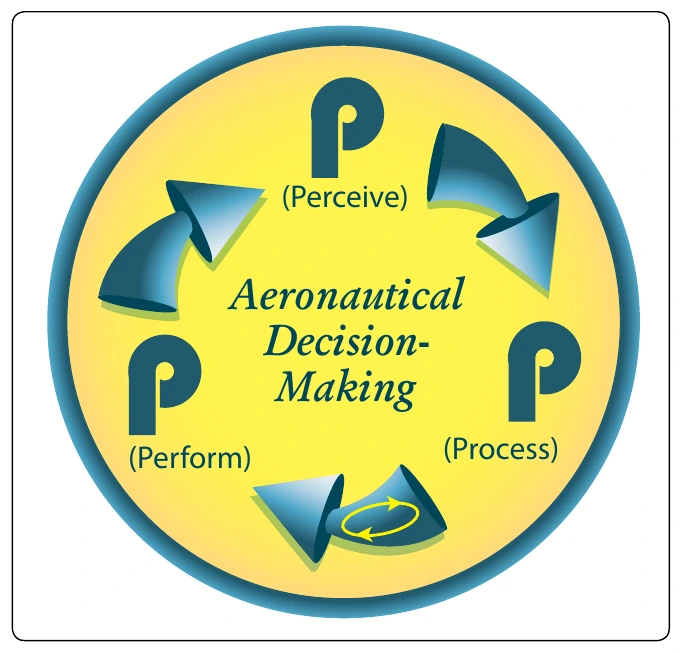
As discussed in the Pilot’s Handbook of Aeronautical Knowledge, the Perceive, Process, Perform (3P) model helps a pilot assess and manage risk effectively in the real world. [Figure 13-6]
To use this model, the pilot will:
- Perceive hazards
- Process level of risk
- Perform risk management
Let’s put this to use through a common scenario, involving a common task, such as a confined area approach. As is often the case, the continuous loop consists of several elements; each element must be addressed through the 3P process.
A utility helicopter pilot receives the task of flying four passengers into a remote area for a hunting expedition. The passengers have picked the location where they would like to be dropped off based on the likelihood of wildlife being in the area. The area has steep, rugged terrain in a series of valleys and canyons leading up to large mountains.
Upon arrival at the location, the pilot locates a somewhat large confined area near the base of one of the mountains. The pilot begins the 3P process by quickly noting (or perceiving) the hazards that affect the approach, landing, and takeoff. Through thorough assessment the pilot takes into consideration: