
Chapter 4
Helicopter Components, Sections, and Systems
Hydraulics
Most helicopters, other than smaller piston-powered helicopters, incorporate the use of hydraulic actuators to overcome high control forces. [Figure 4-25] A typical hydraulic system consists of actuators, also called servos, on each flight control, a pump which is usually driven by the main rotor transmission and a reservoir to store the hydraulic fluid. Some helicopters have accumulators located on the pressure side of the hydraulic system. This allows for a continuous fluid pressure into the system. A switch in the cockpit can turn the system off, although it is left on under normal conditions. When the pilot places the hydraulic switch/circuit breaker into the on position, the electrical power is being removed from the solenoid valve allowing hydraulic fluid to enter the system. When the switch/circuit breaker is put in the off position, the solenoid valve is now de-energized and closes, which then allows the pilot to maintain control of the helicopter with the hydraulic fluid in the actuators. This is known as a failsafe system. If helicopter electrical power is lost in flight, the pilot is still able to maintain control of the hydraulic system. A pressure indicator in the cockpit may also be installed to monitor the system.
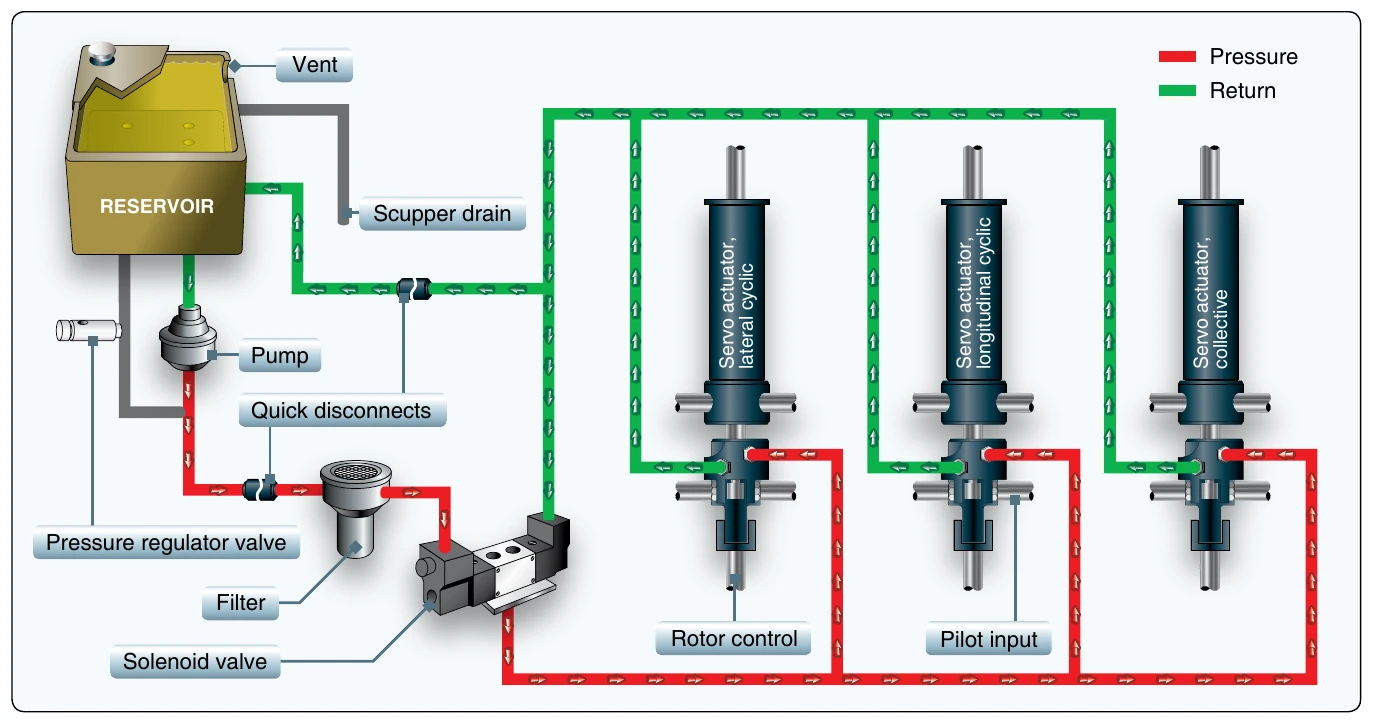
When making a control input, the servo is activated and provides an assisting force to move the respective flight control, thus reducing the force the pilot must provide. These boosted flight controls ease pilot workload and fatigue. In the event of hydraulic system failure, a pilot is still able to control the helicopter, but the control forces are very heavy.
In those helicopters in which the control forces are so high that they cannot be moved without hydraulic assistance, two or more independent hydraulic systems may be installed. Some helicopters are designed to use their hydraulic accumulators to store hydraulic pressure for an emergency, allowing for uninterrupted use of the controls for a short period of time following a hydraulic pump failure. This gives you enough time to land the helicopter with normal control.
Stability Augmentations Systems
Some helicopters incorporate a stability augmentation system (SAS) to help stabilize the helicopter in flight and in a hover. The original purpose and design allowed decreased pilot workload and lessened fatigue. It allowed pilots to place an aircraft at a set attitude to accomplish other tasks or simply stabilize the aircraft for long cross-country flights.
Force Trim
Force trim was a passive system that simply held the cyclic in a position that gave a control force to transitioning airplane pilots who had become accustomed to such control forces. The system uses a magnetic clutch and springs to hold the cyclic control in the position where it was released. The system does not use sensor-based data to make corrections, but rather is used by the pilot to “hold” the cyclic in a desired position. The most basic versions only apply to the cyclic requiring the pilot to continue power and tail rotor inputs. With the force trim on or in use, the pilot can override the system by disengaging the system through the use of a force trim release button or, with greater resistance, can physically manipulate the controls. Some recent basic systems are referred to as attitude retention systems.
Active Augmentation Systems
So-called actual augmentation systems use electric actuators that provide input to the hydraulic servos. These servos receive control commands from a computer that senses external environmental inputs, such as wind and turbulence. SAS complexity varies by manufacturer but can be as sophisticated as providing three-axis stability. That is, computer-based inputs adjust attitude, power and aircraft trim for a more stabilized flight.
Once engaged by the pilot, these actual systems use a multitude of sensors, from stabilized gyros to electro-mechanical actuators, which provide instantaneous inputs to all flight controls without pilot assistance. As with all SASs, they may be overridden or disconnected by the pilot at any time. Helicopters with complex Automatic Flight Control Systems (AFCS) and autopilots normally have a trim switch referred to as “beeper trim.” This switch is used when minor changes to the trim setting are desired.
Stability augmentation systems reduce pilot workload by improving basic aircraft control harmony and decreasing disturbances. These systems are very useful when the pilot is required to perform other duties, such as sling loading and search-and-rescue operations. Other inputs such as heading, speed, altitude, and navigation information may be supplied to the computer to form a complete autopilot system.
Autopilot
Helicopter autopilot systems are similar to stability augmentation systems, but they have additional features. An autopilot can actually fly the helicopter and perform certain functions selected by the pilot. These functions depend on the type of autopilot and systems installed in the helicopter.
The most common functions are altitude and heading hold. Some more advanced systems include a vertical speed or indicated airspeed (IAS) hold mode, where a constant rate of climb/descent or IAS is maintained by the autopilot. Some autopilots have navigation capabilities, such as very high frequency (VHF) OmniRange Navigation System (VOR), Instrument Landing System (ILS), and global positioning system (GPS) intercept and tracking, which is especially useful in instrument flight rules (IFR) conditions. This is referred to as a coupled system. An additional component, called a flight director (FD), may also be installed. The FD provides visual guidance cues to the pilot to fly selected lateral and vertical modes of operation. The most advanced autopilots can fly an instrument approach to a hover without any additional pilot input once the initial functions have been selected.
The autopilot system consists of electric actuators or servos connected to the flight controls. The number and location of these servos depends on the type of system installed. A two-axis autopilot controls the helicopter in pitch and roll; one servo controls fore and aft cyclic, and another controls left and right cyclic. A three-axis autopilot has an additional servo connected to the antitorque pedals and controls the helicopter in yaw. A four-axis system uses a fourth servo which controls the collective. These servos move the respective flight controls when they receive control commands from a central computer. This computer receives data input from the flight instruments for attitude reference and from the navigation equipment for navigation and tracking reference. An autopilot has a control panel in the cockpit that allows the pilot to select the desired functions, as well as engage the autopilot.
For safety purposes, an automatic disengagement feature is usually included which automatically disconnects the autopilot in heavy turbulence or when extreme flight attitudes are reached. Even though all autopilots can be overridden by the pilot, there is also an autopilot disengagement button located on the cyclic or collective which allows pilots to completely disengage the autopilot without removing their hands from the controls. Because autopilot systems and installations differ from one helicopter to another, it is very important to refer to the autopilot operating procedures located in the RFM.
Environmental Systems
Heating and cooling the helicopter cabin can be accomplished in different ways. The simplest form of cooling is by ram air. Air ducts in the front or sides of the helicopter are opened or closed by the pilot to let ram air into the cabin. This system is limited as it requires forward airspeed to provide airflow and also depends on the temperature of the outside air. Air conditioning provides better cooling, but it is more complex and weighs more than a ram air system.