
Chapter 8
Ground Procedures and Flight Preparations
Passengers
Passengers increase the responsibility, workload, and risk for the pilot. The workload and distractions seem magnified to inexperienced pilots while they are developing confidence and ability to operate in the aviation environment. Inexperienced pilots should consider building up their passenger carrying experience while remaining in good flying conditions and in a familiar area.
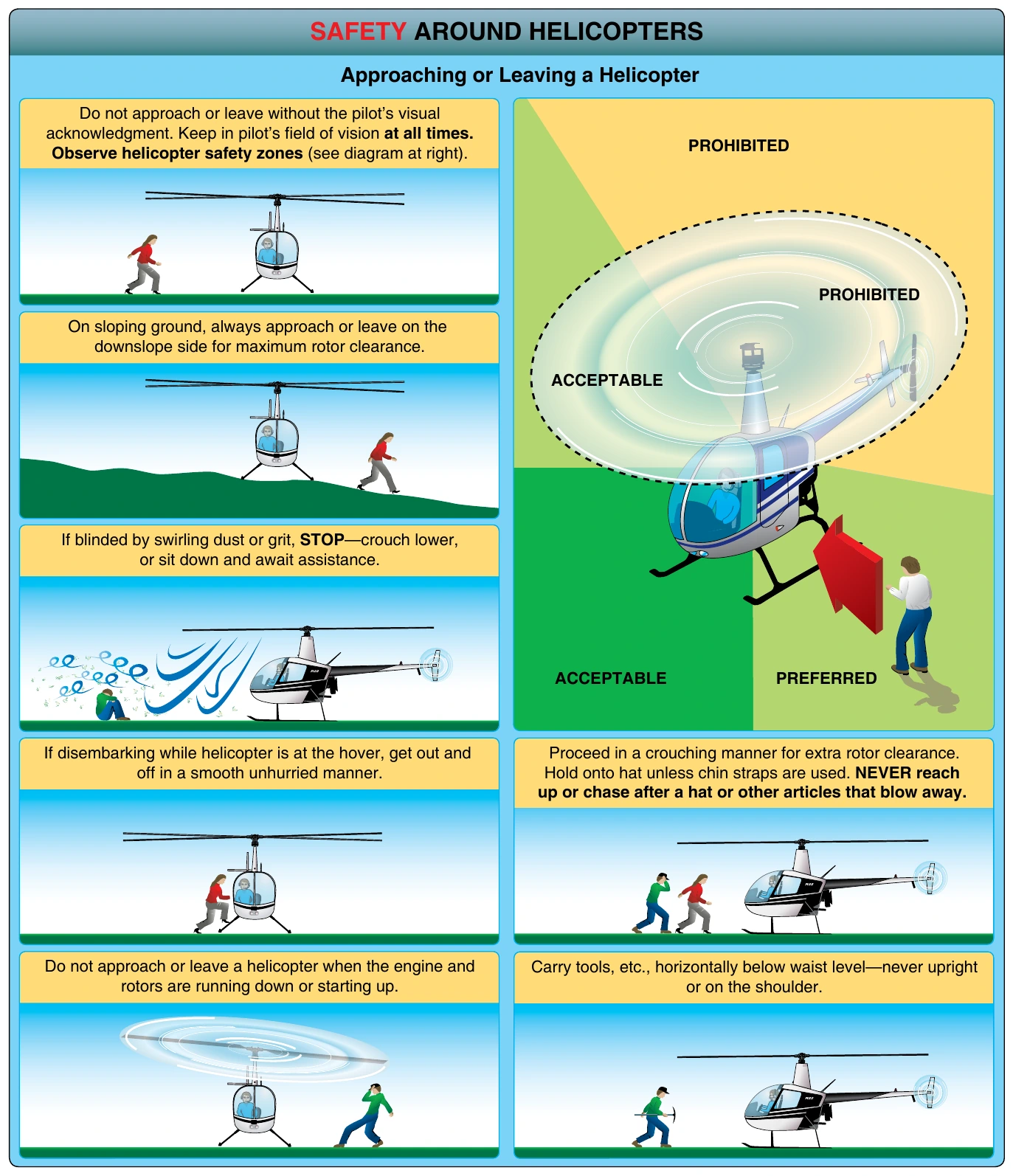
All persons boarding a helicopter while its rotors are turning should be briefed on the safest means of doing so. The pilot in command (PIC) should always brief the passengers prior to engine start to ensure complete understanding of all procedures. The exact procedures may vary slightly from one helicopter model to another, but the following should suffice as a generic guide.
When boarding—
- Stay away from the rear of the helicopter.
- Approach or leave the helicopter in a crouching manner.
- Approach from the side of the helicopter but never out of the pilot’s line of vision. Certain rotor system designs allow for rotor blades to pass closer to the ground towards the front of the helicopter. For that reason, it is generally accepted for personnel to approach from the side of the helicopter. Helicopters designed to be loaded from the rear require personnel to exercise extreme caution due to tailrotor hazards.
- Carry tools horizontally, below waist level—never upright or over the shoulder.
- Hold firmly onto hats and loose articles.
- Never reach up or dart after a hat or other object that might be blown off or away.
- Protect eyes by shielding them with a hand or by squinting.
- If suddenly blinded by dust or a blowing object, stop and crouch lower; better yet, sit down and wait for help.
- Never grope or feel your way toward or away from the helicopter.
- Protect hearing by wearing earplugs or earmuffs.
Since few helicopters carry cabin attendants, the pilot must conduct the pretakeoff and prelanding briefings, usually before takeoff due to noise and cockpit layout. The type of operation dictates what sort of briefing is necessary. All briefings should include the following:
- Passengers should be briefed and understand the proper use of seatbelts, doors, and headsets/intercom system.
- The safe entry and exit paths (away from the tail rotor and within the pilot’s view).
- If possible, remove front passenger flight controls and ensure all passenger personal items, such as cameras and mobile phones are secure.
- For over water flights, the location and use of flotation gear and other survival equipment that are onboard. Pilot instructions should include how and when to exit the helicopter should ditching or a water landing occur.
- For flights over rough or isolated terrain, the pilot should brief all occupants regarding the location of maps and survival equipment.
- Passengers should be informed as to what actions and precautions to take in the event of an emergency, such as the body position for best spinal protection against a high vertical impact (erect with back firmly against the seat back); and when and how to exit. Ensure that passengers are aware of the location of the fire extinguisher, survival equipment and, if equipped, how to use and locate the Emergency Position Indicator Radio Beacon (EPIRB).
When passengers are approaching or leaving a helicopter that is sitting on a slope with the rotors turning, they should approach and depart downhill. This affords the greatest distance between the rotor blades and the ground. If this involves walking around the helicopter, they should always go around the front—never the rear.
Pilot at the Flight Controls
Many helicopter operators have been lured into a “quick turnaround” ground operation to avoid delays at airport terminals and to minimize stop/start cycles of the engine. As part of this quick turn-around, the pilot might leave the cockpit with the engine and rotors turning. Such an operation can be extremely hazardous if a gust of wind disturbs the rotor disk, or the collective flight control moves causing lift to be generated by the rotor system. Either occurrence may cause the helicopter to roll or pitch, resulting in a rotor blade striking the tail boom or the ground. Good operating procedures dictate that, generally, pilots remain at the flight controls whenever the engine is running, and the rotors are turning.
If operations require the pilot to leave the cockpit to refuel, the throttle should be rolled back to flight idle and all controls firmly frictioned to prevent uncommanded control movements. The pilot should be well trained on setting controls and exiting the cockpit without disturbing the flight or power controls.
After Landing and Securing
When the flight is terminated, park the helicopter where it does not interfere with other aircraft and is not a hazard to people during shutdown. For many helicopters, it is advantageous to land with the wind coming from the right over the tail boom (counterrotating blades). This tends to lift the blades over the tail boom but lowers the blades in front of the helicopter. This action decreases the likelihood of a main rotor strike to the tail boom due to gusty winds. Rotor downwash can cause damage to other aircraft in close proximity, and spectators may not realize the danger or see the rotors turning. Passengers should remain in the helicopter with their seats belts secured until the rotors have stopped turning. During the shutdown and postflight inspection, follow the manufacturer’s checklist. Any discrepancies should be noted and, if necessary, reported to maintenance personnel.
Chapter Summary
This chapter explained the importance of preflight and safety when conducting helicopter ground operations. Proper procedures for engine run-up, refueling, and ground safety were detailed and the responsibilities of the pilot when maintenance issues occur before flight.