
Chapter 4
Aerodynamic Factors
Rime Ice
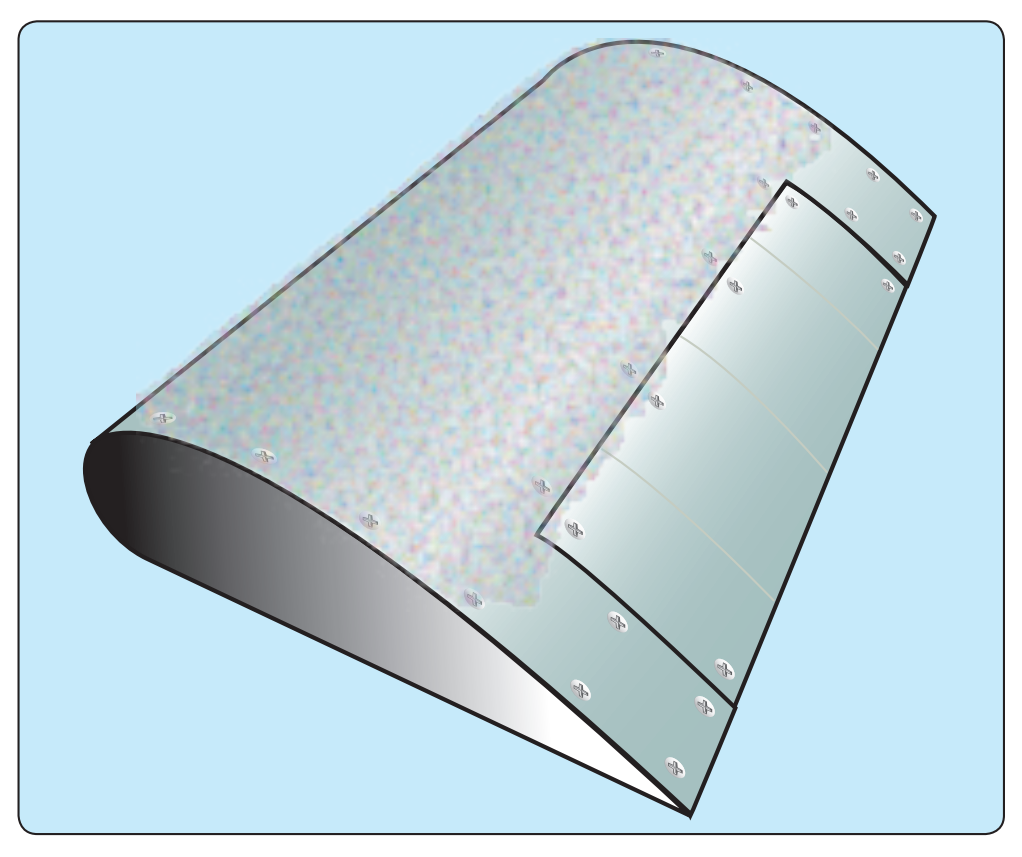
A rough, milky, opaque ice formed by the instantaneous or very rapid freezing of super cooled droplets as they strike the aircraft is known as rime ice. [Figure 4-19] The rapid freezing results in the formation of air pockets in the ice, giving it an opaque appearance and making it porous and brittle. For larger accretions, rime ice may form a streamlined extension of the wing. Low temperatures, lesser amounts of liquid water, low velocities, and small droplets are conducive to the formation of rime ice.
Mixed Ice
Mixed ice is a combination of clear and rime ice formed on the same surface. It is the shape and roughness of the ice that is most important from an aerodynamic point of view.
General Effects of Icing on Airfoils
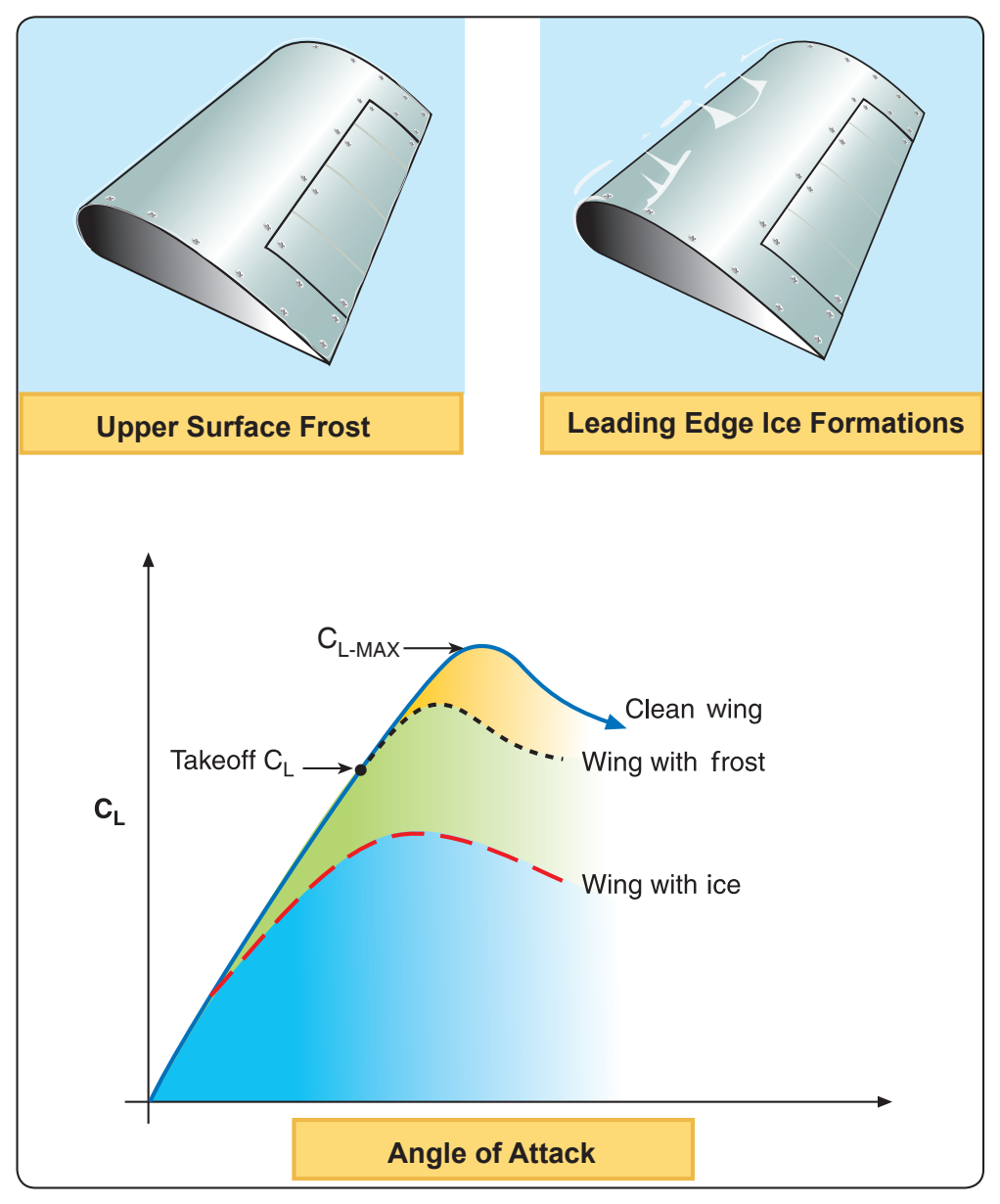
The most hazardous aspect of structural icing is its aerodynamic effects. [Figure 4-20] Ice alters the shape of an airfoil, reducing the maximum coefficient of lift and AOA at which the aircraft stalls. Note that at very low AOAs, there may be little or no effect of the ice on the coefficient of lift. Therefore, when cruising at a low AOA, ice on the wing may have little effect on the lift. However, note that the ice significantly reduces the CL-MAX, and the AOA at which it occurs (the stall angle) is much lower. Thus, when slowing down and increasing the AOA for approach, the pilot may find that ice on the wing, which had little effect on lift in cruise now, causes stall to occur at a lower AOA and higher speed. Even a thin layer of ice at the leading edge of a wing, especially if it is rough, can have a significant effect in increasing stall speed. For large ice shapes, especially those with horns, the lift may also be reduced at a lower AOA. The accumulation of ice affects the coefficient of drag of the airfoil. [Figure 4-20] Note that the effect is significant even at very small AOAs.
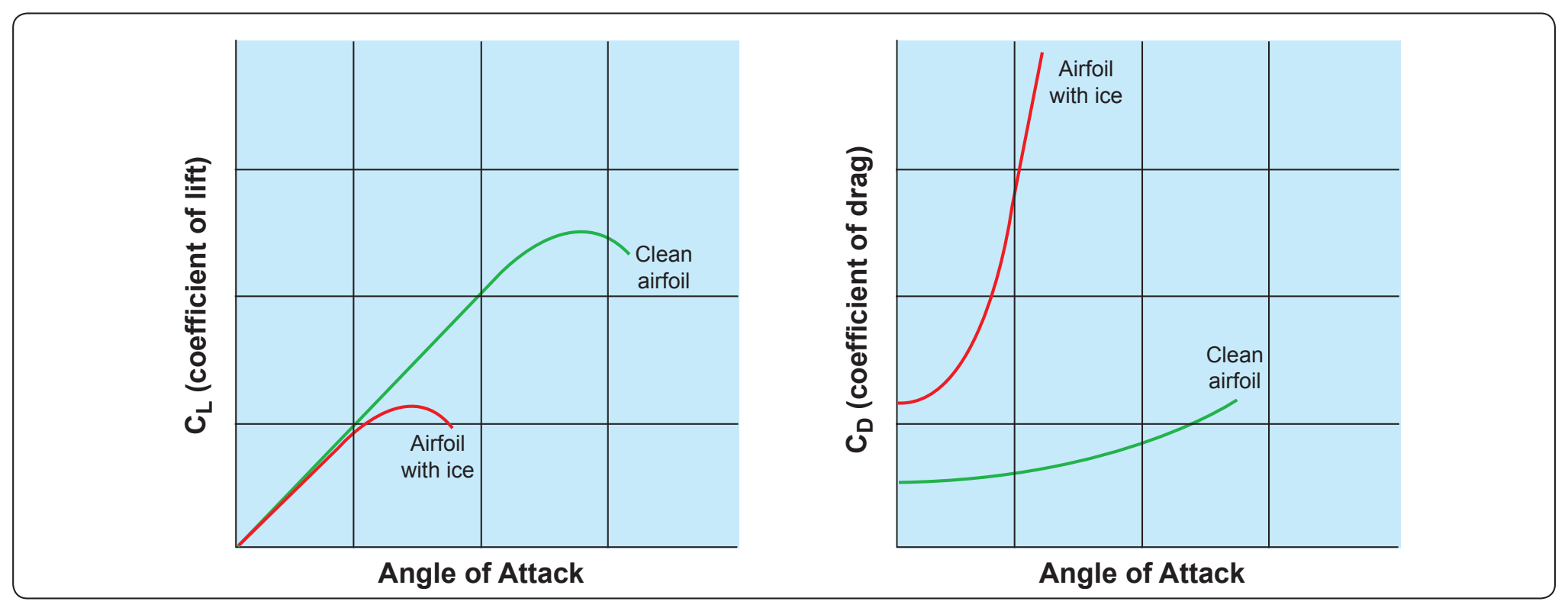
A significant reduction in CL-MAX and a reduction in the AOA where stall occurs can result from a relatively small ice accretion. A reduction of CL-MAX by 30 percent is not unusual, and a large horn ice accretion can result in reductions of 40 percent to 50 percent. Drag tends to increase steadily as ice accretes. An airfoil drag increase of 100 percent is not unusual, and for large horn ice accretions, the increase can be 200 percent or even higher.
Ice on an airfoil can have other effects not depicted in these curves. Even before airfoil stall, there can be changes in the pressure over the airfoil that may affect a control surface at the trailing edge. Furthermore, on takeoff, approach, and landing, the wings of many aircraft are multi-element airfoils with three or more elements. Ice may affect the different elements in different ways. Ice may also affect the way in which the air streams interact over the elements.
Ice can partially block or limit control surfaces, which limits or makes control movements ineffective. Also, if the extra weight caused by ice accumulation is too great, the aircraft may not be able to become airborne and, if in flight, the aircraft may not be able to maintain altitude. Therefore any accumulation of ice or frost should be removed before attempting flight.
Another hazard of structural icing is the possible uncommanded and uncontrolled roll phenomenon, referred to as roll upset, associated with severe inflight icing. Pilots flying aircraft certificated for flight in known icing conditions should be aware that severe icing is a condition outside of the aircraft’s certification icing envelope. Roll upset may be caused by airflow separation (aerodynamic stall), which induces self-deflection of the ailerons and loss of or degraded roll handling characteristics [Figure 4-21]. These phenomena can result from severe icing conditions without the usual symptoms of ice accumulation or a perceived aerodynamic stall.
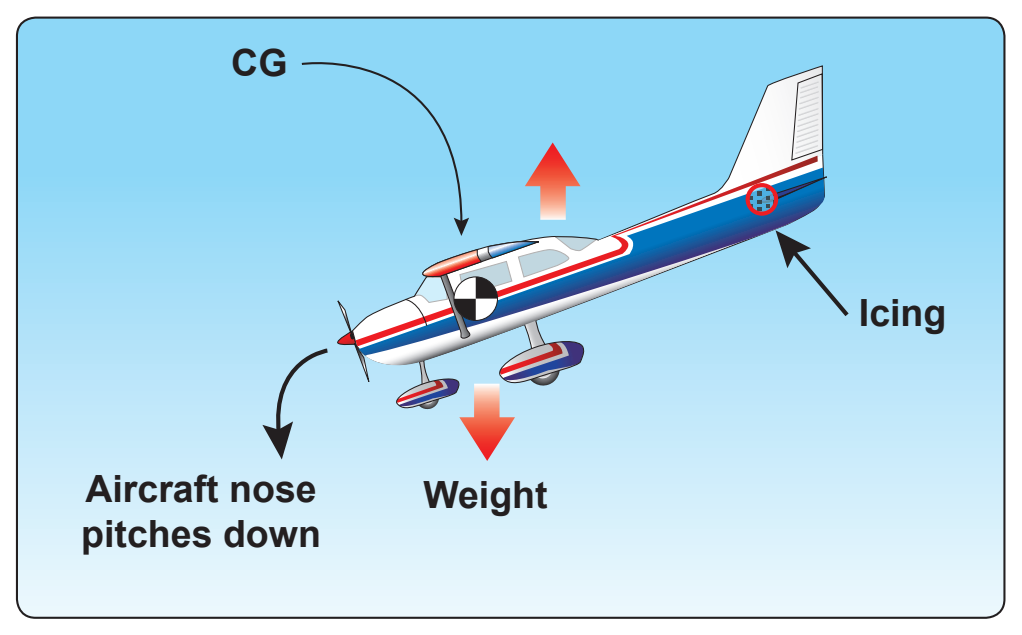
Most aircraft have a nose-down pitching moment from the wings because the CG is ahead of the CP. It is the role of the tailplane to counteract this moment by providing a downward force. [Figure 4-22] The result of this configuration is that actions which move the wing away from stall, such as deployment of flaps or increasing speed, may increase the negative AOA of the tail. With ice on the tailplane, it may stall after full or partial deployment of flaps. [Figure 4-23]
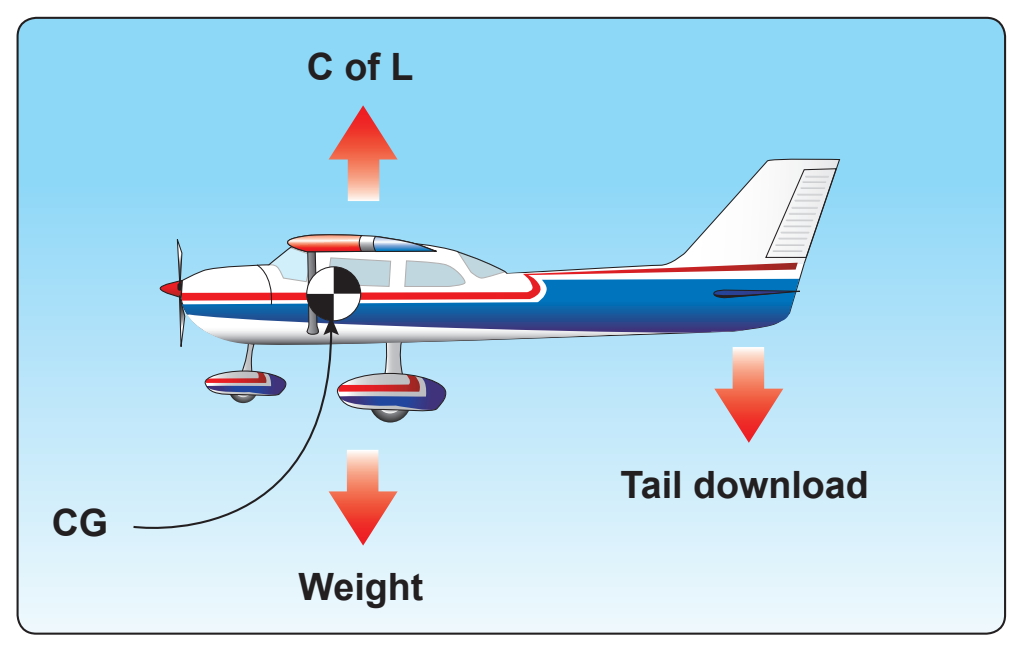
Since the tailplane is ordinarily thinner than the wing, it is a more efficient collector of ice. On most aircraft the tailplane is not visible to the pilot, who therefore cannot observe how well it has been cleared of ice by any deicing system. Thus, it is important that the pilot be alert to the possibility of tailplane stall, particularly on approach and landing.
Piper PA-34-200T (Des Moines, Iowa)
The pilot of this flight, which took place on January 9, 1996, said that upon crossing the runway threshold and lowering the flaps 25°, “the airplane pitched down.” The pilot “immediately released the flaps and added power, but the airplane was basically uncontrollable at this point.” The pilot reduced power and lowered the flaps before striking the runway on its centerline and sliding 1,000 feet before coming to a stop. The accident resulted in serious injury to the pilot, the sole occupant.
Examination of the wreckage revealed heavy impact damage to the airplane’s forward fuselage, engines, and wings. Approximately one-half inch of rime ice was observed adhering to the leading edges of the left and right horizontal stabilizers and along the leading edge of the vertical stabilizer.