Chapter 5
Flight Instruments
Some of the more complex VSIs, called instantaneous vertical speed indicators (IVSI), have two accelerometer-actuated air pumps that sense an upward or downward pitch of the aircraft and instantaneously create a pressure differential. By the time the pressure caused by the pitch acceleration dissipates, the altitude pressure change is effective.
Dynamic Pressure Type Instruments
Airspeed Indicator (ASI)
An ASI is a differential pressure gauge that measures the dynamic pressure of the air through which the aircraft is flying. Dynamic pressure is the difference in the ambient static air pressure and the total, or ram, pressure caused by the motion of the aircraft through the air. These two pressures are taken from the pitot-static system.
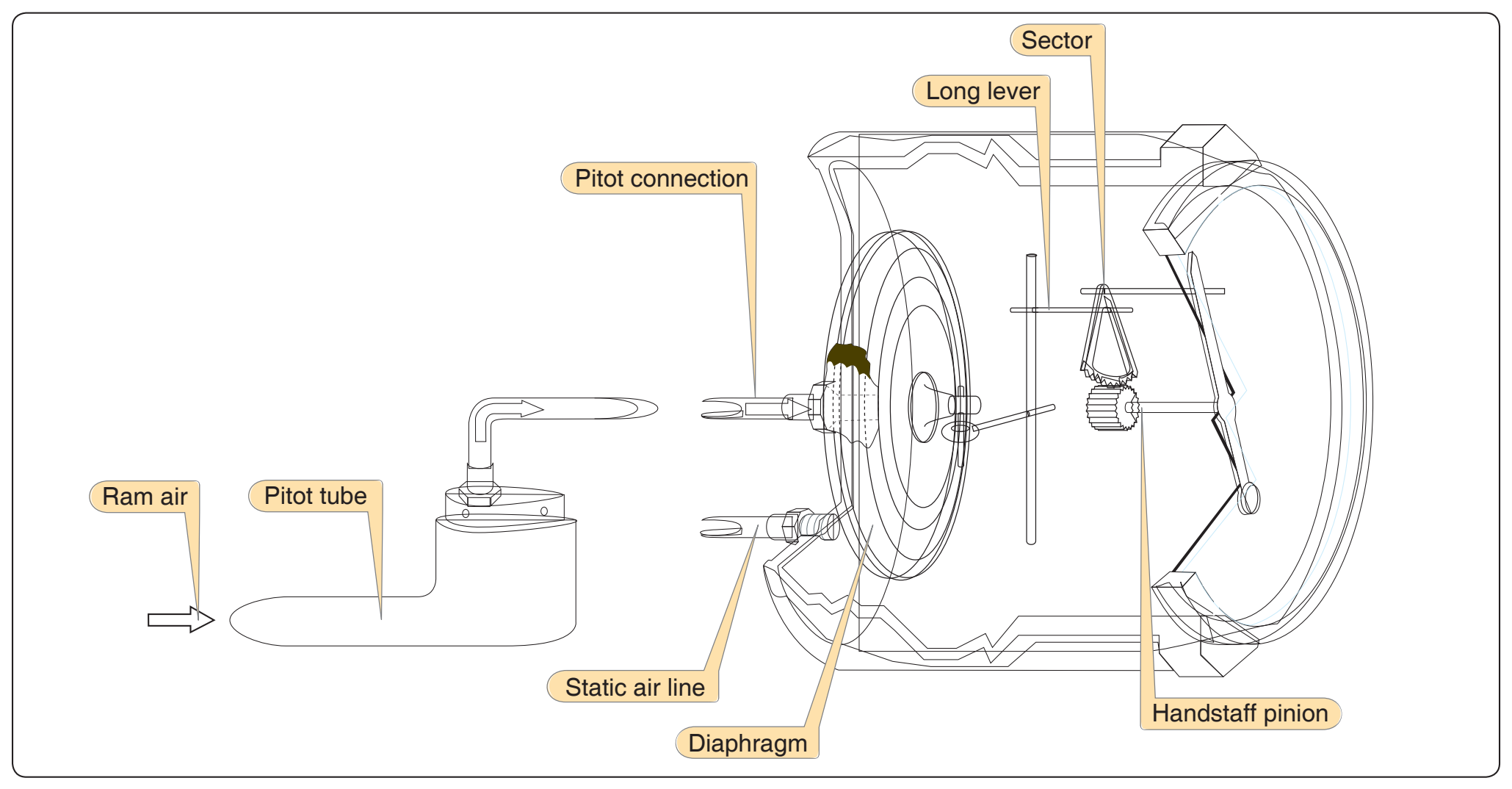
The mechanism of the ASI in Figure 5-11 consists of a thin, corrugated phosphor bronze aneroid, or diaphragm, that receives its pressure from the pitot tube. The instrument case is sealed and connected to the static ports. As the pitot pressure increases or the static pressure decreases, the diaphragm expands. This dimensional change is measured by a rocking shaft and a set of gears that drives a pointer across the instrument dial. Most ASIs are calibrated in knots, or nautical miles per hour; some instruments show statute miles per hour, and some instruments show both.
Types of Airspeed
Just as there are several types of altitude, there are multiple types of airspeed: indicated airspeed (IAS), calibrated airspeed (CAS), equivalent airspeed (EAS), and true airspeed (TAS).
Indicated Airspeed (IAS)
IAS is shown on the dial of the instrument, uncorrected for instrument or system errors.
Calibrated Airspeed (CAS)
CAS is the speed at which the aircraft is moving through the air, which is found by correcting IAS for instrument and position errors. The POH/AFM has a chart or graph to correct IAS for these errors and provide the correct CAS for the various flap and landing gear configurations.
Equivalent Airspeed (EAS)
EAS is CAS corrected for compression of the air inside the pitot tube. EAS is the same as CAS in standard atmosphere at sea level. As the airspeed and pressure altitude increase, the CAS becomes higher than it should be, and a correction for compression must be subtracted from the CAS.
True Airspeed (TAS)
TAS is CAS corrected for nonstandard pressure and temperature. TAS and CAS are the same in standard atmosphere at sea level. Under nonstandard conditions, TAS is found by applying a correction for pressure altitude and temperature to the CAS.
Some aircraft are equipped with true ASIs that have a temperature-compensated aneroid bellows inside the instrument case. This bellows modifies the movement of the rocking shaft inside the instrument case so the pointer shows the actual TAS.
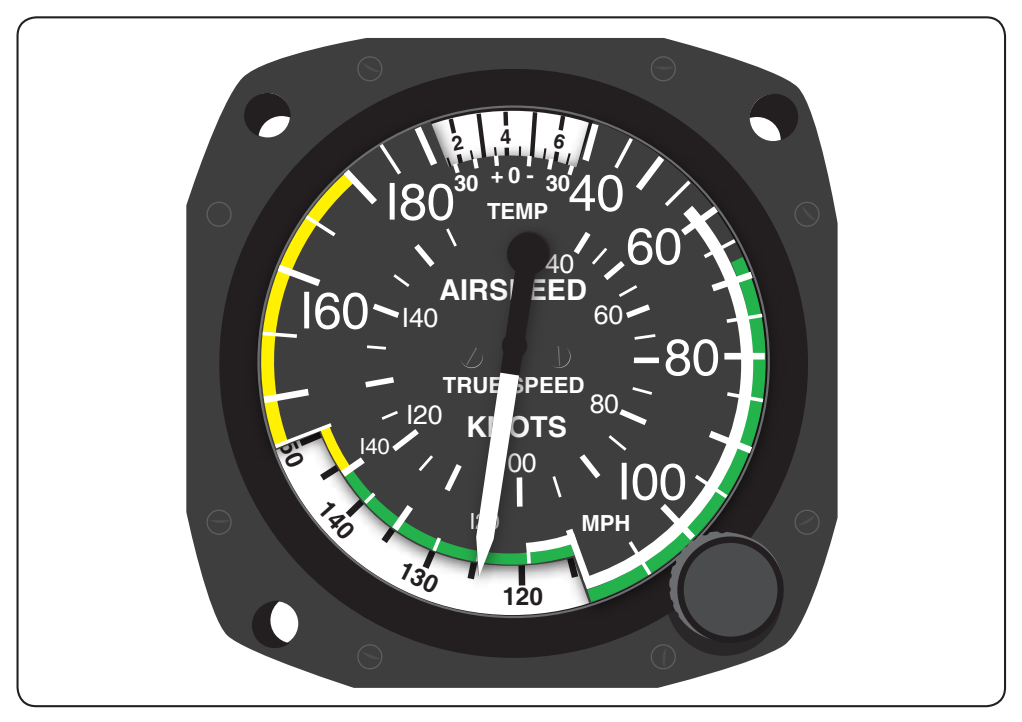
The TAS indicator provides both true and IAS. These instruments have the conventional airspeed mechanism, with an added subdial visible through cutouts in the regular dial. A knob on the instrument allows the pilot to rotate the subdial and align an indication of the outside air temperature with the pressure altitude being flown. This alignment causes the instrument pointer to indicate the TAS on the subdial. [Figure 5-12]