Chapter 6
Airplane Attitude Instrument Flying
Section I — Analog Instrumentation
Introduction
Attitude instrument flying is defined as the control of an aircraft’s spatial position by using instruments rather than outside visual references. Today’s aircraft come equipped with analog and/or digital instruments. Analog instrument systems are mechanical and operate with numbers representing directly measurable quantities, such as a watch with a sweep second hand. In contrast, digital instrument systems are electronic and operate with numbers expressed in digits. Although more manufacturers are providing aircraft with digital instrumentation, analog instruments remain more prevalent. This section acquaints the pilot with the use of analog flight instruments.
Any flight, regardless of the aircraft used or route flown, consists of basic maneuvers. In visual flight, aircraft attitude is controlled by using certain reference points on the aircraft with relation to the natural horizon. In instrument flight, the aircraft attitude is controlled by reference to the flight instruments. Proper interpretation of the flight instruments provides essentially the same information that outside references do in visual flight. Once the role of each instrument in establishing and maintaining a desired aircraft attitude is learned, a pilot is better equipped to control the aircraft in emergency situations involving failure of one or more key instruments.
Learning Methods
The two basic methods used for learning attitude instrument flying are “control and performance” and “primary and supporting.” Both methods utilize the same instruments and responses for attitude control. They differ in their reliance on the attitude indicator and interpretation of other instruments.
Attitude Instrument Flying Using the Control and Performance Method
Aircraft performance is achieved by controlling the aircraft attitude and power. Aircraft attitude is the relationship of both the aircraft’s pitch and roll axes in relation to the Earth’s horizon. An aircraft is flown in instrument flight by controlling the attitude and power, as necessary, to produce both controlled and stabilized flight without reference to a visible horizon. This overall process is known as the control and performance method of attitude instrument flying. Starting with basic instrument maneuvers, this process can be applied through the use of control, performance, and navigation instruments resulting in a smooth flight from takeoff to landing.
Control Instruments
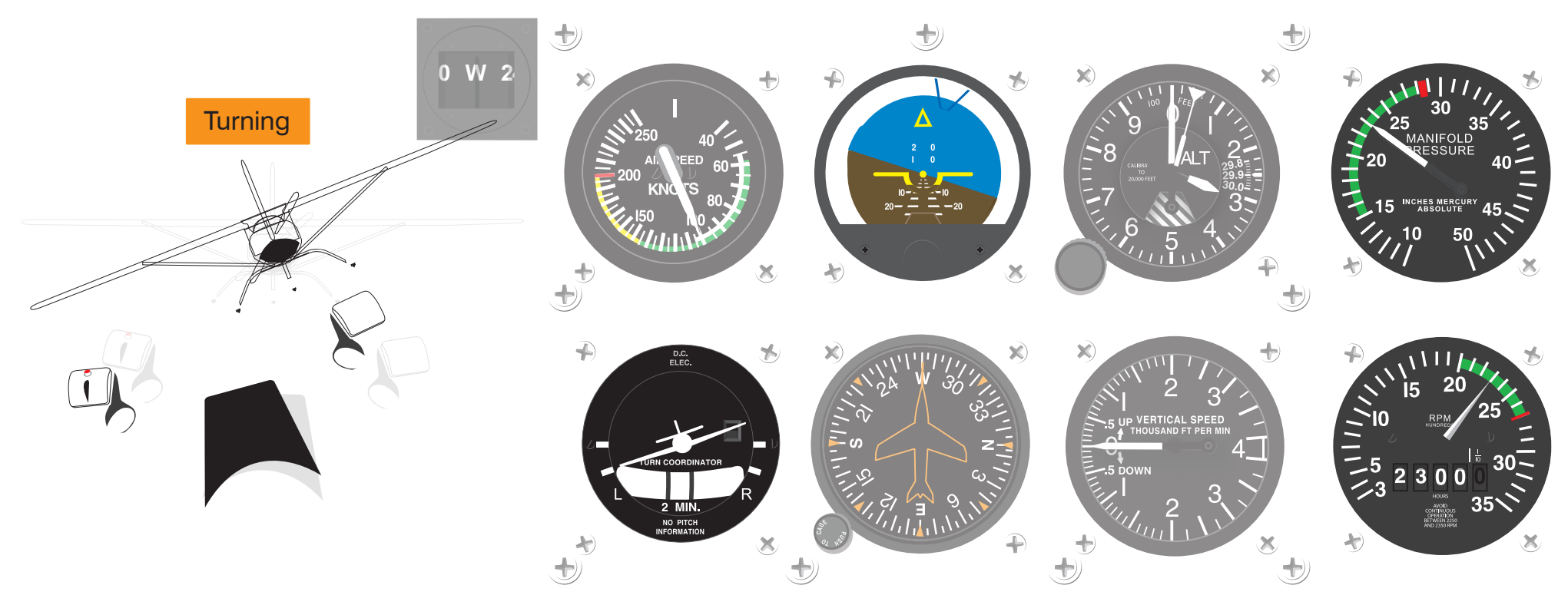
The control instruments display immediate attitude and power indications and are calibrated to permit those respective adjustments in precise increments. In this discussion, the term “power” is used in place of the more technically correct term “thrust or drag relationship.” Control is determined by reference to the attitude and power indicators. Power indicators vary with aircraft and may include manifold pressure, tachometers, fuel flow, etc. [Figure 6-1]
Performance Instruments
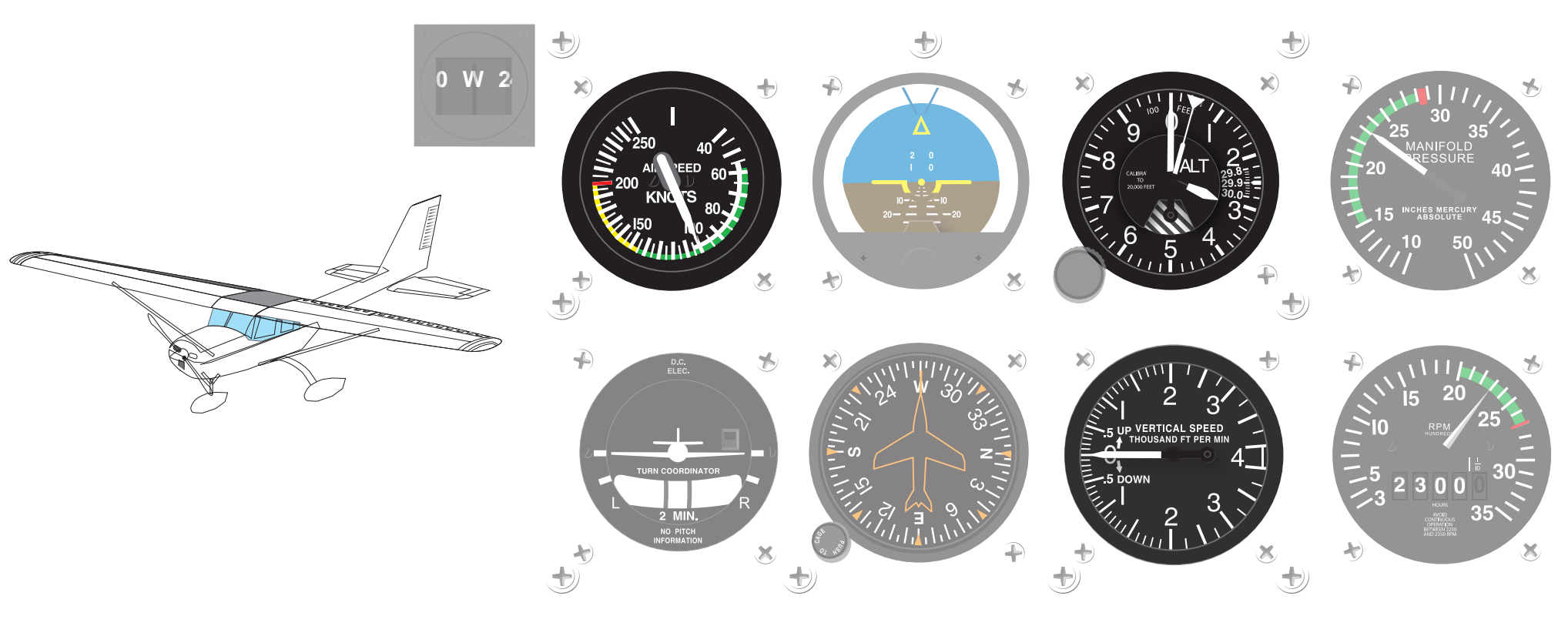
The performance instruments indicate the aircraft’s actual performance. Performance is determined by reference to the altimeter, airspeed, or vertical speed indicator (VSI). [Figure 6-2]
Navigation Instruments
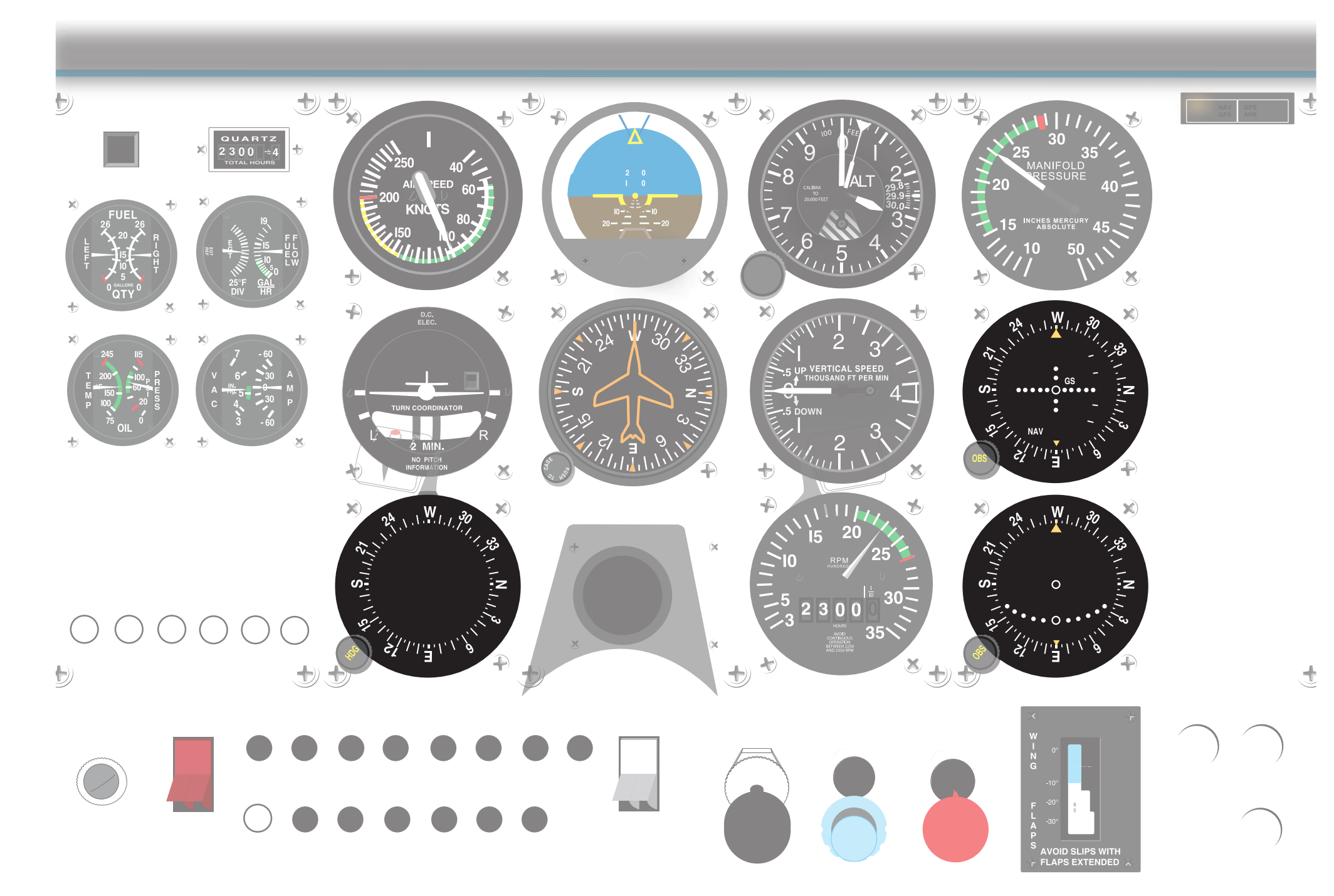
The navigation instruments indicate the position of the aircraft in relation to a selected navigation facility or fix. This group of instruments includes various types of course indicators, range indicators, glideslope indicators, and bearing pointers. [Figure 6-3] Newer aircraft with more technologically advanced instrumentation provide blended information, giving the pilot more accurate positional information.
Procedural Steps in Using Control and Performance
- Establish an attitude and power setting on the control instruments that results in the desired performance. Known or computed attitude changes and approximated power settings helps to reduce the pilot’s workload.
- Trim (fine tune the control forces) until control pressures are neutralized. Trimming for hands-off flight is essential for smooth, precise aircraft control.