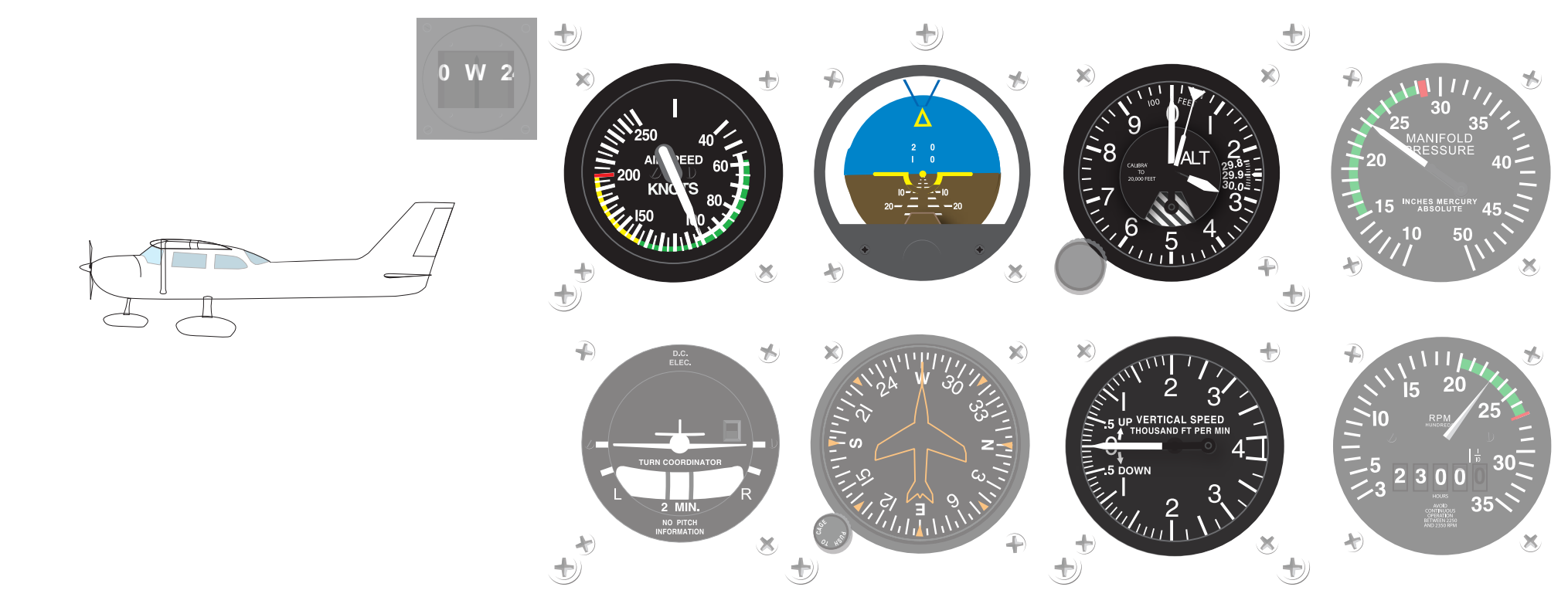
Chapter 6
Airplane Attitude Instrument Flying
It allows a pilot to attend to other flight deck duties with minimum deviation from the desired attitude.
- Cross-check the performance instruments to determine if the established attitude or power setting is providing the desired performance. The cross-check involves both seeing and interpreting. If a deviation is noted, determine the magnitude and direction of adjustment required to achieve the desired performance.
- Adjust the attitude and/or power setting on the control instruments as necessary.
Aircraft Control During Instrument Flight
Attitude Control
Proper control of aircraft attitude is the result of proper use of the attitude indicator, knowledge of when to change the attitude, and then smoothly changing the attitude a precise amount. The attitude reference provides an immediate, direct, and corresponding indication of any change in aircraft pitch or bank attitude.
Pitch Control
Changing the “pitch attitude” of the miniature aircraft or fuselage dot by precise amounts in relation to the horizon makes pitch changes. These changes are measured in degrees, or fractions thereof, or bar widths depending upon the type of attitude reference. The amount of deviation from the desired performance determines the magnitude of the correction.
Bank Control
Bank changes are made by changing the “bank attitude” or bank pointers by precise amounts in relation to the bank scale. The bank scale is normally graduated at 0°, 10°, 20°, 30°, 60°, and 90° and is located at the top or bottom of the attitude reference. Bank angle use normally approximates the degrees to turn, not to exceed 30°.
Power Control
Proper power control results from the ability to smoothly establish or maintain desired airspeeds in coordination with attitude changes. Power changes are made by throttle adjustments and reference to the power indicators. Power indicators are not affected by such factors as turbulence, improper trim, or inadvertent control pressures. Therefore, in most aircraft little attention is required to ensure the power setting remains constant.
Experience in an aircraft teaches a pilot approximately how far to move the throttle to change the power a given amount. Power changes are made primarily by throttle movement, followed by an indicator cross-check to establish a more precise setting. The key is to avoid fixating on the indicators while setting the power. Knowledge of approximate power settings for various flight configurations helps the pilot avoid overcontrolling power.
Attitude Instrument Flying Using the Primary and Supporting Method
Another basic method for teaching attitude instrument flying classifies the instruments as they relate to control function, as well as aircraft performance. All maneuvers involve some degree of motion about the lateral (pitch), longitudinal (bank/roll), and vertical (yaw) axes. Attitude control is stressed in this handbook in terms of pitch control, bank control, power control, and trim control. Instruments are grouped as they relate to control function and aircraft performance as pitch control, bank control, power control, and trim.
Pitch Control
Pitch control is controlling the rotation of the aircraft about the lateral axis by movement of the elevators. After interpreting the pitch attitude from the proper flight instruments, exert control pressures to effect the desired pitch attitude with reference to the horizon. These instruments include the attitude indicator, altimeter, VSI, and airspeed indicator. [Figure 6-4] The attitude indicator displays a direct indication of the aircraft’s pitch attitude while the other pitch attitude control instruments indirectly indicate the pitch attitude of the aircraft.
Attitude Indicator
The pitch attitude control of an aircraft controls the angular relationship between the longitudinal axis of the aircraft and the actual horizon. The attitude indicator gives a direct and immediate indication of the pitch attitude of the aircraft. The aircraft controls are used to position the miniature aircraft in relation to the horizon bar or horizon line for any pitch attitude required. [Figure 6-5] The miniature aircraft should be placed in the proper position in relation to the horizon bar or horizon line before takeoff. The aircraft operator’s manual explains this position. As soon as practicable in level flight and at desired cruise airspeed, the miniature aircraft should be moved to a position that aligns its wings in front of the horizon bar or horizon line. This adjustment can be made any time varying loads or other conditions indicate a need. Otherwise, the position of the miniature aircraft should not be changed for flight at other than cruise speed. This is to make sure that the attitude indicator displays a true picture of pitch attitude in all maneuvers.