
Chapter 8
Helicopter Attitude Instrument Flying
30° Bank Turn
A turn using 30° of bank is seldom necessary or advisable in instrument meteorological conditions (IMC) and is considered an unusual attitude in a helicopter. However, it is an excellent maneuver to practice to increase the ability to react quickly and smoothly to rapid changes of attitude. Even though the entry and recovery techniques are the same as for any other turn, it is more difficult to control pitch because of the decrease in vertical lift as the bank increases. Also, because of the decrease in vertical lift, there is a tendency to lose altitude and/or airspeed. Therefore, to maintain a constant altitude and airspeed, additional power is required. Do not initiate a correction, however, until the instruments indicate the need for one. During the maneuver, note the need for a correction on the altimeter and VSI, check the attitude indicator, and then make the necessary adjustments. After making a change, check the altimeter and VSI again to determine whether or not the correction was adequate.
Climbing and Descending Turns
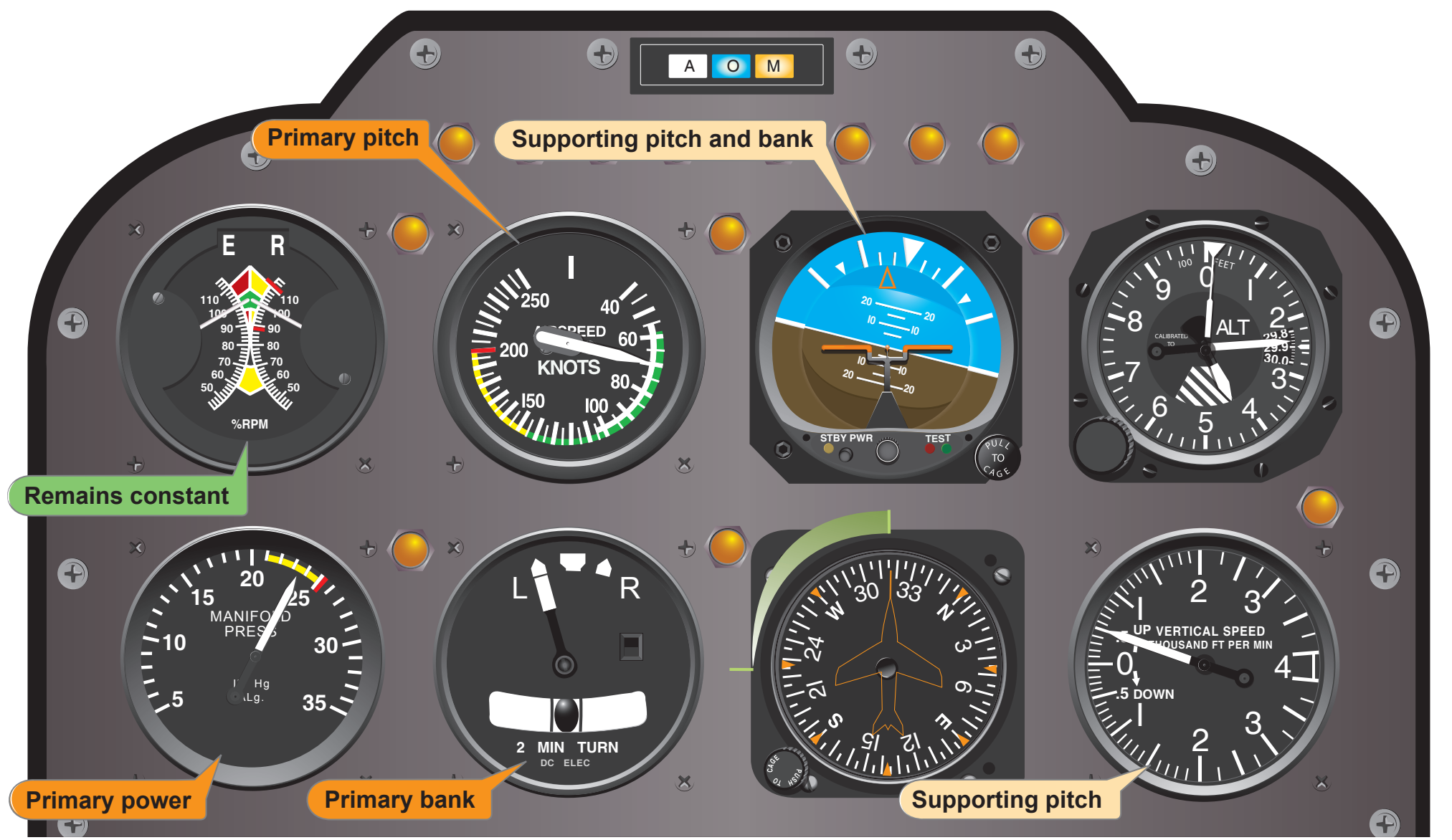
For climbing and descending turns, the techniques described previously for straight climbs, descents, and standard rate turns are combined. For practice, simultaneously turn and start the climb or descent. The primary and supporting instruments for a stabilized constant airspeed left climbing turn are illustrated in Figure 8-15. The level off from a climbing or descending turn is the same as the level off from a straight climb or descent. To return to straight-and-level flight, stop the turn and then level off, or level off and then stop the turn, or simultaneously level off and stop the turn. During climbing and descending turns, keep the ball of the turn indicator centered with pedal trim.
Common Errors During Turns
- Failure to maintain desired turn rate
- Failure to maintain altitude in level turns
- Failure to maintain desired airspeed
- Variation in the rate of entry and recovery
- Failure to use proper lead in turns to a heading
- Failure to properly compute time during timed turns
- Failure to use proper leads and lags during the compass turns
- Improper use of power
- Failure to use proper pedal trim
Unusual Attitudes
Any maneuver not required for normal helicopter instrument flight is an unusual attitude and may be caused by any one or combination of factors, such as turbulence, disorientation, instrument failure, confusion, preoccupation with flight deck duties, carelessness in cross-checking, errors in instrument interpretation, or lack of proficiency in aircraft control. Due to the instability characteristics of the helicopter, unusual attitudes can be extremely critical. As soon as an unusual attitude is detected, make a recovery to straight-and-level flight as soon as possible with a minimum loss of altitude.
To recover from an unusual attitude, a pilot should correct bank-and-pitch attitude and adjust power as necessary. All components are changed almost simultaneously, with little lead of one over the other. A pilot must be able to perform this task with and without the attitude indicator. If the helicopter is in a climbing or descending turn, adjust bank, pitch, and power. The bank attitude should be corrected by referring to the turn-and-slip indicator and attitude indicator. Pitch attitude should be corrected by reference to the altimeter, airspeed indicator, VSI, and attitude indicator. Adjust power by referring to the airspeed indicator and manifold pressure.
Since the displacement of the controls used in recovery from unusual attitudes may be greater than those used for normal flight, make careful adjustments as straight-and-level flight is approached. Cross-check the other instruments closely to avoid overcontrolling.
Common Errors During Unusual Attitude Recoveries
- Failure to make proper pitch correction
- Failure to make proper bank correction
- Failure to make proper power correction
- Overcontrolling pitch and/or bank attitude
- Overcontrolling power
- Excessive loss of altitude
Emergencies
Emergencies during instrument flight are handled similarly to those occurring during VFR flight. A thorough knowledge of the helicopter and its systems, as well as good aeronautical knowledge and judgment, is the best preparation for emergency situations. Safe operations begin with preflight planning and a thorough preflight inspection. Plan a route of flight to include adequate landing sites in the event of an emergency landing. Make sure all resources, such as maps, publications, flashlights, and fire extinguishers, are readily available for use in an emergency.
During any emergency, first fly the aircraft. This means ensure the helicopter is under control, and determine emergency landing sites. Then perform the emergency checklist memory items, followed by items written in the rotorcraft flight manual (RFM). When all these items are under control, notify air traffic control (ATC). Declare any emergency on the last assigned ATC frequency. If one was not issued, transmit on the emergency frequency 121.5. Set the transponder to the emergency squawk code 7700. This code triggers an alarm or special indicator in radar facilities.
When experiencing most in-flight emergencies, such as low fuel or complete electrical failure, land as soon as possible. In the event of an electrical fire, turn off all nonessential equipment and land immediately. Some essential electrical instruments, such as the attitude indicator, may be required for a safe landing. A navigation radio failure may not require an immediate landing if the flight can continue safely. In this case, land as soon as practical. ATC may be able to provide vectors to a safe landing area. For specific details on what to do during an emergency, refer to the RFM for the helicopter.
Autorotations
Both straight-ahead and turning autorotations should be practiced by reference to instruments. This training ensures prompt corrective action to maintain positive aircraft control in the event of an engine failure.
To enter autorotation, reduce collective pitch smoothly to maintain a safe rotor RPM and apply pedal trim to keep the ball of the turn-and-slip indicator centered. The pitch attitude of the helicopter should be approximately level as shown by the attitude indicator. The airspeed indicator is the primary pitch instrument and should be adjusted to the recommended autorotation speed. The heading indicator is primary for bank in a straight-ahead autorotation. In a turning autorotation, a standard rate turn should be maintained by reference to the needle of the turn-and-slip indicator.