
Chapter 2
En Route Operations
Flights in a Radar Environment
When informed by ATC that their aircraft are in “Radar Contact,” pilots should discontinue position reports over designated reporting points. They should resume normal position reporting when ATC advises “radar contact lost” or “radar service terminated.” ATC informs pilots that they are in radar contact:
- When their aircraft is initially identified in the ATC system; and
- When radar identification is reestablished after radar service has been terminated or radar contact lost.
Subsequent to being advised that the controller has established radar contact, this fact is not repeated to the pilot when handed off to another controller. At times, the aircraft identity is confirmed by the receiving controller; however, this should not be construed to mean that radar contact has been lost. The identity of transponder equipped aircraft is confirmed by asking the pilot to “ident,” “squawk standby,” or to change codes. Aircraft without transponders are advised of their position to confirm identity. In this case, the pilot is expected to advise the controller if in disagreement with the position given. Any pilot who cannot confirm the accuracy of the position given because of not being tuned to the NAVAID referenced by the controller should ask for another radar position relative to the tuned in NAVAID.
Position Report Items
Position reports should include the following items:
- Aircraft identification
- Position
- Time
- Altitude or flight level (include actual altitude or flight level when operating on a clearance specifying VFR-on-top)
- Type of flight plan (not required in IFR position reports made directly to ARTCCs or approach control)
- ETA and name of next reporting point
- The name only of the next succeeding reporting point along the route of flight
- Pertinent remarks
Additional Reports
The following reports should be made at all times to ATC or Flight Service facilities without a specific ATC request:
- When vacating any previously assigned altitude or flight level for a newly assigned altitude or flight level.
- When an altitude change is made if operating on a clearance specifying VFR-on-top.
- When unable to climb/descend at a rate of a least 500 feet per minute (fpm).
- When approach has been missed. (Request clearance for specific action (i.e., to alternative airport, another approach).
- Change in the average true airspeed (at cruising altitude) when it varies by 5 percent or 10 knots (whichever is greater) from that filed in the flight plan.
- The time and altitude or flight level upon reaching a holding fix or point to which cleared.
- When leaving any assigned holding fix or point. Note: The reports stated in subparagraphs 6 and 7 may be omitted by pilots of aircraft involved in instrument training at military terminal area facilities when radar service is being provided.
- Any loss, in controlled airspace, of VOR, TACAN, ADF, low frequency navigation receiver capability, GPS anomalies while using installed IFR-certified GPS/GNSS receivers, complete or partial loss of ILS receiver capability or impairment of air/ground communications capability. Reports should include aircraft identification, equipment affected, degree to which the capability to operate under IFR in the ATC system is impaired, and the nature and extent of assistance desired from ATC.
- Any information relating to the safety of flight.
Other equipment installed in an aircraft may impair your ability to safely operate under IFR. If a malfunction of such equipment (e.g., weather radar) affects any safety or IFR capability, reports should be made as stated above. When reporting GPS anomalies, be very specific and include the location, altitude, and duration of the anomaly. Deliberate GPS interference or outage areas resulting from pre-approved government tests will be disseminated in NOTAMs. These outages should not be reported to ATC, as this condition is known and not an anomaly. See also AIM 1-1-13.
Communication Failure
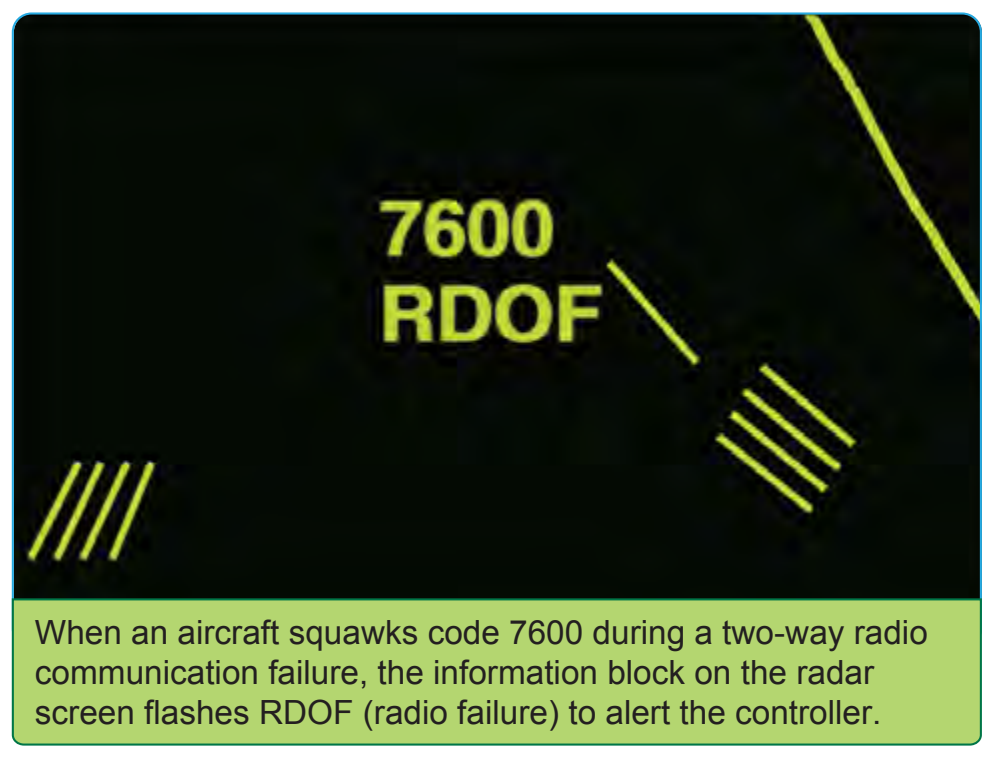
Two-way radio communication failure procedures for IFR operations are outlined in 14 CFR Part 91, § 91.185. Unless otherwise authorized by ATC, pilots operating under IFR are expected to comply with this regulation. Expanded procedures for communication failures are found in the Aeronautical Information Manual (AIM). Pilots can use the transponder to alert ATC to a radio communication failure by squawking code 7600. [Figure 2-69] If only the transmitter is inoperative, listen for ATC instructions on any operational receiver, including the navigation receivers. It is possible ATC may try to make contact with pilots over a VOR, VORTAC, NDB, or localizer frequency. In addition to monitoring NAVAID receivers, attempt to reestablish communications by contacting ATC on a previously assigned frequency or calling an FSS.
The primary objective of the regulations governing communication failures is to preclude extended IFR no-radio operations within the ATC system since these operations may adversely affect other users of the airspace. If the radio fails while operating on an IFR clearance, but in VFR conditions, or if encountering VFR conditions at any time after the failure, continue the flight under VFR conditions, if possible, and land as soon as practicable. The requirement to land as soon as practicable should not be construed to mean as soon as possible. Pilots retain the prerogative of exercising their best judgment and are not required to land at an unauthorized airport, at an airport unsuitable for the type of aircraft flown, or to land only minutes short of their intended destination. However, if IFR conditions prevail, pilots must comply with procedures designated in the CFRs to ensure aircraft separation. If pilots must continue their flight under IFR after experiencing two-way radio communication failure, they should fly one of the following routes:
- The route assigned by ATC in the last clearance received.
- If being radar vectored, the direct route from the point of radio failure to the fix, route, or airway specified in the radar vector clearance.
- In the absence of an assigned route, the route ATC has advised to expect in a further clearance.
- In the absence of an assigned or expected route, the route filed in the flight plan.
It is also important to fly a specific altitude should two-way radio communications be lost. The altitude to fly after a communication failure can be found in 14 CFR Part 91, § 91.185 and must be the highest of the following altitudes for each route segment flown.
- The altitude or flight level assigned in the last ATC clearance.
- The minimum altitude or flight level for IFR operations.
- The altitude or flight level ATC has advised to expect in a further clearance.
In some cases, the assigned or expected altitude may not be as high as the MEA on the next route segment. In this situation, pilots normally begin a climb to the higher MEA when they reach the fix where the MEA rises. If the fix also has a published MCA, they start the climb so they are at or above the MCA when reaching the fix. If the next succeeding route segment has a lower MEA, descend to the applicable altitude either the last assigned altitude or the altitude expected in a further clearance—when reaching the fix where the MEA decreases.