
Chapter 2
En Route Operations
ARTCC Radio Frequency Outage
ARTCCs normally have at least one back-up radio receiver and transmitter system for each frequency that can usually be placed into service quickly with little or no disruption of ATC service. Occasionally, technical problems may cause a delay but switchover seldom takes more than 60 seconds. When it appears that the outage is not quickly remedied, the ARTCC usually requests a nearby aircraft, if there is one, to switch to the affected frequency to broadcast communications instructions. It is important that the pilot wait at least one minute before deciding that the ARTCC has actually experienced a radio frequency failure. When such an outage does occur, the pilot should, if workload and equipment capability permit, maintain a listening watch on the affected frequency while attempting to comply with the following recommended communications procedures:
- If two-way communications cannot be established with the ARTCC after changing frequencies, a pilot should attempt to re-contact the transferring controller for the assignment of an alternative frequency or other instructions.
- When an ARTCC radio frequency failure occurs after two-way communications have been established, the pilot should attempt to reestablish contact with the center on any other known ARTCC frequency, preferably that of the next responsible sector when practicable, and ask for instructions. However, when the next normal frequency change along the route is known to involve another ATC facility, the pilot should contact that facility, if feasible, for instructions. If communications cannot be reestablished by either method, the pilot is expected to request communication instructions from the FSS appropriate to the route of flight.
Climbing and Descending En Route
When ATC issues a clearance or instruction, pilots are expected to execute its provisions upon receipt. In some cases, ATC includes words that modify their expectation. For example, the word “immediately” in a clearance or instruction is used to impress urgency to avoid an imminent situation, and expeditious compliance is expected and necessary for safety. The addition of a climb point or time restriction, for example, does not authorize pilots to deviate from the route of flight or any other provision of the ATC clearance. If the pilot receives the term “climb at pilot’s discretion” in the altitude information of an ATC clearance, it means that the pilot has the option to start a climb when they desire and are authorized to climb at any rate, and to temporarily level off at any intermediate altitude as desired, although once you vacate an altitude, you may not return to that altitude. When ATC has not used the term nor imposed any climb restrictions, pilots should climb promptly on acknowledgment of the clearance. Climb at an optimum rate consistent with the operating characteristics of the aircraft to 1,000 feet below the assigned altitude, and then attempt to climb at a rate of between 500 and 1,500 fpm until the assigned altitude is reached. If at any time the pilot is unable to climb at a rate of at least 500 fpm, advise ATC. If it is necessary to level off at an intermediate altitude during climb, advise ATC.
When ATC issues the instruction, “Expedite climb,” this normally indicates that the pilot should use the approximate best rate of climb without an exceptional change in aircraft handling characteristics. Normally controllers inform pilots of the reason for an instruction to expedite. If flying a turbojet aircraft equipped with afterburner engines, such as a military aircraft, pilots should advise ATC prior to takeoff if intending to use afterburning during the climb to the en route altitude. Often, the controller may be able to plan traffic to accommodate a high performance climb and allow the pilot to climb to the planned altitude without “expedite” clearance from restriction. If you receive an ATC instruction, and your altitude to maintain is subsequently changed or restated without an expedite instruction, the expedite instruction is canceled.
During en route climb, as in any other phase of flight, it is essential that you clearly communicate with ATC regarding clearances. In the following example, a flight crew experienced an apparent clearance readback/hearback error, that resulted in confusion about the clearance and, ultimately, to inadequate separation from another aircraft. “Departing IFR, clearance was to maintain 5,000 feet, expect 12,000 in 10 minutes.” After handoff to Center, the pilot understood and read back, “Leaving 5,000 turn left heading 240° for vector on course.” The pilot turned to the assigned heading climbing through 5,000 feet. At 5,300 feet, Center advised assigned altitude was 5,000 feet. The pilot immediately descended to 5,000. Center then informed the pilot that there was traffic at 12 o’clock and a mile at 6,000. After passing traffic, a higher altitude was assigned and climb resumed. The pilot then believed the clearance was probably "reaching" 5,000, etc. Even the readback to the controller with "leaving" did not catch the different wording. “Reaching” and “leaving” are commonly used ATC terms having different usages. They may be used in clearances involving climbs, descents, turns, or speed changes. In the flight deck, the words “reaching” and “leaving” sound much alike.
For altitude awareness during climb, pilots often call out altitudes on the flight deck. The pilot monitoring may call 2,000 and 1,000 feet prior to reaching an assigned altitude. The callout may be, “two” climbing through the transit to go altitude (QNH), both pilots set their altimeters to 29.92 inches of mercury and announce “2992 inches” (or ‘standard,’ on some aircraft) and the flight level passing. For example, “2992 inches” (standard), flight level one eight zero. The second officer on three pilot crews may ensure that both pilots have inserted the proper altimeter setting. On international flights, pilots must be prepared to differentiate, if necessary, between barometric pressure equivalents with inches of mercury, and millibars or hectopascals, to eliminate any potential for error. For example, 996 millibars erroneously being set as 2996.
For a typical IFR flight, the majority of in-flight time often is flown in level flight at cruising altitude from top of climb (TOC) to top of descent (TOD). Generally, TOD is used in airplanes with a FMS and represents the point at which descent is first initiated from cruise altitude. FMS also assist in level flight by cruising at the most fuel saving speed, providing continuing guidance along the flight plan route including great circle direct routes, and continuous evaluation and prediction of fuel consumption along with changing clearance data.
Aircraft Speed and Altitude
During the en route descent phase of flight, an additional benefit a FMS is that it provides fuel saving idle thrust descent to your destination airport. This allows an uninterrupted profile descent from level cruising altitude to an appropriate MIA, except where level flight is required for speed adjustment. Controllers anticipate and plan that the pilot may level off at 10,000 feet MSL on descent to comply with the 14 CFR Part 91 indicated airspeed limit of 250 knots. Leveling off at any other time on descent may seriously affect air traffic handling by ATC. It is imperative that pilots make every effort to fulfill ATC expected actions on descent to aid in safely handling and expediting air traffic.
ATC issues speed adjustments if the flight is being radar controlled to achieve or maintain required or desired spacing. They express speed adjustments in terms of knots based on indicated airspeed in 10 knot increments except that at or above FL 240 speeds may be expressed in terms of Mach numbers in 0.01 increments. The use of Mach numbers by ATC is restricted to turbojets. If complying with speed adjustments, pilots are expected to maintain that speed within plus or minus 10 knots or 0.02 Mach.
Speed and altitude restrictions in clearances are subject to misinterpretation, as evidenced in this case where a corporate flight crew treated instructions in a published procedure as a clearance. The aircraft was at FL 310 and had already programmed the ‘expect-crossing altitude’ of 17,000 feet at the VOR. When the altitude alerter sounded, the pilot advised Center that we were leaving FL 310. ATC acknowledged with a “Roger.” At FL 270, Center questioned the pilot about the aircrafts descent. The pilot told the controller that the reason for the descent was to cross the VOR at 17,000 feet. ATC advised the pilot that he did not have clearance to descend. What the pilot thought was a clearance was in fact an “expect” clearance. Whenever pilots are in doubt about a clearance it is imperative they request clarity from ATC. Also, the term “Roger” only means that ATC received the transmission, not that they understood the transmission. “Expect” altitudes are published for planning purposes and are not considered crossing restrictions until verbally issued by ATC.
En Route Holding Procedures
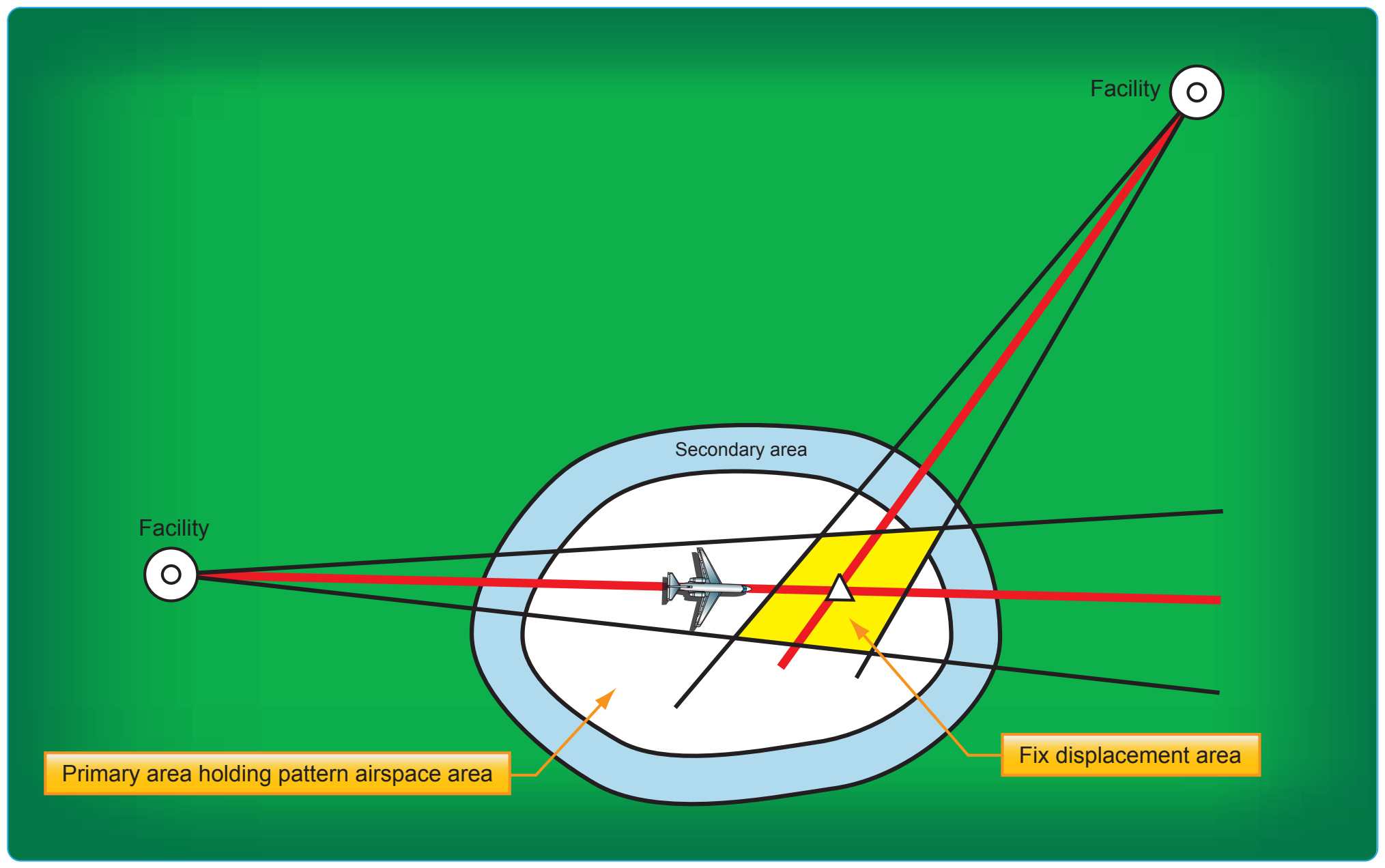
The criteria for holding pattern airspace is developed both to provide separation of aircraft, as well as obstacle clearance. The alignment of holding patterns typically coincides with the flight course you fly after leaving the holding fix. For level holding, a minimum of 1,000 feet obstacle clearance is provided throughout the primary area. In the secondary area, 500 feet of obstacle clearance is provided at the inner edge, tapering to zero feet at the outer edge. Allowance for precipitous terrain is considered, and the altitudes selected for obstacle clearance may be rounded to the nearest 100 feet. When criteria for a climb in hold are applied, no obstacle penetrates the holding surface. [Figure 2-70]