
Chapter 4
Approaches
The training, procedures, and system requirements for SOIA ILS/PRM and LDA/PRM approaches are identical with those used for simultaneous close parallel ILS/PRM approaches until near the LDA/PRM approach MAP, where visual acquisition of the ILS aircraft by the LDA aircraft must be accomplished. If visual acquisition is not accomplished prior to reaching the LDA MAP, a missed approach must be executed. A visual segment for the LDA/PRM approach is established between the LDA MAP and the runway threshold. Aircraft transition in visual conditions from the LDA course, beginning at the LDA MAP, to align with the runway and can be stabilized by 500 feet AGL on the extended runway centerline. Pilots are reminded that they are responsible for collision avoidance and wake turbulence mitigation between the LDA MAP and the runway.
The FAA website has additional information about PRM and SOIA approaches, including an instructional PowerPoint training presentation at [http://www.faa.gov/training_](https://www.faa.gov/training_testing/training/prm/) testing/training/prm/. ([source link](https://www.faa.gov/training_testing/training/prm/))
Converging ILS Approaches
Another method by which ILS approach capacity can be increased is through the use of converging approaches. Converging approaches may be established at airports that have runways with an angle between 15° and 100° and each runway must have an ILS. Additionally, separate procedures must be established for each approach, and each approach must have a MAP at least 3 NM apart with no overlapping of the protected missed approach airspace. Only straight-in approaches are approved for converging ILS procedures. If the runways intersect, the controller must be able to visually separate intersecting runway traffic.
Approaches to intersecting runways generally have higher minimums, commonly with 600-foot ceiling and 1 1/4 to 2 mile visibility requirements. Pilots are informed of the use of converging ILS approaches by the controller upon initial contact or through ATIS. [Figure 4-50]
Dallas/Fort Worth International airport is one of the few airports that makes use of converging ILS approaches because its runway configuration has multiple parallel runways and two offset runways. [Figure 4-51] The approach chart title indicates the use of converging approaches and the notes section highlights other runways that are authorized for converging approach procedures. Note the slight different in charting titles on the IAPs. Soon all Converging ILS procedures will be charted in the newer format shown in Figure 4-50, with the use of "V" in the title, and "CONVERGING" in parenthesis.
VOR Approach
The VOR is one of the most widely used non-precision approach types in the NAS. VOR approaches use VOR facilities both on and off the airport to establish approaches and include the use of a wide variety of equipment, such as DME and TACAN. Due to the wide variety of options included in a VOR approach, TERPS outlines design criteria for both on and off airport VOR facilities, as well as VOR approaches with and without a FAF. Despite the various configurations, all VOR approaches are non-precision approaches, require the presence of properly operating VOR equipment, and can provide MDAs as low as 250 feet above the runway. VOR also offers a flexible advantage in that an approach can be made toward or away from the navigational facility.
The VOR approach into Fort Rucker, Alabama, is an example of a VOR approach where the VOR facility is on the airport and there is no specified FAF. [Figure 4-52] For a straight-in approach, the final approach course is typically aligned to intersect the extended runway centerline 3,000 feet from the runway threshold, and the angle of convergence between the two does not exceed 30°. This type of VOR approach also includes a minimum of 300 feet of obstacle clearance in the final approach area. The final approach area criteria include a 2 NM wide primary area at the facility that expands to 6 NM wide at a distance of 10 NM from the facility. Additional approach criteria are established for courses that require a high altitude teardrop approach penetration.
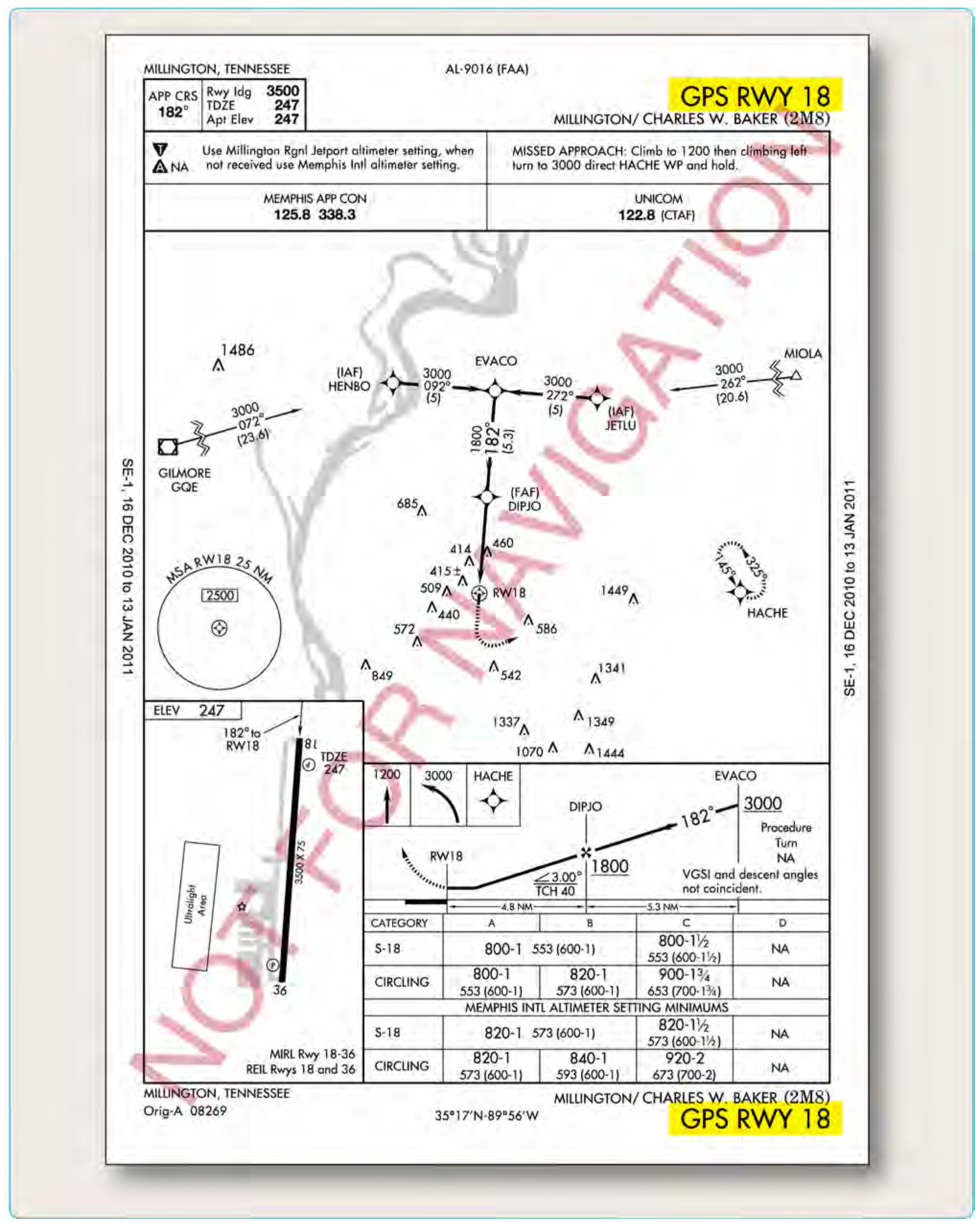
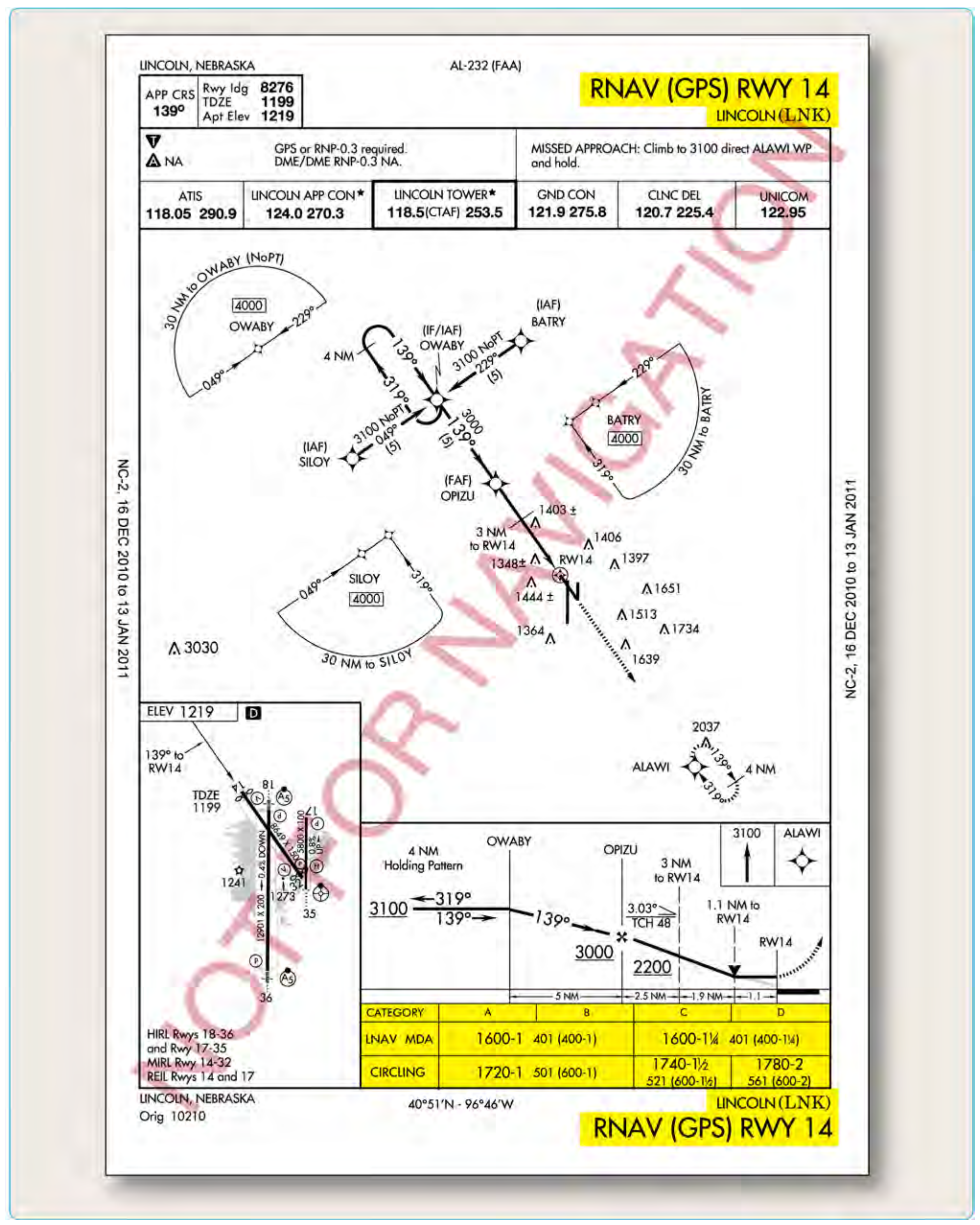
When DME is included in the title of the VOR approach, operable DME must be installed in the aircraft in order to fly the approach from the FAF. The use of DME allows for an accurate determination of position without timing, which greatly increases situational awareness throughout the approach. Alexandria, Louisiana, is an excellent example of a VOR/DME approach in which the VOR is off the airport and a FAF is depicted. [Figure 4-53] In this case, the final approach course is a radial or straight-in final approach and is designed to intersect the runway centerline at the runway threshold with the angle of convergence not exceeding 30°.
The criteria for an arc final approach segment associated with a VOR/DME approach is based on the arc being beyond 7 NM and no farther than 30 NM from the VOR and depends on the angle of convergence between the runway centerline and the tangent of the arc. Obstacle clearance in the primary area, which is considered the area 4 NM on either side of the arc centerline, is guaranteed by at least 500 feet.
NDB Approach
Like the VOR approach, an NDB approach can be designed using facilities both on and off the airport, with or without a FAF, and with or without DME availability. At one time, it was commonplace for an instrument student to learn how to fly an NDB approach, but with the growing use of GPS, many pilots no longer use the NDB for instrument approaches. New RNAV approaches are also rapidly being constructed into airports that are served only by NDB. The long-term plan includes the gradual phase out of NDB facilities, and eventually, the NDB approach becomes nonexistent. Until that time, the NDB provides additional availability for instrument pilots into many smaller, remotely located airports.
The NDB Runway 35 approach at Carthage/Panola County Sharpe Field is an example of an NDB approach established with an on-airport NDB that does not incorporate a FAF. [Figure 4-54] In this case, a procedure turn or penetration turn is required to be a part of the approach design. For the NDB to be considered an on-airport facility, the facility must be located within one mile of any portion of the landing runway for straight-in approaches and within one mile of any portion of usable landing surface for circling approaches. The final approach segment of the approach is designed with a final approach area that is 2.5 NM wide at the facility and increases to 8 NM wide at 10 NM from the facility. Additionally, the final approach course and the extended runway centerline angle of convergence cannot exceed 30° for straight-in approaches. This type of NDB approach is afforded a minimum of 350 feet obstacle clearance.
When a FAF is established for an NDB approach, the approach design criteria changes. It also takes into account whether or not the NDB is located on or off the airport. Additionally, this type of approach can be made both moving toward or away from the NDB facility. The Tuscon Ryan Field, NDB/DME RWY 6 is an approach with a FAF using an on-airport NDB facility that also incorporates the use of DME. [Figure 4-55] In this case, the NDB has DME capabilities from the LOC approach system installed on the airport. While the alignment criteria and obstacle clearance remain the same as an NDB approach without a FAF, the final approach segment area criteria changes to an area that is 2.5 NM wide at the facility and increases to 5 NM wide, 15 NM from the NDB.
Radar Approaches
The two types of radar approaches available to pilots when operating in the NAS are precision approach radar (PAR) and airport surveillance radar (ASR). Radar approaches may be given to any aircraft at the pilot’s request. ATC may also offer radar approach options to aircraft in distress regardless of the weather conditions or as necessary to expedite traffic. Despite the control exercised by ATC in a radar approach environment, it remains the pilot’s responsibility to ensure the approach and landing minimums listed for the approach are appropriate for the existing weather conditions considering personal approach criteria certification and company OpSpecs.
Perhaps the greatest benefit of either type of radar approach is the ability to use radar to execute a no gyro approach. Assuming standard rate turns, ATC can indicate when to begin and end turns. If available, pilots should make use of this approach when the heading indicator has failed and partial panel instrument flying is required.