
Chapter 1
Introduction to Parachute Rigging
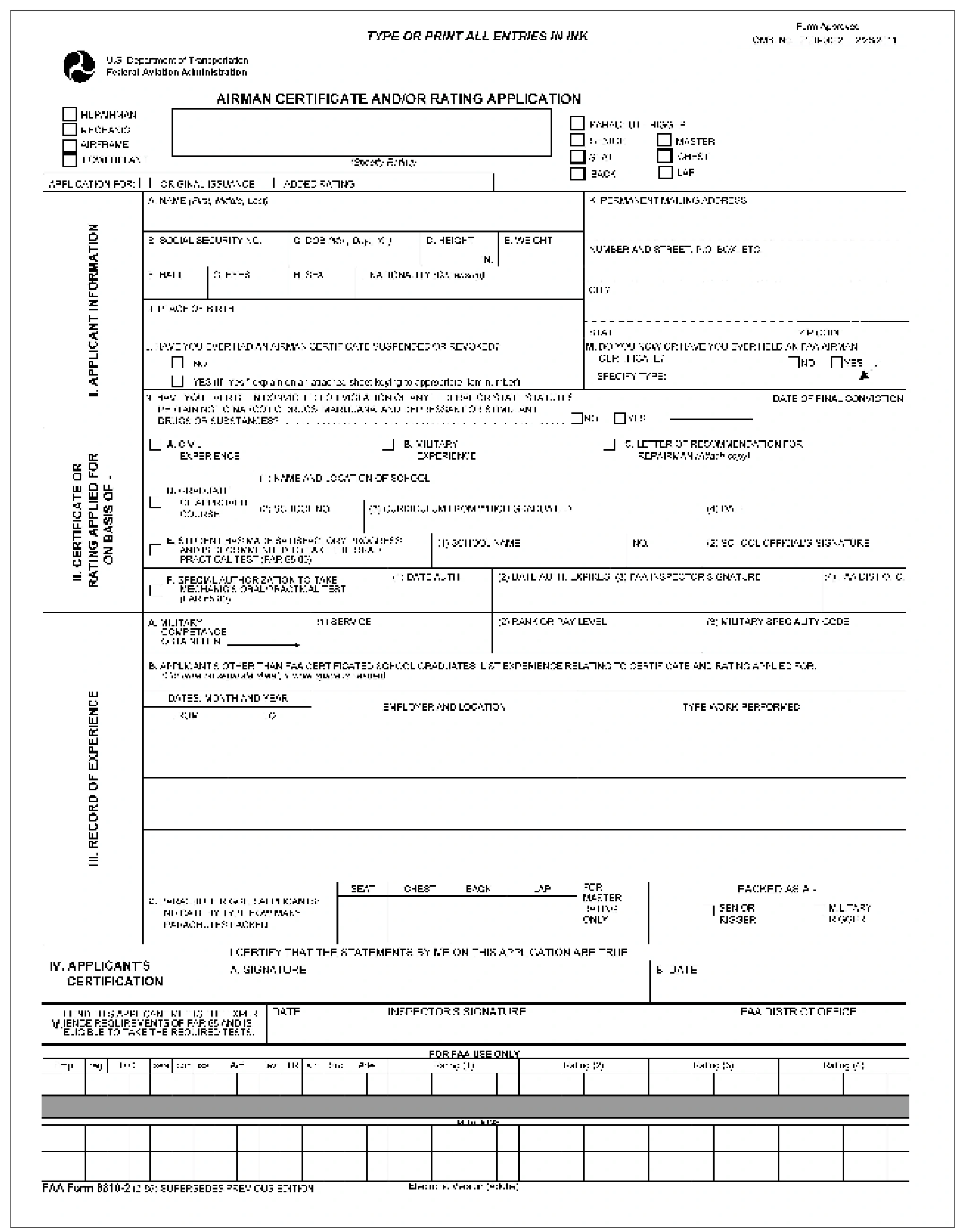
Under 14 CFR, part 183, DPREs are Master Parachute Riggers who have attended an FAA course and are authorized to conduct oral and practical tests for the Administrator. In many cases, these individuals are full-time professionals who work in the parachute industry. Upon the successful completion of the oral and practical tests, in most cases, the DPRE issues a Temporary Parachute Rigger Certificate and a seal symbol to the candidate. [Figure 1-5] In some FSDO jurisdictions, the district office may issue the temporary certificate and/or seal symbol. The seal symbol consists of three letters or numbers or a combination of both. [Figure 1-6] The seal symbol is very important; it serves as the identifying mark for that individual parachute rigger and is used to seal any parachute that he or she packs.
Alternate Means of Qualifying for a Parachute Rigger Certificate
Active duty military personnel and civilian personnel who work for the military as parachute riggers may qualify for a Senior Parachute Rigger Certificate under the provisions of 14 CFR part 65, section 65.117, Special Certification Rule. If they meet the practical requirements, they need only take a special 25-question test.
A Senior Parachute Rigger applying for a Master Parachute Rigger Certificate only needs to take the oral and practical test. A person with 3 years experience as a parachute rigger, but not holding a Senior Parachute Rigger Certificate, must take both the knowledge test and the oral and practical test. Any parachute rigger, senior or master, who wishes to add additional ratings to his or her certificate needs to take only a practical test for the type rating sought. No additional knowledge test is necessary.
Retesting
If the applicant fails the knowledge test, he or she may retake the test under the following conditions: An applicant may apply for retesting by presenting the failed test report:
- 30 days after the date the applicant failed the test; or
- before 30 days have expired if the applicant presents a signed statement from an airman holding the certificate and rating sought by the applicant certifying that the airman has given the applicant additional instruction in each of the subjects failed and that the airman considers the applicant ready for retesting.
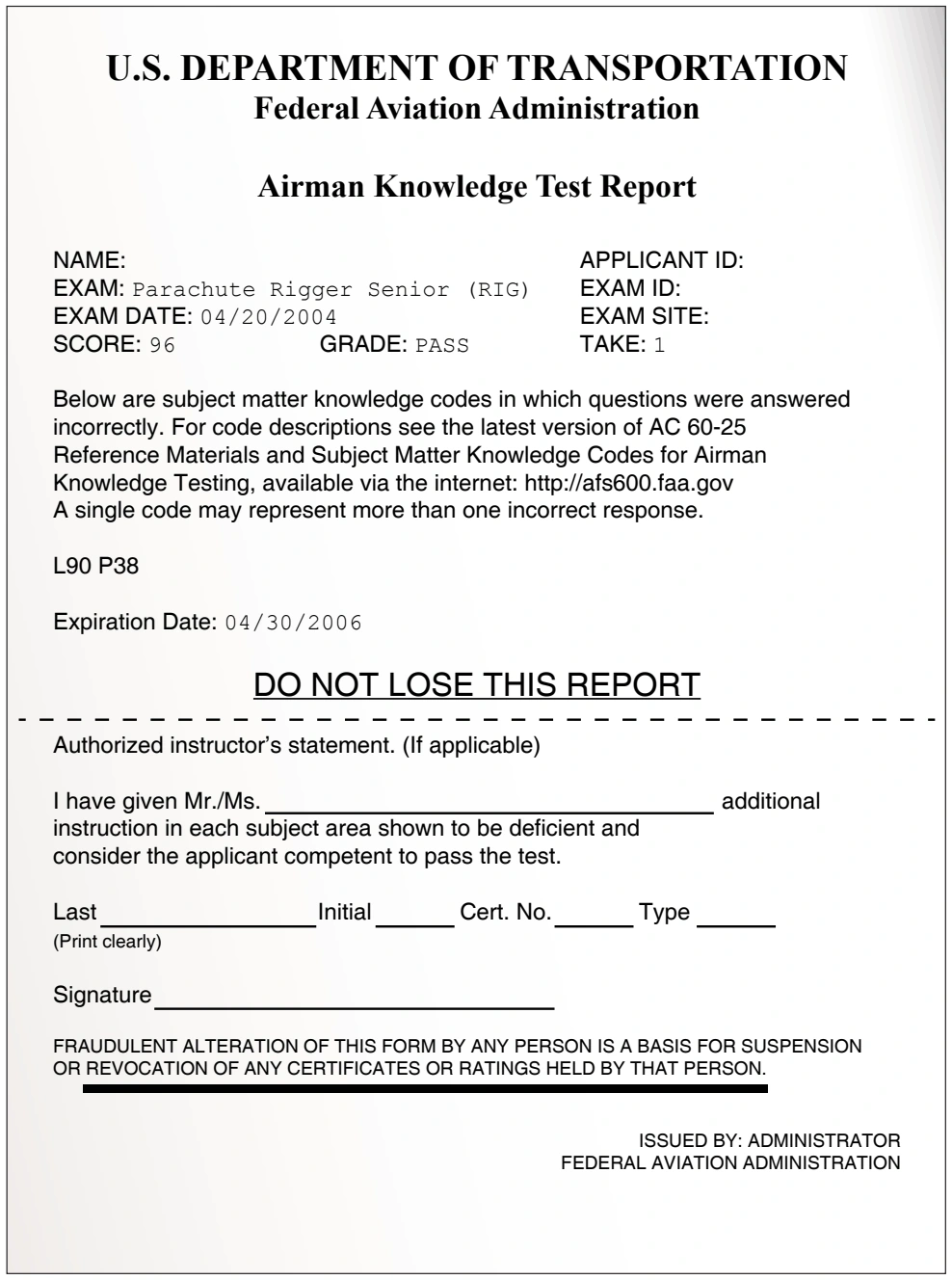
It is also possible for candidates who pass the test but receive a marginal score to retake the test with the anticipation of getting a higher score. In this case, the candidate must wait a minimum of 30 days from the date the last test was taken to retake a passed test. Prior to retesting, the individual must give his or her current airman test report to the proctor. The most recent test taken reflects the official score.
Responsibilities of a Certificated Parachute Rigger
Parachute riggers have a broad range of responsibilities that include ensuring that proper facilities and equipment are available to him or her, adhering to certain performance standards, record keeping, and use of their seal. The following describes the responsibilities of a certificated parachute rigger.
Facilities and Tools
Issuance of a Parachute Rigger Certificate is just the first step toward becoming a professional parachute rigger. As the un-certificated apprentice gains experience packing, he or she should also begin to acquire an inventory of tools and manuals necessary to exercise the privileges of a certificate. In compliance with 14 CFR part 65, section 65.127, there are several items required. One of these requirements is a smooth tabletop that is at least 3 feet wide by 40 feet long. Note that there is no specification for height. A table is only desirable if the parachute rigger is going to pack round parachutes. With the predominance of square reserve parachutes in the skydiving community, some parachute riggers specialize in packing only square reserves. A table can be used for packing this type of parachute, but the manufacturer may specify any smooth, clean surface of a size that accommodates the canopy. In this case, a clean, carpeted floor does the job and a table may not be necessary. According to 14 CFR part 65, subsection 65.127(b), the parachute rigger needs suitable housing that is adequately heated, lighted, and ventilated for drying and airing parachutes. This is subject to interpretation by the parachute rigger and the Administrator since the standards fluctuate based on location and time of year.
A parachute rigger must have enough tools and equipment to pack and maintain the types of parachutes for which he or she is rated to service. This may include only the basic tools of a packing fid, temporary pin, and pull-up cord if this is all that the manufacturer says is necessary to pack its product. However, there is a broad selection of tools necessary for a well-equipped parachute rigger to possess. These are covered in detail in Chapter 6, Hand Tools, Sewing Machines, and the Parachute Loft.
Performance Standards
A number of performance standards are defined in 14 CFR part 65, section 65.129 to guide the parachute rigger’s performance of the duties that fall under the certificate. The parachute rigger may not:
- Pack, maintain, or alter any parachute unless he or she is rated for that type.
- Pack a parachute that is not safe for emergency use.
- Pack a parachute that is not thoroughly dried and aired.
- Alter a parachute in a manner not specifically authorized by the Administrator or the manufacturer of the parachute.
The last item in this list is one that has been abused by many Master Parachute Riggers over the years. The Master Parachute Rigger must have Administrator or manufacturer approval, in writing, to be in compliance with this regulation.
Aside from the necessary tools, 14 CFR part 65, subsection 65.129(f) states that parachute riggers may exercise the privileges of the certificate only if they understand the current manufacturer’s instructions for the operation involved. This means that the rigger must possess a copy of the instructions or have access to them during the operation. If they do not have a copy, but the owner of the parachute provides them, then the parachute rigger may pack or maintain the parachute.