
Chapter 1
Introduction to the Powered Parachute
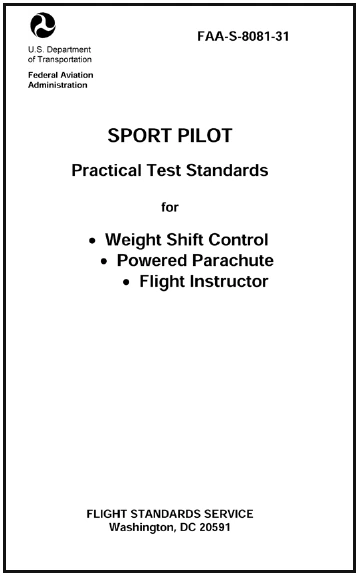
Title 14 CFR, part 61 specifies the requirements to earn a pilot certificate. This regulation also states the pilot applicant must be able to read, speak, write, and understand the English language. The FAA Practical Test Standards (PTS) establish the standards for the knowledge and skills necessary for the issuance of a pilot certificate. [Figure 1-4] You should reference both these documents to understand the knowledge, skills and experience required to obtain a pilot certificate to fly a powered parachute.
Pilot applicants must have a valid U.S. driver’s license or a current third-class medical certificate issued under 14 CFR part 67. If you use your valid driver’s license to exercise the privileges of a Sport Pilot certificate, then you must also adhere to any restrictions on that driver’s license. You must hold a current third-class medical certificate to exercise the privileges of a Private Pilot certificate.
The process of learning to fly includes a combination of ground training (to include successful completion of the FAA Knowledge Exam) and flight training to include dual flights with a certified flight instructor (CFI), as well as solo flights under the supervision of your CFI.
To be eligible to fly solo in a PPC, you must be at least 16 years of age and demonstrate satisfactory aeronautical knowledge on a test developed by your instructor. You must have received and logged flight training for the maneuvers and procedures in 14 CFR part 61 for the PPC, as well as demonstrated satisfactory proficiency and safety. Only after all of these requirements are met can your instructor endorse your student pilot certificate and logbook for solo flight.
Once you obtain the required aeronautical knowledge and experience required by 14 CFR part 61, your flight instructor will endorse you to take a practical test (often called a “checkride”) with a sport pilot examiner (SPE) or an FAA inspector. After you’ve demonstrated satisfactory aeronautical knowledge and skill in the Areas of Operation and Tasks outlined in the PTS, this examiner or inspector will issue your temporary (paper) pilot certificate. You will receive a plastic certificate in the mail once the results of the practical test are received by the FAA Registration branch.
A sport pilot is certified to fly a light-sport aircraft. To be eligible for a sport pilot certificate with a powered parachute rating, you must be at least 17 years of age, complete the specific training and flight time requirements described in 14 CFR part 61 subpart J, pass the FAA Knowledge Exam, and successfully complete the practical test.
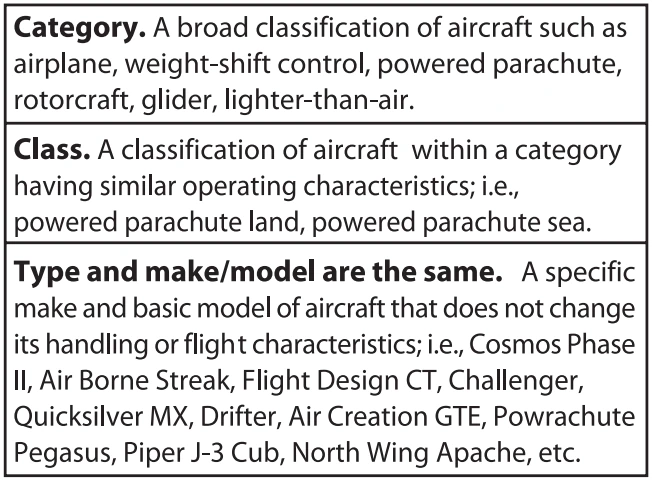
If you hold at least a private pilot certificate, but not a rating for the category and class of PPC LSA, you can operate the powered parachute with a logbook endorsement and passing a proficiency check. [Table 1] If you hold at least a private pilot certificate with a PPC category and class rating, and have a current third-class medical, then you may operate any PPC LSA in that category and class, and do not need to hold any of the endorsements required by Sport Pilots, nor do you need to comply with the limitations of a Sport Pilot certificate.
A Sport Pilot instructor can instruct, endorse logbooks for privileges, and give proficiency check flights in a LSA. To be eligible for a Sport Pilot instructor certificate, you must be at least 18 years of age and hold at least a current and valid Sport Pilot certificate with category and class ratings or endorsements appropriate to the flight instructor privileges sought. You must also pass the Sport Pilot instructor and fundamentals of instructing knowledge exams and meet the experience and knowledge requirements outlined in 14 CFR part 61.
Aeronautical Decision Making (ADM)
Your current attitude or mindset is something you, as PIC, must constantly be alert to in order to maintain your safety and that of the aircraft, your passenger and the general public on the ground. To accomplish sound aeronautical decision making (ADM), you must first be aware of your limitations and well-being (physical and psychological health), even before beginning the first preflight routine. While technology is constantly improving equipment and strengthening materials, safe flight comes down to the decisions made by the human pilot prior to and during flight.
The well-being of the pilot is the starting point for the decision making processes that will occur while in control of the aircraft. Just as physical fatigue and illness will directly affect your judgment, so too will your attitude management, stress management, risk management, personality tendencies, and situational awareness. Hence, it is the awareness of your human factors and the knowledge of the related corrective action that will not only improve the safety of operating a powered parachute, but will also enhance the joy of flying. See Chapter 16 of the Pilot’s Handbook of Aeronautical Knowledge (FAA-H-8083-25) to learn the decision-making process, risk management techniques, and hazardous attitude antidotes you should use in all your flight operations.
The phrase “pilot error” points to the human factors which have caused an incident or accident, including the pilot’s failure to take appropriate action. Typically, it is not a single decision or indecision that leads to an accident, but most likely it is a chain of error-related factors. This inadequate action and poor judgment path is referred to as the human “error chain.” You only need to be aware of a situation and break one link in this error chain to improve the outcome of a sequence of events and return to safe and secure flight.
A good instructor will immediately begin teaching ADM when the student has the ability to confidently control the powered parachute during the most basic maneuvers. During a proficiency or practical test, the instructor or examiner will be evaluating the applicant’s ability to use satisfactory ADM practices as the pilot determines risks and coordinates safe procedures.
Resource Management
Pilots must make effective use of single-pilot resource management (SRM): human resources (pilot, passenger, maintenance personnel, and the weather briefer, as applicable), hardware (equipment), and information. It is similar to crew resource management (CRM) procedures that are being emphasized in multi-crewmember operations except only one crewmember (the pilot) is involved. Resource management is one way of optimizing the risk elements (the pilot, the aircraft, the environment, and the type of flight operation). This ability to manage the resources available to you is as critical to the successful outcome of the flight as your skills and procedures as a pilot.
Light-sport aircraft are flown by a single pilot. Nonetheless, there are numerous resources available to that pilot. For instance, even though the passenger is not a pilot, he or she can be asked to assist with scanning the skies and a possible landing location during an emergency. Your knowledge, skills, and consistent use of a checklist are also valuable resources. External resources for the powered parachute pilot include those that can assist with Notices to Airmen (NOTAMs) and weather information. These resources can include Automated Weather Observing System (AWOS), Automated Surface Observing System (ASOS), Hazardous Inflight Weather Advisory Service (HIWAS), and Flight Service Stations (FSS) 800-WX-BRIEF.