
Chapter 1
Introduction to the Powered Parachute
Hypoxia is a lack of oxygen. There are many forms of hypoxia that are beyond the scope and need for discussion in a PPC manual, but the results from oxygen deficiency are the impairment of the functions of the brain and other organs. Symptoms include headache, drowsiness, dizziness, euphoria, and blue fingernails and lips.
The most likely cause for a PPC pilot to experience symptoms of hypoxia would be flying too high. Unless you are a private pilot with a powered parachute rating, you need to stay below 10,000 feet where you will have less chance of experiencing hypoxia in a PPC. However, if you are acclimated to sea level conditions and climb above 8,000 feet, you may feel the effects of hypoxia. The longer you stay at altitude, the greater the effects of hypoxia will be. In addition, recent consumption of alcohol, smoking, and some medications will render a pilot more susceptible to disorientation and hypoxia. If you question your condition and consider hypoxia to be a potential problem, you should fly at lower altitudes and/or use supplemental oxygen.
Motion Sickness
Motion sickness, or airsickness, is caused by the brain receiving conflicting messages about the orientation of the body. The inner ear—specifically the vestibular system—is reporting one spatial orientation, and the eyes are communicating a different scenario. This not only causes confusion in your thinking, it may possibly create vertigo or spatial disorientation. It often causes vomiting and a debilitating feeling. Vomiting is due to a nerve that is connected from the brain to the stomach. When confusion or disagreement occurs between the eyes and the orientating vestibular system, vomiting may erupt.
When symptoms of motion sickness begin, get back on the ground. In the meantime, avoid unnecessary head movements and keep your eyes on the horizon.
As the pilot, you should note if the passenger, who had been talking throughout the flight, gets quiet. You should ask “how are you doing” because getting quiet is sometimes a precursor to feelings of nausea. Inform passengers while still on the ground to let you know if their stomach begins to feel “uneasy.”
Motion sickness can be the result of continued flight stimulation, such as rapid or unexpected turns and swinging through the PPC pendulum. As the pilot, you will find a reduced rate of upset stomachs if you let the passenger know, ahead of time, the flight maneuver you are about to make and avoid abrupt maneuvers.
For new students, anxiety and stress may greatly contribute to motion sickness. However, after a few lessons and some time in the air from the front seat, these feelings/symptoms will usually dissipate.
Medication like Dramamine can be used to prevent motion sickness/nausea in passengers, but since it can cause drowsiness, it is not recommended for the pilot.
Scuba Diving
Taking a flight, especially a high flight, after a deep scuba dive can have some devastating results. This is because the increased pressure of the water during a dive causes nitrogen to be absorbed into the body tissues and bloodstream. Then, when flying at altitudes of reduced atmospheric pressure, the nitrogen will move out of the bloodstream and tissues at a rapid rate. This rapid out-gassing of nitrogen is called the bends (as it is felt in the joints—the bending joints of the limbs) and is painful and incapacitating.
A pilot or passenger who intends to fly after scuba diving should allow the body sufficient time to rid itself of excess nitrogen that was absorbed during the dive. If the appropriate amount of time is not allowed, decompression sickness due to gases released in the blood can result in a serious in-flight emergency.
As an absolute standard safety measure, any pilot flying near a large body of water should ask the passenger during the preflight if he or she has recently been scuba diving.
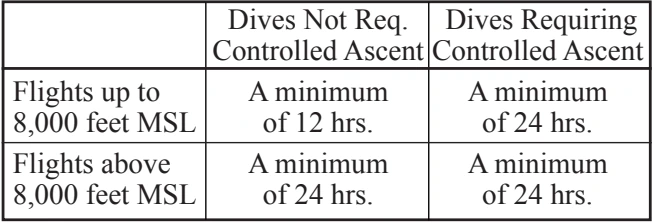
The following waiting times are recommended:
Spatial Disorientation
Spatial disorientation is not normally associated with slow and low (non-aerobatic) powered parachute flights. However, it is important to know that spatial disorientation is a condition of the body’s confusion relative to the spatial position. This commonly results from the eyes disagreeing with the sense of balance (the vestibular system of the inner ear) which may be disagreeing with the postural nerve impulses from the pressure areas in the skin and muscles. Hence, the brain gets conflicting spatial information. This condition is sometimes called vertigo.
The recommended procedure to deal with spatial disorientation is to maintain constant, straight and level flight via the throttle and remove all control input to the steering controls.
Stress
Stress is a strong factor in pilot error. Stressful situations are very disruptive conditions. There are three categories of stress: environment (physical, such as loud noises), psychological (the loss of a loved one) and physiological (fatigue). Any of these factors can be influential on your mental capacities, and hence should be given consideration when begining your medical self-evaluation prior to preflight inspection. Any pilot experiencing a high level of stress is not safe and should not fly as PIC.