
Chapter 11
Approaches and Landings
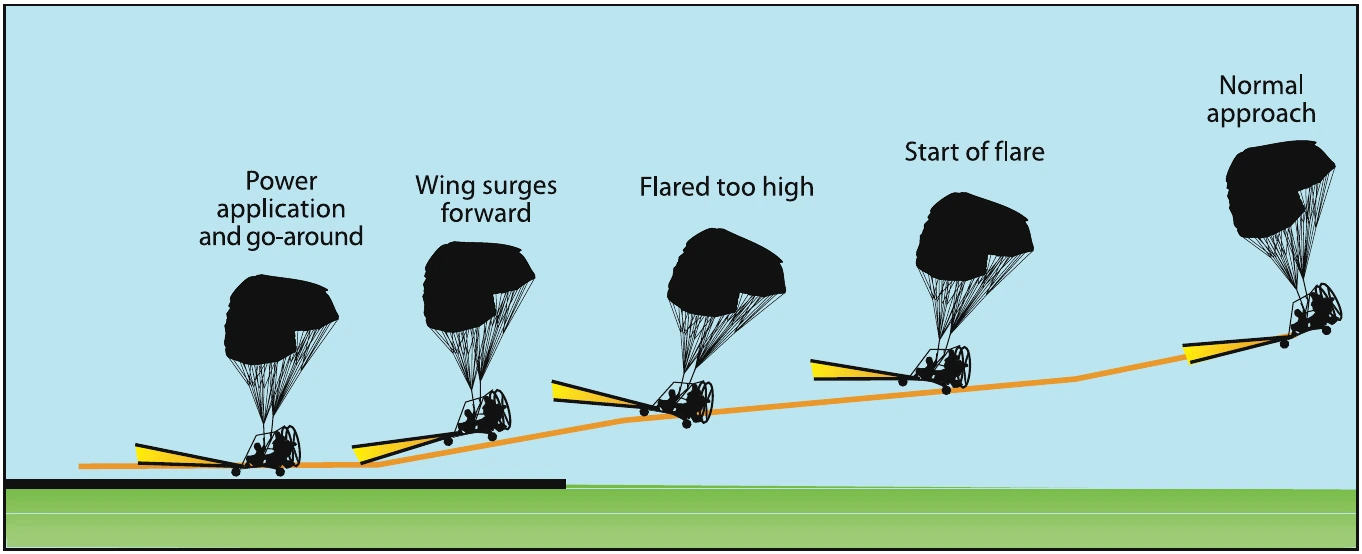
When the powered parachute contacts the ground with a sharp impact as the result of an excessive sink rate, the cart tends to bounce back into the air.
The corrective action for a bounce when it is very slight is to make a follow-up landing by applying sufficient power to cushion the subsequent touchdown and by adding flare as needed.
When a bounce is severe, the safest procedure is to EXECUTE A GO-AROUND IMMEDIATELY. No attempt to salvage the landing should be made. Apply full power and check the wing is LOC (lines free, cells open, wing centered) since a hard landing can collapse a ram-air wing. It would be extremely foolish to attempt a landing from a bad bounce since the skill set that would allow a student to make a severe bounce would not be up to the task of salvaging a bad landing.
Hard Landing
When the powered parachute contacts the ground during landings, its vertical speed is instantly reduced to zero. Unless provisions are made to slow this vertical speed and cushion the impact of touchdown, the force of contact with the ground may be so great it could cause structural damage to the powered parachute. Reductions in rapid descent rates are made through throttle increases. Closer to the ground, additional flare is applied before touchdown.
The purpose of pneumatic tires, shock absorbing landing gears, and other devices is to cushion the impact and to increase the time in which the powered parachute’s vertical descent is stopped. Within a fraction of a second, the powered parachute must be slowed from a high rate of vertical descent to zero, without damage.
During this time, the landing gear together with some aid from the lift of the ram-air wing must supply whatever force is needed to counteract the force of the powered parachute’s inertia and weight. The lift decreases rapidly as the powered parachute’s forward speed is decreased, and the force on the landing gear increases by the impact of touchdown. When the descent stops, the lift will be zero, leaving the landing gear alone to carry both the powered parachute’s weight and inertia force. Any time you have a hard landing, inspect your landing gear, tires, and structure to make sure there is no structural damage.
Wing Blowing Over After Touchdown
When landing in a crosswind, there is a concern that the wing will blow downwind during the after-landing roll. This is due to the fact that the wing is flexibly attached to the cart.
Anytime a powered parachute is rolling on the ground in a crosswind condition, the upwind side of the parachute is receiving a force that wants to push it down-wind.
If no correction is applied, it is possible that the upwind side of the parachute will rise sufficiently to cause the downwind side of the parachute to strike the ground. If the wind and/or the forward motion of the powered parachute is great enough, a rollover may result. It is important for a pilot to remember that the parachute should be flown or pulled to the ground right after landing the cart. The cart and the parachute’s movements should be controlled together on the ground.