
Chapter 11
Approaches and Landings
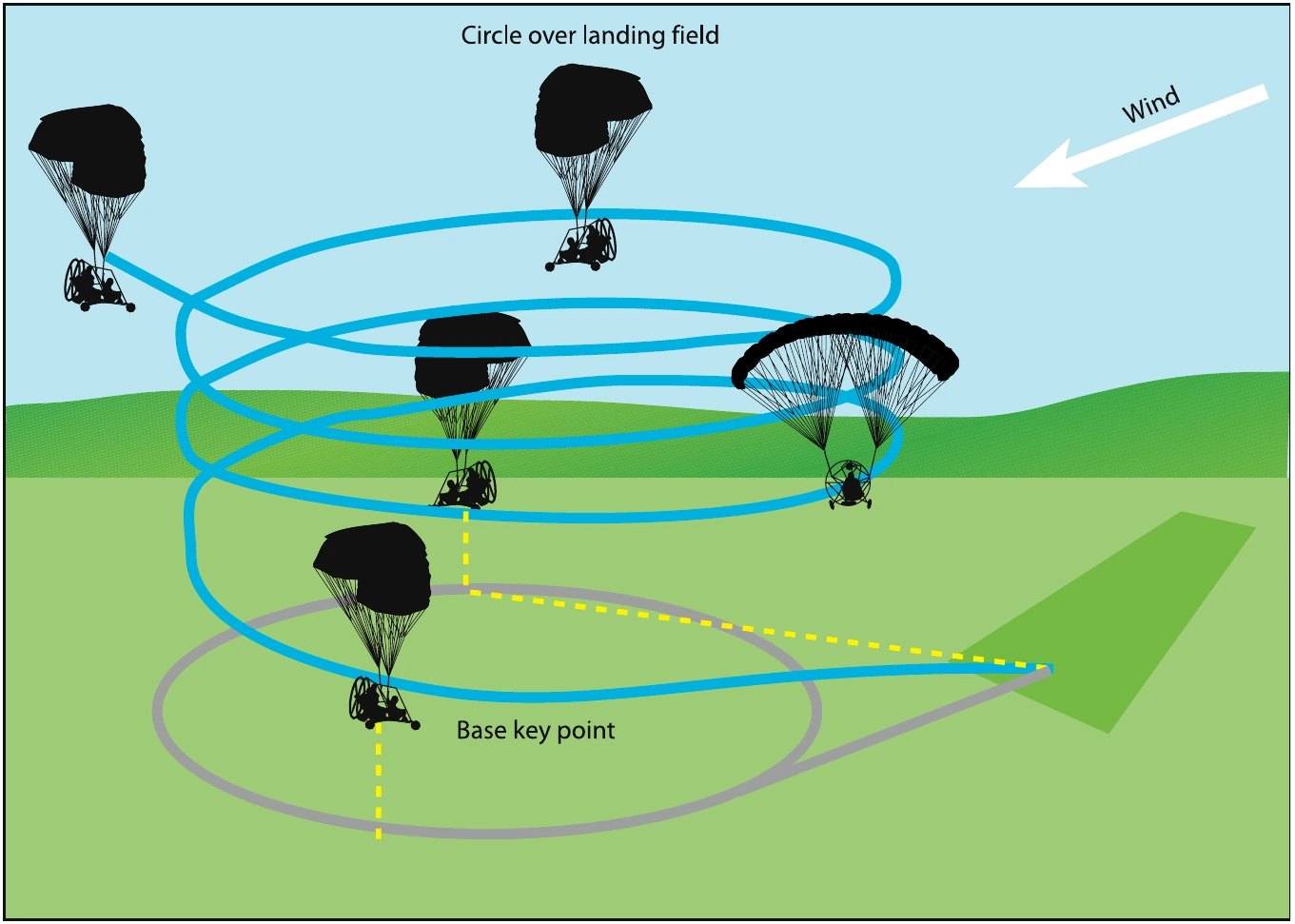
During all simulated emergency landings, the engine should be kept warm and cleared. During a simulated emergency landing, either the instructor or the student should have complete control of the throttle. There should be no doubt as to who has control since many near accidents have occurred from such misunderstandings.
Every simulated emergency landing approach should be terminated as soon as it can be determined whether a safe landing could have been made. In no circumstances should you violate the altitude restrictions detailed in 14 CFR part 91 or any local nonaviation regulations in force. It is also important to be courteous to anyone on the ground. In no case should it be continued to a point where it creates a hazard or an annoyance to persons or property on the ground.
In addition to flying the powered parachute from the point of simulated engine failure to where a reasonable safe landing could be made, the pilot should also learn certain emergency cockpit procedures. The habit of performing these cockpit procedures should be developed to such an extent that, when an engine failure actually occurs, the pilot will check the critical items that would be necessary to get the engine operating again after selecting a field and planning an approach. Accomplishing emergency procedures and executing the approach may be difficult for the pilot during the early training in emergency landings.
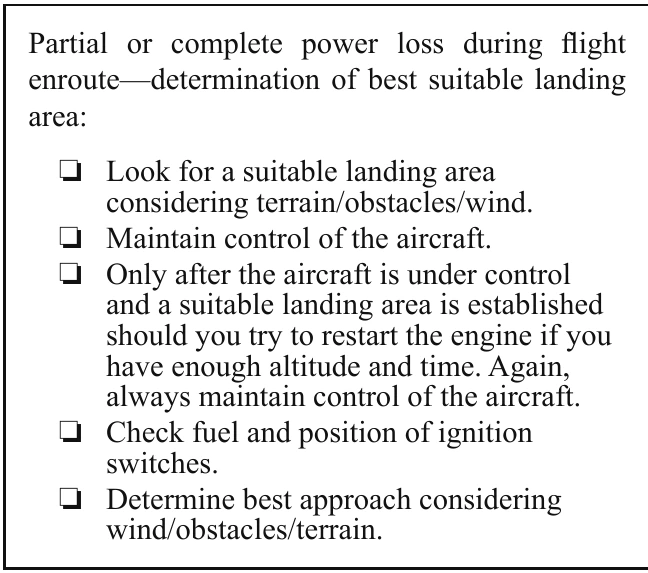
There are definite steps and procedures to follow in a simulated emergency landing. They should be learned thoroughly by the student, and each step called out to the instructor. The use of a checklist is strongly recommended. Most powered parachute manufacturers provide a checklist of the appropriate items. [Figure 11-10]
Critical items to be checked should include the quantity of fuel in the tank and the position of the ignition switches. Many actual emergency landings could have been prevented if the pilots had developed the habit of checking these critical items during flight training to the extent that it carried over into later flying.
Instruction in emergency procedures should not be limited to simulated emergency landings caused by power failures. Other emergencies associated with the operation of the powered parachute should be explained, demonstrated, and practiced if practicable. Among these emergencies are such occurrences as fire in flight, electrical system malfunctions, unexpected severe weather conditions, engine overheating, imminent fuel exhaustion, and the emergency operation of powered parachute systems and equipment.
Faulty Approaches and Landings
Low Final Approach
When the base leg is too low, insufficient power is used or the velocity of the wind is misjudged, sufficient altitude may be lost, which will cause the powered parachute to be well below the proper final approach path. In such a situation, you would have to apply considerable power to fly the powered parachute (at an excessively low altitude) up to the runway threshold.
When it is realized the runway will not be reached unless appropriate action is taken, power must be applied immediately to stop the descent. When the proper approach path has been intercepted, the correct approach attitude should be re-established and the power reduced and a stabilized approach maintained. [Figure 11-11] If there is any doubt about the approach being safely completed, it is advisable to EXECUTE AN IMMEDIATE GO-AROUND.
High Final Approach
When the final approach is too high, reduce power as required. [Figure 11-12] When the proper approach path has been intercepted, adjust the power as required to maintain a stabilized approach. When steepening the approach path, however, care must be taken that the descent does not result in an excessively high sink rate. If a high sink rate is continued close to the surface, it may be difficult to slow to a proper rate prior to ground contact. Any sink rate in excess of 800–1,000 feet per minute is considered excessive. A go-around should be initiated if the sink rate becomes excessive.
Use of Power
Power can be used effectively during the approach and roundout to compensate for errors in judgment. Power can be added to slow the descent rate to an acceptable rate. Some pilots use power rather than wing flare to land smoothly. After the powered parachute has touched down, it will be necessary to close the throttle so the additional thrust and lift will be removed and the powered parachute will stay on the ground.
High Roundout
It is possible to flare for landing too high above the ground. [Figure 11-13] If this happens, efforts need to be made to prevent the wing from surging forward. The power should not be reduced and the flare should only be reduced slightly or the wing could surge forward as the pendulum starts swinging back. Some pilots try to correct this situation by reducing the throttle too much and letting off the flare completely in order to land closer to their chosen landing point. This invariably results in the cart rotating back under the forward surging wing and diving towards the ground because lift has been dramatically reduced. Any surging forward of the wing above the cart should be slowed by increased flare. If the flare is performed too high off the ground, a go-around can be accomplished.
It is recommended that a go-around be executed any time it appears that there may not be enough runway to safely land the powered parachute or if the landing is in any other way uncertain.