Chapter 12
Night, Abnormal, and Emergency Procedures
Night Operations and the Powered Parachute
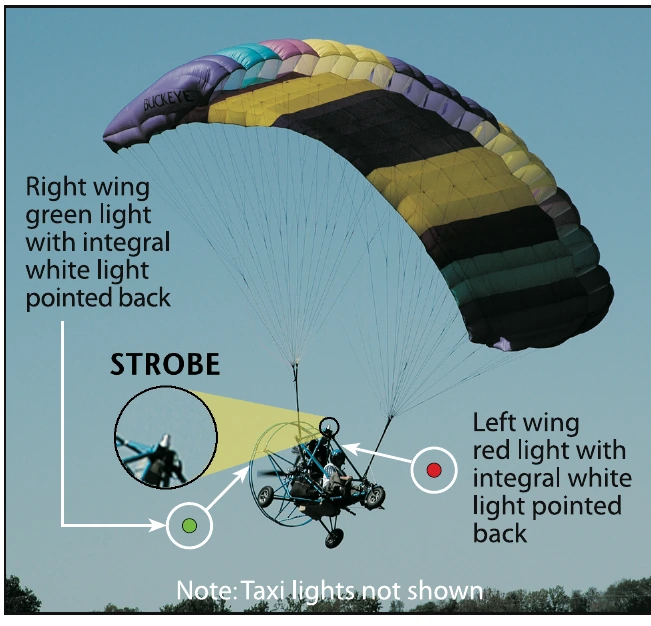
Flying a powered parachute after sunset requires a private pilot powered parachute certificate. In addition, the powered parachute needs to be equipped for night operations by adding position lights for taxi and flight. Position lights are green on the right, red on the left, and white in the back. Anti-collision strobe lights can also be used in addition to position lights. [Figure 12-1]
The use of lighted runways for night flight imposes several problems for the powered parachute pilot. Setting up on a runway and conducting a preflight on a powered parachute cart and wing in the dark could tie up a designated runway area for a considerable amount of time, not to mention raise issues about being able to see the aircraft and wing components for proper preflight inspection.
A pilot planning to fly a powered parachute at night should ensure adequate illumination is provided for takeoff. The wing needs to be illuminated to ensure the wing cells are all open, the wing is centered, and the lines are not tangled (LOC). The takeoff area needs adequate illumination to ensure hazards are avoided. Typically, lights on poles can present a hazard at an airfield.
A powered parachute flight where the preflight inspection was completed during daylight, just prior to sunset, and then the final landing made after sunset may be a more feasible endeavor. If a powered parachute pilot holding a private pilot certificate or higher were to venture into night flight, Chapter 15 of the Pilot’s Handbook of Aeronautical Knowledge should be carefully reviewed to understand the parameters that need to be considered prior to conducting a flight in the dark.
Emergency Situations
This section contains information on dealing with unexpected situations that may occur in flight. The key to successful management of an emergency situation, and/or preventing a problem from progressing into a true emergency, is a thorough familiarity with, and adherence to, the procedures developed by the powered parachute (PPC) manufacturer. Hence, the following guidelines are generic and are not meant to replace the manufacturer’s recommended procedures. Rather, they are meant to enhance your general knowledge in the area of emergency operations. If any of the guidance in this chapter conflicts in any way with the manufacturer’s recommended procedures, the manufacturer’s recommended procedures take precedence.
Review the lost procedures and flight diversion techniques in Chapter 14 of the Pilot’s Handbook of Aeronautical Knowledge. You must be able to select an appropriate alternate airport or landing area and route, determine there is sufficient fuel to fly to the alternate airport or landing area, turn to and establish a course to the select alternate destination, and maintain the appropriate altitude and heading while doing so. As a PPC pilot you must be able to select an appropriate course of action if you become lost, including maintaining an appropriate heading and climb if necessary, identify prominent landmarks, and use your navigation system (GPS) or contact an ATC facility for assistance, as appropriate.
Review the POH for the aircraft you fly to be familiar with the necessary pilot actions required for system and equipment malfunctions. You must be prepared to analyze the situation and take action if you experience any of the following system and equipment malfunctions: engine/oil and fuel, electrical, carburetor or induction icing, smoke and/or fire, flight control/trim, pitot static/vacuum and associated flight instruments, propeller, ballistic recovery system malfunction (if applicable), or any other emergency unique to the powered parachute you are flying.
Accidents
It is estimated that 85 percent of accidents occur during the takeoff process, 10 percent transpire during landings, and 5 percent happen in flight. The vast majority of these accidents are the direct result of complacency. The cause of this complacency is that the PPC is relatively easy to fly. Hence, if you find complacency setting in, you need to turn from outside distractions, and direct your attention to the immediate situational awareness of the aircraft.
The following are some reasons for PPC complacency during flight:
- The PPC does not require quick reactions.
- When compared to other light-sport aircraft (LSA), the PPC flies very slowly.
- The PPC has only two axes around which you can directly control (lateral-pitch and vertical-yaw). Note: As there are no ailerons on a PPC, roll or movement around the longitudinal axis cannot be directly controlled. However, there is longitudinal roll invoked during a steep turn as the centrifugal force of the cart directs the cart to the outside of the suspension point of the wing.
- The controls are very intuitive (push right to go right, left to go left, more throttle to go up, and less to go down).
It is possible the outside environment can become a distraction to the necessary situational awareness of flying (i.e., situational complacency). Hence, in-flight accidents can be due to the pilot’s failure to see obstructions (power lines and tower cables) and to anticipate weather-related turbulence and its resultant negative effects on a PPC’s light wing (i.e., wind rotors or mechanical turbulence). Landing accidents are usually the result of porpoising (too rapid throttle movements), thermals, or unsafe field terrain. Takeoff problems can be caused by: (1) failure to get a wing LOC before adding airborne power; and (2) failure to take off into the wind.
Potential Hazards of the Standing PPC
Even while parked on the ground, high winds can pick up the wing of an unsecured powered parachute and begin carrying it away. To regain control of a freestanding PPC with a semi-inflated, dragging wing, rescuers need to grasp the steering lines—not the cart! Then with a steering line in hand, pull the line back toward the front of the cart (into the wind) and tie it off to any structured part of the PPC. This will keep the wing from gathering air and re-inflating. If you are by yourself, you do not have to do both lines simultaneously. It would be best to get both lines, but with a PPC that is dragging down the field, grab any steering line and get at least one line secured; then secure the second line. When you pull a steering line, the canopy will be pulled down on that side and the air in the wing will literally be pulled out, as the wing is hauled back and down.
The best safety procedure is prevention. To safeguard a PPC from high winds, immediately after landing, secure the wing. Even if you only intend to refuel, it is highly recommended to condense the exposure of the wing to the elements: the harmful ultraviolet rays of the sun and those unexpected wind gusts. As soon as possible after landing, condense the wing by folding it on top of itself and put something on top of it to secure it. It is best to pack the canopy to keep it out of the sun and make sure the wind cannot inflate the wing and if possible, lean the nose wheel up, then place the fan guard of the cart back and down on the folded wing. Securing it this way will usually be adequate for short breaks when the make and model allows for this static positioning. [Figure 12-2]