
Chapter 12
Night, Abnormal, and Emergency Procedures
Restricted Lines During the Takeoff Roll
If the lines (steering or suspension lines) become restricted, such as around part of an outrigger, a trim lock, or an accessory—then while safely maintaining your ground direction into the wind and holding your RPM down to kiting speed—reach out and push the line off of the restricting object. If this is not possible, then shut the PPC down and abort the takeoff.
To abort a takeoff (i.e., to shutdown) maintain your ground steering clear of obstacles as you: (1) power down the throttle, (2) push the magneto switches into the OFF position, and (3) pull the wing down.
Entangled or Embedded Lines
If the lines become entangled or embedded with debris, then shut the PPC down and clean up the lines. If you don’t, and you load the wing by beginning the lift-off, the stress on the lines as they pull through the debris (twigs, sticks, and so forth) can break the lines.
Lines Caught Under a Wheel
If the lines go under a wheel, IMMEDIATELY abort the takeoff. Shut down: power, magnetos and wing down.
A Wing Wall
The term “wall” is simply defined as the canopy literally forming a wall-like appearance behind the PPC. [Figure 12-3] The trailing edge of the canopy is still on the ground, while the leading edge of the canopy forms the top of the wall. The “wall” is the first canopy problem that might occur during the initial kiting of the wing.
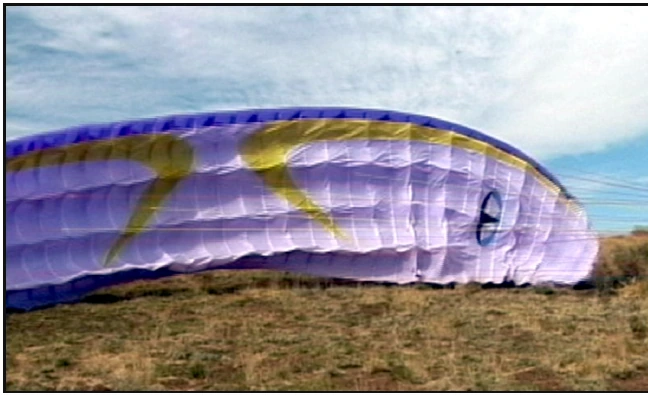
Even though some pilots will try to “pop” the canopy out of the “wall,” the only safe solution is to immediately abort the takeoff, and re-layout the canopy. By shutting down and restarting the takeoff preflight, pilots will save the expense of many line and propeller repairs. Lines will inevitably become damaged when a pilot tries to “pop” the canopy out of the wall via sharp throttle movements. When you fight the wall, you create an ideal situation for lines to get sucked into the propeller.
A Wing Lock-Out
A wing “lock-out” occurs when the initial forward momentum is insufficient to move the canopy through the prop-wash and up and above the PPC cart. [Figure 12-4] During this phenomenon, the inflated canopy will hang at about a 45° angle behind the cart. This is a “parachutal-wing stall” while the pilot is still on the ground. Usually, regardless of how much ground-speed is increased, the wing will stay in a parachutal-wing stall behind the cart as long as the tension on the suspension lines remains the same; the wing will stay “locked-out” in that 45° position.
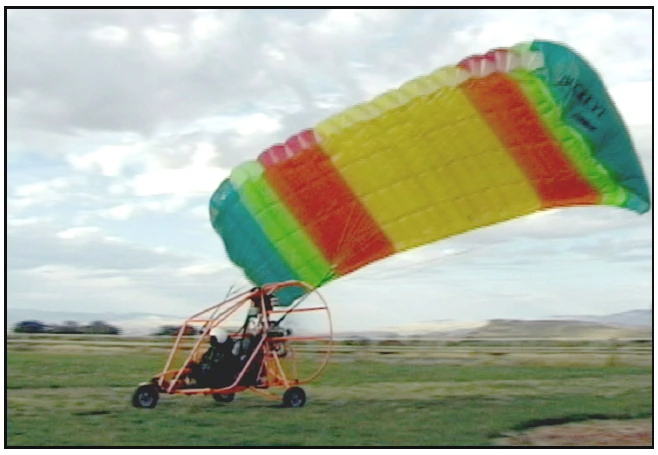
There are two techniques that can be used to correct this “parachutal-wing stall” position of a rectangular wing:
- Lower the groundspeed until the canopy begins to fall down and back behind the cart. Then before the wing touches the ground, smoothly and firmly increase the groundspeed to move (“sling-shot”) the canopy up and above the cart.
- Maintain the groundspeed and pull the canopy back via a flare (i.e., pushing both foot steering bars). Hold the flare until the drag caused on the tail of the wing pulls the wing back down—about a 60° angle—and then smoothly release the flare. The release of the flare will again “sling-shot” the canopy up and above the cart.
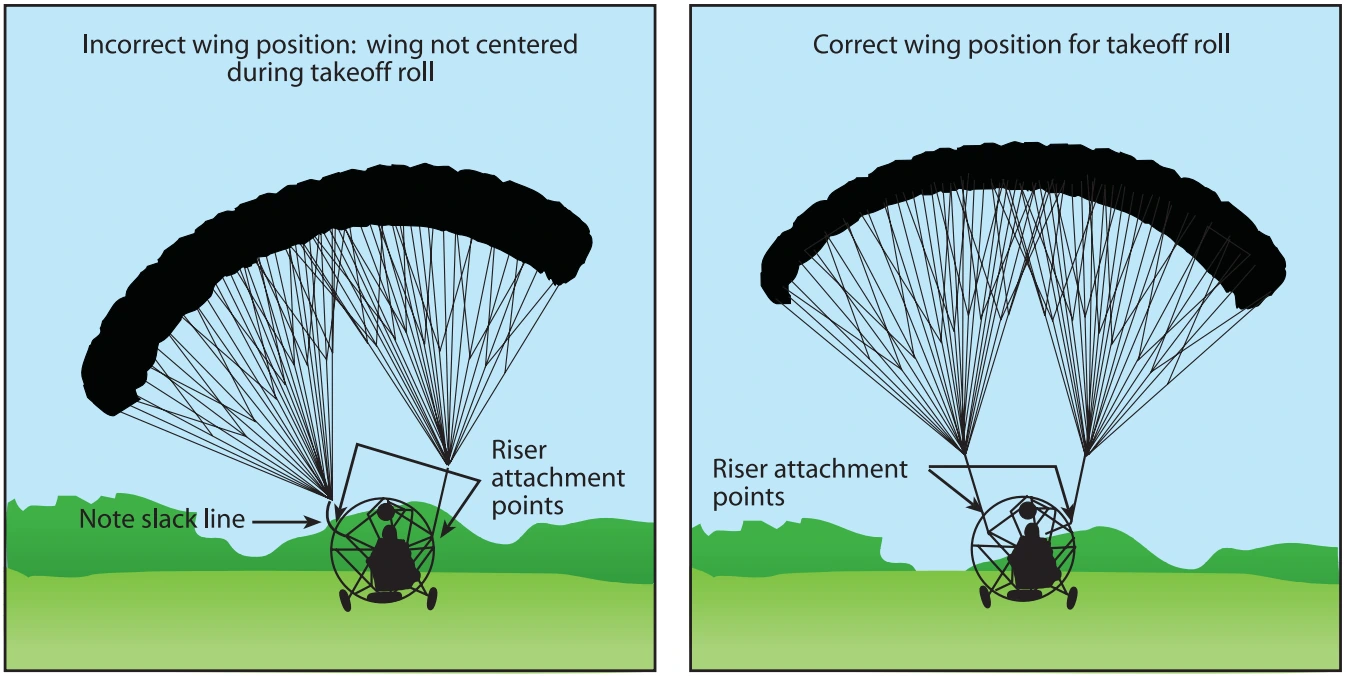
Wing Not Centered Overhead
No takeoff should ever be attempted until the wing is centered above the cart and forward to the riser attachment points. [Figure 12-5]