
Chapter 12
Night, Abnormal, and Emergency Procedures
The altitude available is, in many ways, the controlling factor in the successful accomplishment of an emergency landing. If an actual engine failure should occur immediately after takeoff and before a safe maneuvering altitude is attained, it is usually not advisable to attempt to turn back to the field from where the takeoff was made. Instead, it is safer to immediately establish the proper glide attitude, and select a landing area directly ahead or slightly to either side of the takeoff path. Complete the landing in accordance with the next section.
In the event of an engine failure on initial climb-out, the powered parachute is typically at a high pitch angle with the cart well in front of the wing. When the engine fails, the cart swings back under the wing and the wing can surge forward bringing the PPC into a temporary and potentially dangerous dive. If the engine-out occurs close to the ground, and the wing starts to surge out in front of the cart, it is necessary to immediately flare the wing to slow the surge. Gradually release the flare when the forward surge is controlled and the wing is back overhead in a normal flying position.
Engine Failure In Flight
Never fly over something you cannot land on (considering your altitude and glide slope) and remain constantly aware of the surrounding terrain and hence potential landing zones. If you adhere to these rules, an in-flight engine failure will not directly correlate to an accident or incident. If this happens, continue to fly the aircraft. You simply glide it away from all obstacles and toward the safest landing area.
The safest landing zone may perhaps be in the middle of the flight park if you have a lot of altitude. Or, the best landing zone may be straight ahead if you are below 100 feet. If at all possible, set up your landing approach so you touch down into the wind—but the number one priority of an engine-out scenario is safe terrain (not ground wind direction). Wind direction is a secondary concern. Land into the wind if possible; otherwise land downwind. Crosswind is the least favorable wind direction to land into.
When you are about one second from touchdown, begin applying a full flare. [Figure 12-7] With a single 1-2-3 rhythmic timing motion, push both foot steering bars completely forward and hold that position as the rear wheels touch the ground. You can increase the amount of flare before landing, but you cannot release it when you are close to the ground and without power! Once on the ground smoothly release the flare and pull down the canopy (since the engine is already off).
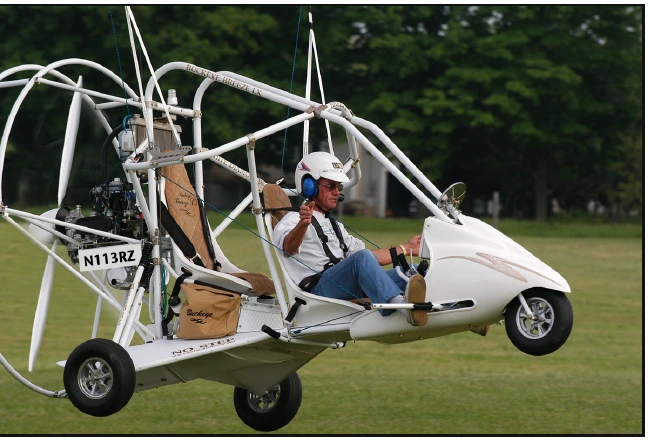
Engine Failure in a PPCL
When planning any over-water flight, wear a life vest. Maintain an altitude that will allow you to safely glide to land should the engine fail. [Figure 12-8] If you consistently fly over water, consider attaching an automatic, inflatable device or pontoons to the bottom of your PPC (i.e., so it becomes a PPCS with pontoons, as opposed to a PPCL in water). Carry a line-cutter that is easy to access, yet placed so as not to cause additional injury upon impact. Practice emergency procedures so you are prepared and brief your passengers on evacuation procedures prior to any over-water flight.
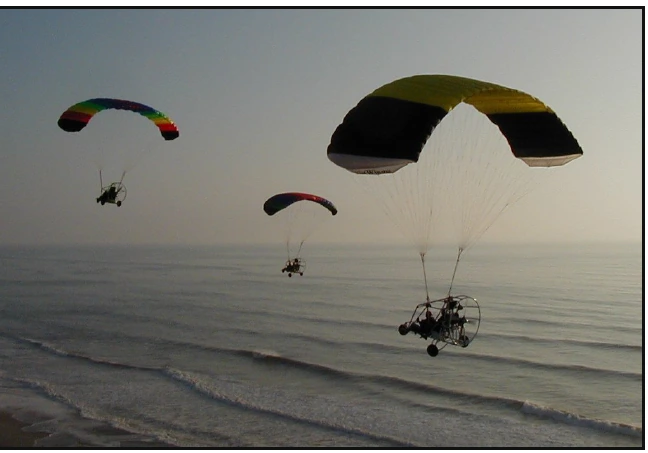
If you find yourself over water with an engine failure, too far to glide to shore, remain strapped in so the cart can provide some impact protection. It is possible you will become disorientated, as the PPCL will likely flip over when you hit the water and settle upside-down in the water. You may become entangled in the wing and lines as it descends upon the craft and the occupants.
Although your PPCL may float for a few minutes, it will eventually sink. The time before sinking will depend on the amount of fuel left, the condition of the seals on the ends of your tubing, and the air left in your tires after impact.
As soon as you know a water landing is inevitable, your first step is to align your PPCL into the wind if possible, and move as close to shore as possible.
- Don’t panic. Use the ADM “DECIDE” method.
- Stay seated.
- Turn off all electronics.
- Remove any objects that will delay your evacuation of the aircraft prior to impact (i.e., communication cords, camera straps, etc.).
- Discard any objects that may penetrate your skin upon impact (or hit you, such as cameras).
- Tighten your seatbelt and shoulder harnesses.
- At approximately 2 seconds (~25 feet) above the water, bring your head, neck, and legs in as close to your body as possible. Place your arms along the side of your head, with your hands over the lower back of your head.
- If experienced, you could execute a full flare and a parachutal-wing stall approximately 3 seconds (~40 feet) above the water (recommended for PPCs with foot steering bars only).
- Once in the water, release your seatbelt and shoulder harness and exit the cart.
- Help your passenger with his or her restraints.
- Do not try to retrieve items on the aircraft or try to save the aircraft. When surfacing, avoid the wing and swim to the side of the PPC (if entangled with the canopy lines, cut them with the line cutter and work your way to the edge of the wing).
- Swim to shore.
In-Flight Fire
Considering the flammability of a ram-air wing, it is easy to realize that in-flight fire—especially an engine or fuel fire—is one of the most serious emergencies a PPC pilot can encounter. (Note: An electrical fire in the front of the cart is unlikely to cause anything more than an engine failure. Therefore, see “Engine Failures” above for this specific emergency.) If there is any sign of fire near the engine, fuel containers, or fuel lines, do everything possible to reduce the possibilities of the fire spreading and land as soon as possible. The necessary procedures are:
- Reduce throttle to idle;
- If possible, shut off fuel valves;
- Shut off magnetos;
- Shut off all electronics;
- Land immediately and stop as quickly as possible; and
- Evacuate the aircraft immediately.
After landing, get far away. The principal danger after evacuating the PPC is that the fuel will ignite and explode, with the potential to injure people at considerable distances.
Landing Porpoise
Porpoising refers to pitch oscillations, most noticeable during a landing. These erratic pilot-induced movements are a result of rapid throttle movements. This is a common, correctable error pilots need to be aware of. There is a delay between throttle changes and pitch changes. Porpoising will result if you overcontrol the throttle during a landing attempt, causing pitch oscillations. As a result of over-reacting, the PPC, which is now dangerously close to the ground, will be further induced into increasing the forward/rearward swinging oscillations from the pilot throttle movements. [Figure 12-9]