
Chapter 4
Powerplants
Crankcase Transfer/Exhaust—Piston at lowest: Figure 4-3 d When the piston is near the bottom of its stroke, the transfer port opening from the crankcase to the combustion chamber is exposed, and the high pressure fuel/air mixture in the crankcase transfers around the piston into the main cylinder.
This fresh fuel/air/oil mixture pushes out the exhaust (called scavenging) as the piston is at its lowest point and the exhaust port is open. Some of the fresh fuel/air/oil mixture can escape out the exhaust port resulting in the higher fuel use of the two stroke engine.
Cylinder start of Compression Stroke—Piston initially Moving up: Figure 4-3 e As the piston starts to move up, covering the transfer port, the tuned exhaust bounces a pressure wave at the precise time across the exhaust port (more on this in the exhaust system discussion) to minimize the fuel/air/oil mixture from escaping out the exhaust port.
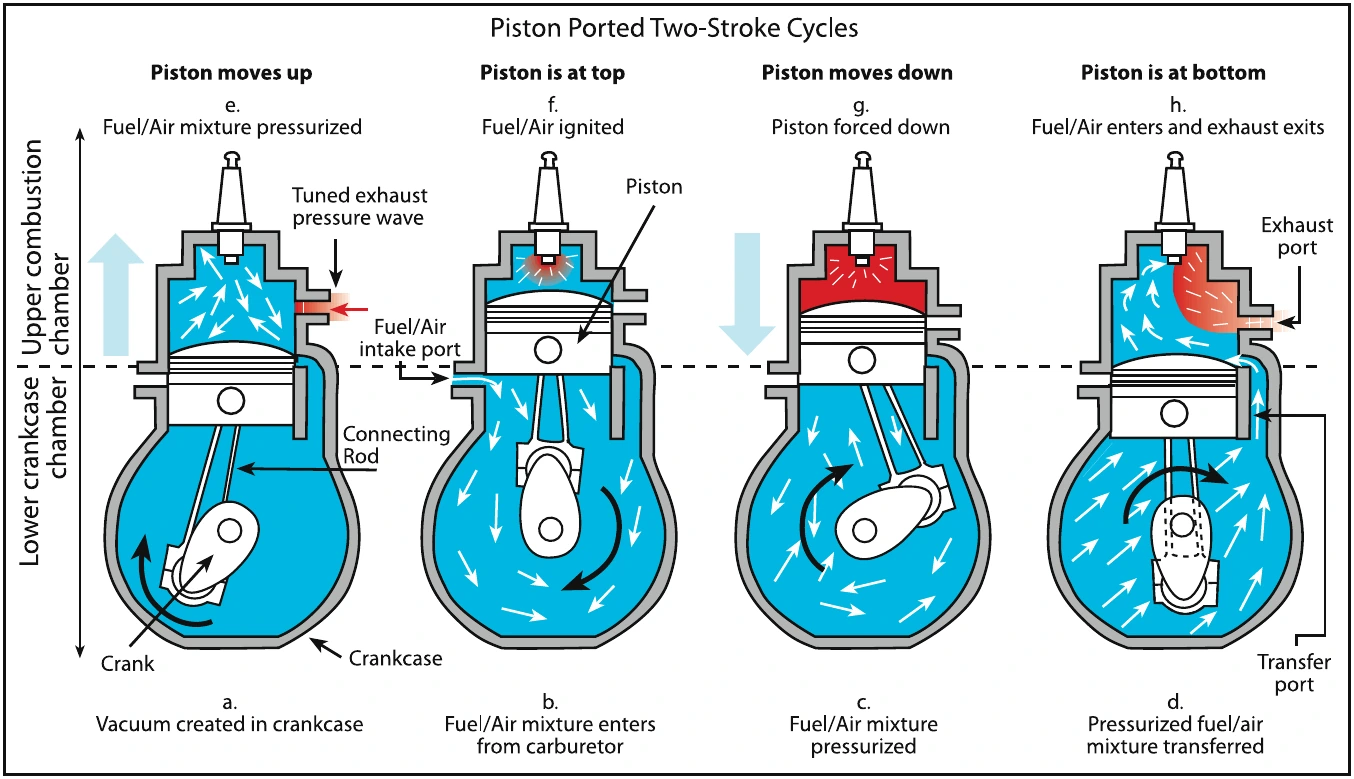
Cylinder Compression Stroke—Piston Moving Up: Figure 4-3 e to f The piston then rises, and compresses the fuel mixture in the combustion chamber. During this piston compression process, the crankcase vacuum intake process is happening simultaneously, as described earlier. This is why four processes can happen in two strokes.
Cylinder Power Stroke—Piston Moving Down: Figure 4-3 f to g At the top of the stroke, the spark plug ignites the fuel mixture and drives the piston down as the power stroke of the engine.
Cylinder Power Stroke—Piston Moving Down: Figure 4-3 g to h As the piston passes the exhaust port, the exhaust starts to exit the combustion chamber. As the piston continues down, the transfer port opens and the swirling motion of the air/fuel/oil mixture pushes the exhaust out the exhaust port.
Piston Reverses Direction From Down Stroke to Up Stroke: Figure 4-3 h to a As the piston reverses direction from the down stroke to the up stroke the process is complete.
Four-Stroke Engines
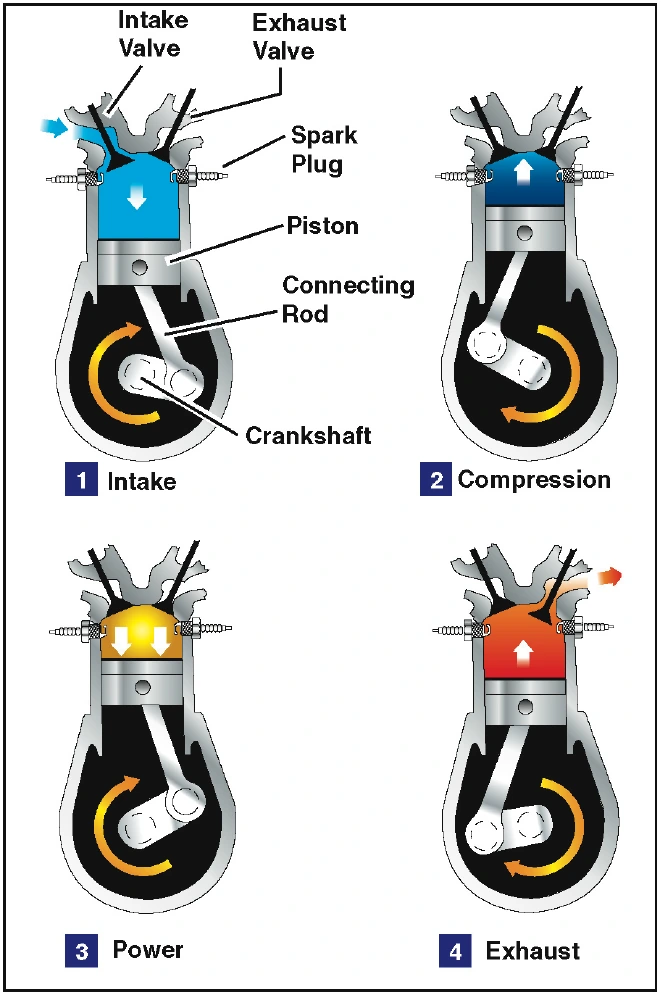
Four-stroke engines are very common in most aircraft categories, and are becoming more common in powered parachutes. [Figure 4-4] Four-stroke engines have a number of advantages, including reliability, fuel economy, longer engine life, and higher horsepower ranges.
These advantages are countered by a higher acquisition cost, lower power-to-weight ratios, and a higher overall weight. The increased weight and cost are the result of additional components, e.g., camshaft, valves, complex head to house the valve train, etc., incorporated in a four-stoke engine.
Exhaust Systems
Engine exhaust systems vent the burned combustion gases overboard, reduce engine noise, and (in the case of two-stroke engines) help keep the fresh fuel-air mixture in the cylinders. An exhaust system has exhaust piping attached to the cylinders, as well as a muffler. The exhaust gases are pushed out of the cylinder and through the exhaust pipe system to the atmosphere.
Some exhaust systems have an exhaust gas temperature probe. This probe transmits an electric signal to an instrument in front of the pilot. This instrument reads the signal and provides the exhaust gas temperature (EGT) of the gases at the exhaust manifold. This temperature varies with power and with the mixture (ratio of fuel to air entering the cylinders), and is used to make sure the fuel-air mixture is within specifications. When there is a problem with carburetion, the EGT gauge will normally be the first notification for a pilot.
Two-Stroke Tuned Exhaust Systems
In two-stroke engines, the exhaust system increases the fuel economy and power of the engine. The two-stroke exhaust system is an integral part of any two-stroke engine design; often controlling peak power output, the torque curve, and even the RPM limit of the engine.
The exhaust system must be tuned to produce a back pressure wave to act as an exhaust valve. When hot spent gases are vented out of the exhaust port, they are moving fast enough to set up a high-pressure wave. The momentum of that wave down the exhaust pipe diffuser lowers the pressure behind it. That low pressure is used to help suck out all of the residual, hot, burnt gas from the power stroke and at the same time help pull a fresh fuel-air charge into the cylinder. This is called scavenging and is an important function of a tuned two-stroke exhaust system.
The design of the exhaust converging section causes a returning pressure wave to push the fresh fuel-air charge back into the exhaust port before the cylinder closes off that port. That is called pulse-charging and is another important function of the exhaust system.