
Chapter 4
Powerplants
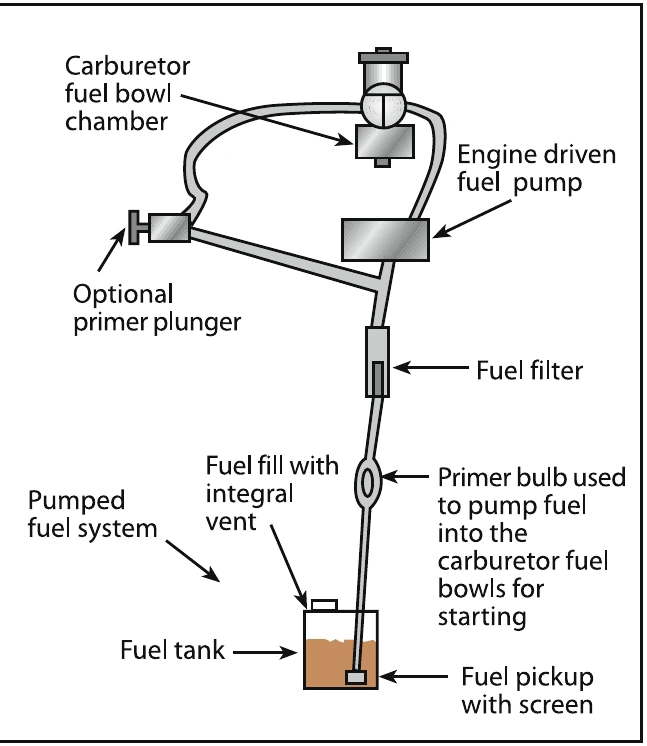
Fuel Pumps
Powered parachutes have fuel pump systems. The main pump system is engine-driven and sometimes an electrically-driven auxiliary pump is provided for use in engine starting and in the event the engine pump fails. The auxiliary pump, also known as a boost pump, provides added reliability to the fuel system. The electrically-driven auxiliary pump is controlled by a switch in the cockpit.
A diaphragm pump is the primary pump in the fuel system for two-stroke engines. Air pulses in the crankcase actuate a diaphragm and provide fuel under pressure to the carburetor. Four-stroke engines have a mechanical pump driven directly off the engine.
Fuel Plunger Primer
The fuel plunger primer is used to draw fuel from the tanks to supply it directly into the cylinders prior to starting the engine. This is particularly helpful during cold weather when engines are hard to start because there is not enough heat available to vaporize the fuel in the carburetor. For some powered parachutes, it is the only way to deliver fuel to the engine when first starting. After the engine starts and is running, the fuel pump pushes fuel to the carburetors and begins normal fuel delivery. To avoid overpriming, read the priming instructions in your POH for your powered parachute.
Choke
A choke or fuel enrichening system is an alternate method to provide additional fuel to the engine for initial cold starting. Actuating the choke control allows more fuel to flow into the carburetor.
Fuel Bulb Primer
The fuel bulb primer is manually actuated by squeezing the bulb to draw fuel from the tanks. This charges the fuel lines and carburetor float bowls before starting the engine the first time on a given day. After the engine starts, the fuel pump is able to deliver the fuel to the fuel bowls.
Fuel Gauges
The fuel quantity gauge indicates the amount of fuel measured by a sensing unit in each fuel tank and is displayed in gallons. Do not depend solely on the accuracy of the fuel quantity gauge. Always visually check the fuel level in the tank during the preflight inspection, and then compare it with the corresponding fuel quantity indication. It is also important to track your inflight fuel consumption. Be sure to consult the POH for your powered parachute and know the approximate consumption rate to ensure sufficient fuel for your flight.
If an auxiliary electric fuel pump is installed in the fuel system, a fuel pressure gauge is sometimes included. This gauge indicates the pressure in the fuel lines. The normal operating pressure can be found in the POH.
Fuel Filter
After leaving the fuel tank, the fuel passes through a filter before it enters the fuel pump or carburetor. This filter removes sediments that might be in the fuel.
Fuel
Aviation gasoline, or AVGAS, is identified by an octane or performance number (grade), which designates the antiknock value or knock resistance of the fuel mixture in the engine cylinder. The higher the grade of gasoline, the more pressure the fuel can withstand without detonating. Lower grades of fuel are used in lower-compression engines because these fuels ignite at a lower temperature. Higher grades are used in higher-compression engines, because they must ignite at higher temperatures, but not prematurely. If the proper grade of fuel is not available, use the next higher grade as a substitute. Never use a lower grade. This can cause the cylinder head temperature to exceed its normal operating range, which may result in detonation.
Unfortunately, aviation gasoline or AVGAS 100LL is not recommended by at least one of the major two-stroke engine manufacturers. Even though the “LL” stands for “Low Lead,” 100LL contains more lead than the old premium leaded gas dispensed at automotive filling stations. The lead in the fuel leaves deposits in the piston ring grooves, freezing the rings in position and reducing engine performance.
Spark plugs are also very susceptible to lead fouling. This is especially true in two-stroke engines that use cooler ignition temperatures than standard aircraft engines.
AVGAS does have some advantages. It degrades slower than regular gas, maintaining its efficiency for a full 3 months. AVGAS 100LL has no seasonal or regional variations and is manufactured according to a standardized “recipe” worldwide.