
Chapter 8
Airspace Classification and Requirements
This chapter introduces the various classifications of airspace and provides information on the requirements to operate in such airspace. For further information, consult the Pilot’s Handbook of Aeronautical Information, the Aeronautical Information Manual (AIM) and Title 14 of the Code of Federal Regulations (14 CFR) parts 71, 73, and 91.
Powered parachutes (PPC) share the airspace with all other types of aircraft and must avoid the flow of fixed wing aircraft. Although most PPCs fly low, slow and close to the field, you must be aware of the airspace in which you are operating. Each type of airspace has communication, equipment, visibility and cloud clearance requirements, and therefore may require additional pilot training with logbook endorsements. Some airspace may not be accessible (Class A) while other airspace (Class B and Class C) may not be prudent for PPC operation. Knowing the types of airspace and their requirements is necessary for safe and proper PPC operations.
The two categories of airspace are: regulatory and non-regulatory. Within these two categories, there are four types: controlled, uncontrolled, special use, and other airspace.
Each type of airspace may have different minimum pilot certification, equipment, visibility and cloud clearance, and entry requirements.
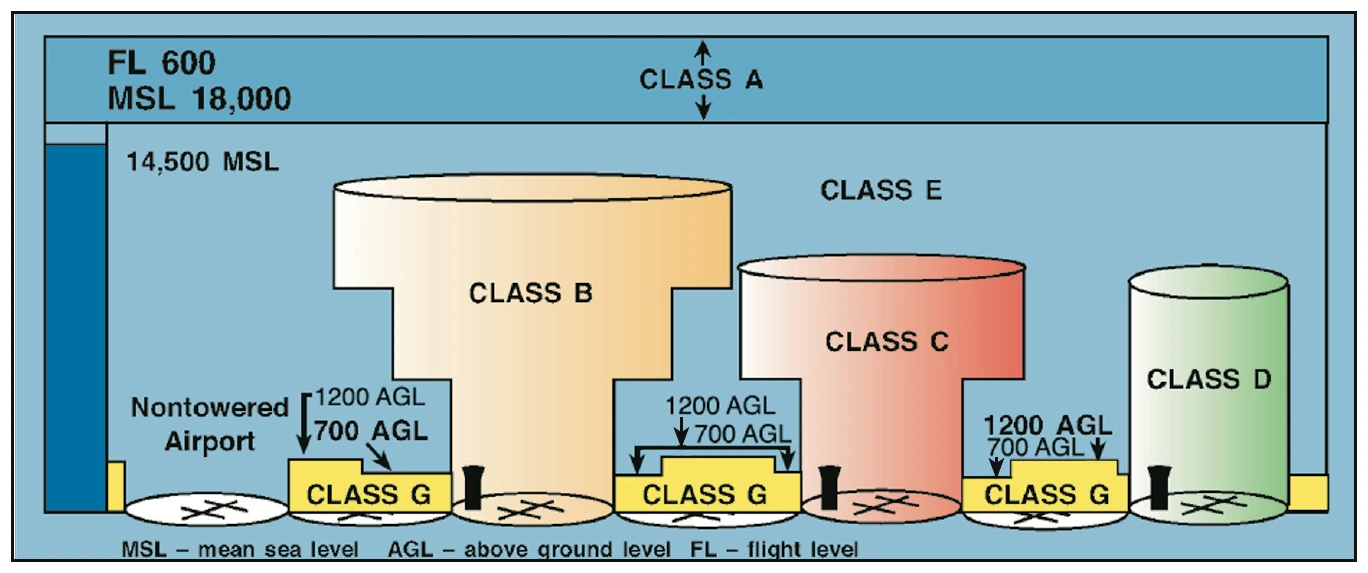
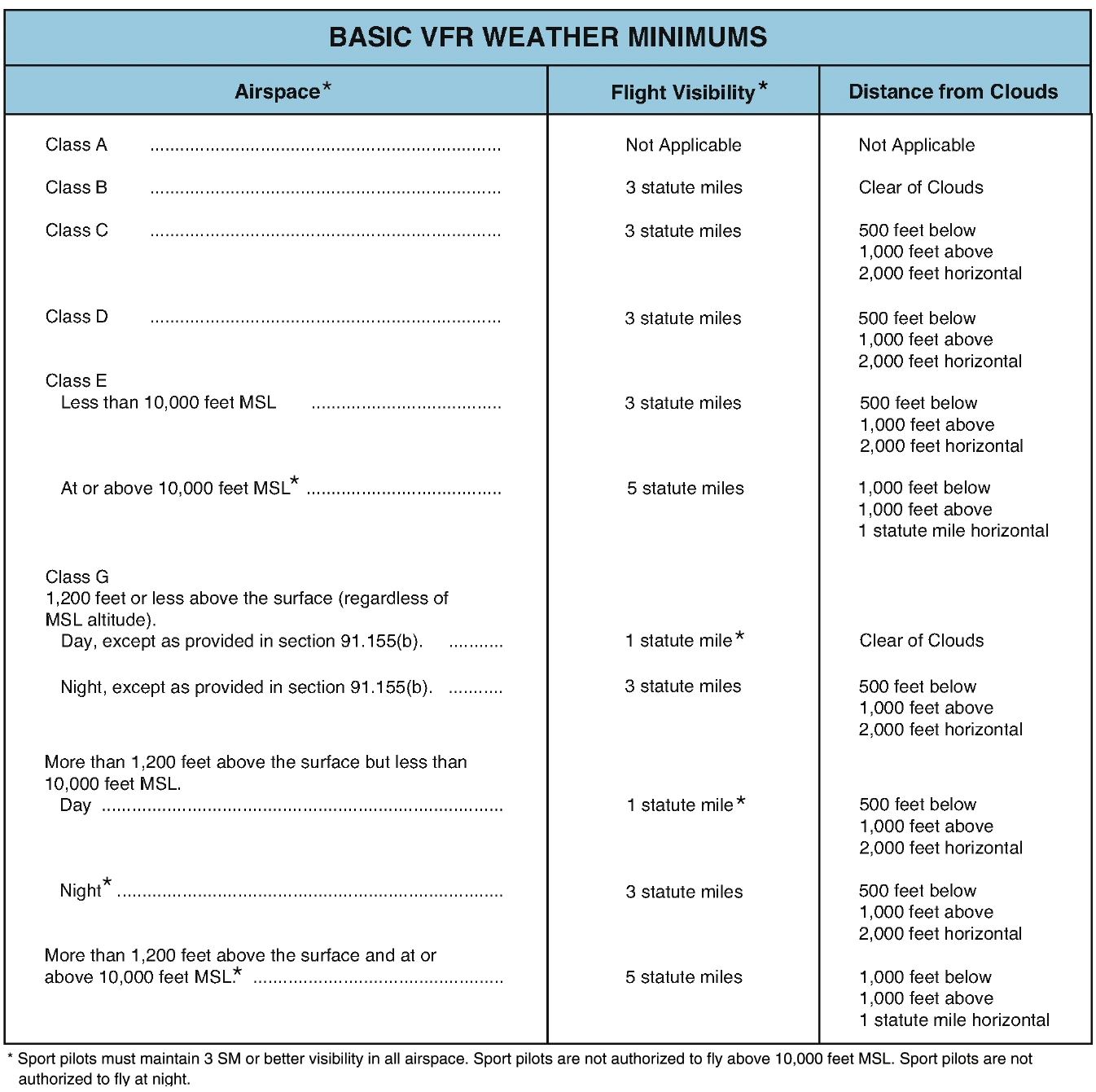
Figure 8-1 presents a profile view of the dimensions of various airspace classes. Figure 8-2 provides the basic weather minimums for operating in the different airspace classes. Figure 8-3 lists the operational and equipment requirements. Refer to these figures as you review this chapter.
Controlled Airspace
Controlled airspace is a generic term that covers the different classifications of airspace and defined dimensions within which air traffic control service is provided in accordance with the airspace classification. Controlled airspace consists of Class A, Class B, Class C, Class D, and Class E.
Class A Airspace
Class A airspace is generally the airspace from 18,000 feet mean sea level (MSL) up to and including 60,000 feet (FL600), including the airspace overlying the waters within 12 nautical miles (NM) of the coast of the 48 contiguous states and Alaska. Unless otherwise authorized, all operation in Class A airspace will be conducted under instrument flight rules (IFR). It is not likely PPCs will be operated in Class A airspace.
Class B Airspace
Class B airspace is generally the airspace from the surface to 10,000 feet MSL surrounding the nation’s busiest airports. The configuration of Class B airspace is individually tailored to the needs of a particular area and consists of a surface area and two or more layers. Some Class B airspace resembles an upside-down wedding cake. At least a private pilot certificate is required to operate in Class B airspace; however, there is an exception to this requirement. Student pilots, recreational pilots, and sport pilots may operate in the airspace if they have received training and a logbook endorsement by an authorized flight instructor in accordance with 14 CFR part 61.
With proper communication equipment, a Mode C transponder (a device that transmits your exact position and altitude), pilot certification and endorsements as required, and an air traffic control (ATC) clearance, a powered parachute may operate in Class B airspace. Due to large jets and congested traffic operating in Class B airspace, powered parachute operations may not be advised.
When associated with Class B airspace and within 30 nautical miles of the primary airport, aircraft must be equipped with a Mode C transponder. This requirement must be complied with even if there is no intent to enter the Class B airspace.
Class C Airspace
Class C airspace generally surrounds those airports having an operational control tower, are serviced by a radar approach control, and with a certain number of instrument flight (IFR) operations or passenger enplanements. This airspace is charted in mean sea level feet. Although the configuration of each Class C airspace is individually tailored, the airspace usually consists of a 5 NM radius core surface area that extends from the surface up to 4,000 feet above the airport elevation, and a 10 NM radius shelf area that extends no lower than 1,200 feet up to 4,000 feet above the airport elevation. Though not requiring regulatory action, Class C airspace areas have a procedural Outer Area. Normally this area is 20 NM from the primary Class C airspace airport. Within the outer area, pilots are encouraged to participate but it is not a VFR requirement. With proper communication equipment, a Mode C transponder, endorsements as required, and two-way communications established, a powered parachute may operate in Class C airspace though it may still not be advisable. A Mode C transponder is also required for overflying the Class C airspace.
Class D Airspace
Class D airspace is for smaller airports operating with a control tower and generally extends from the surface to 2,500 feet above the airport elevation surrounding those airports that have an operational control tower. The configuration of Class D airspace will be tailored to meet the operational needs of the area. At many Class D airports, the airspace is configured as a circle with a 4 nautical mile radius around the primary airport. Some are keyhole shaped. With the proper communication equipment, endorsements as required, and two-way communications established with ATC, a powered parachute may operate within Class D. If advised by ATC to remain clear of the Class D airspace the powered parachute pilot must comply and remain clear of the Class D airspace. Alternatives may include circumnavigating the Class D airspace and/or landing at an alternative airport.