
Chapter 9
Ground Reference Maneuvers

Purpose and Scope
Ground reference maneuvers and their related factors are used in developing a high degree of pilot skill. Although most of these maneuvers are not performed as such in normal everyday flying, the elements and principles involved in each are applicable to performance of the customary pilot operations. They aid the pilot in analyzing the effect of wind and other forces acting on the powered parachute, and in developing a fine control touch and the division of attention necessary for accurate and safe powered parachute maneuvering.
All of the early part of the pilot’s training has been conducted for the purpose of developing technique, knowledge of maneuvers, feel, and the handling of the powered parachute in general. This training will have required that most of the pilot’s attention be given to the actual handling of the powered parachute, and the results of control pressures on the action of the powered parachute.
If permitted to continue beyond the appropriate training stage, however, the student pilot’s concentration of attention will become a fixed habit, one that will seriously detract from the student’s ease and safety as a pilot, and will be very difficult to eliminate. Therefore it is necessary, as soon as the pilot shows proficiency in the fundamental maneuvers, that the pilot be introduced to maneuvers requiring outside attention on a practical application of these maneuvers and the knowledge gained.
During ground reference maneuvers, it is important that basic flying technique previously learned be maintained. The flight instructor should not allow any relaxation of the student’s previous standard of technique simply because a new factor is added. This requirement should be maintained throughout the student’s progress from maneuver to maneuver. Each new maneuver should embody some advance and include the principles of the preceding one in order that continuity is maintained. Each new factor introduced should be merely a step-up of one already learned so that orderly, consistent progress can be made.
Maneuvering by Reference to Ground Objects
Ground track or ground reference maneuvers are performed at a relatively low altitude while applying wind drift correction as needed to follow a predetermined track or path over the ground. They are designed to develop the ability to control the powered parachute and to recognize and correct for the effect of wind while dividing attention among other matters. This requires planning ahead of the powered parachute, maintaining orientation in relation to ground objects, flying appropriate headings to follow a desired ground track, and being cognizant of other air traffic in the immediate vicinity.
Pilots should perform clearing turns prior to beginning a maneuver. The essential idea of the clearing turn is to be certain that the next maneuver is not going to proceed into another aircraft’s flightpath. Some pilot training programs have hard and fast rules, such as requiring two 90° turns in opposite directions before executing any training maneuver. Other types of clearing procedures may be developed by individual flight instructors. Whatever the preferred method, a clearing procedure should be used. Execute the appropriate clearing procedure before all turns and before executing any training maneuver. Proper clearing procedures, combined with proper visual scanning techniques, are the most effective strategy for collision avoidance.
Ground reference maneuvers should be flown so as not to descend below 200 feet above the ground. The actual altitude will depend on a number of factors. You should plan and fly the maneuver so as not to descend below an altitude of 200 feet above ground level (AGL); however you must also plan and fly so as not to come closer than 500 feet to any person, vessel, vehicle or structure.
- The radius of the turn and the path of the powered parachute over the ground should be easily noted and changes planned and effected as circumstances require.
- Drift should be easily discernable, but not tax the student too much in making corrections.
- The altitude should be low enough to render any gain or loss apparent to the student, but in no case closer than 500 feet to the highest obstruction or lower then 200 feet above the ground.
During these maneuvers, both the instructor and the student should be alert for available forced-landing fields. The area chosen should be away from communities, livestock, or groups of people to prevent possible annoyance or hazards to others. Due to the altitudes at which these maneuvers are performed, there is little time available to search for a suitable field for landing in the event the need arises.
Drift and Ground Track Control
Whenever any object is free from the ground, it is affected by the medium with which it is surrounded. This means that a free object will continue to move in its current direction and speed unless acted upon by another force. For example, if a powerboat is crossing a river and the river is still, the boat could head directly to a point on the opposite shore and travel on a straight course to that point without drifting. However, if the river were flowing swiftly, the water current would have to be considered. That is, as the boat progresses forward with its own power, it must also move upstream at the same rate the river is moving it downstream. This is accomplished by angling the boat upstream sufficiently to counteract the downstream flow. If this is done, the boat will follow the desired track across the river from the departure point directly to the intended destination point. Should the boat not be headed sufficiently upstream, it would drift with the current and run aground at some point downstream on the opposite bank. [Figure 9-1]
As soon as a powered parachute becomes airborne, it is free of ground friction. Its path is then affected by the air mass in which it is flying; therefore, the powered parachute (like the boat) will not always track along the ground in the exact direction that it is headed. When flying with the longitudinal axis of the powered parachute aligned with a road, the powered parachute may get closer to or farther from the road without any turn having been made. This would indicate the air mass is moving sideward in relation to the powered parachute. Since the powered parachute is flying within this moving body of air (wind), it moves or drifts with the air in the same direction and speed, just like the boat moved with the river current. [See Figure 9-1] When flying straight and level and following a selected ground track, the preferred method of correcting for wind drift is to head the powered parachute sufficiently into the wind to cause the powered parachute to move forward into the wind at the same rate the wind is moving it sideways. Depending on the wind velocity, this may require a large wind correction angle or one of only a few degrees. When the drift has been neutralized, the powered parachute will follow the desired ground track.
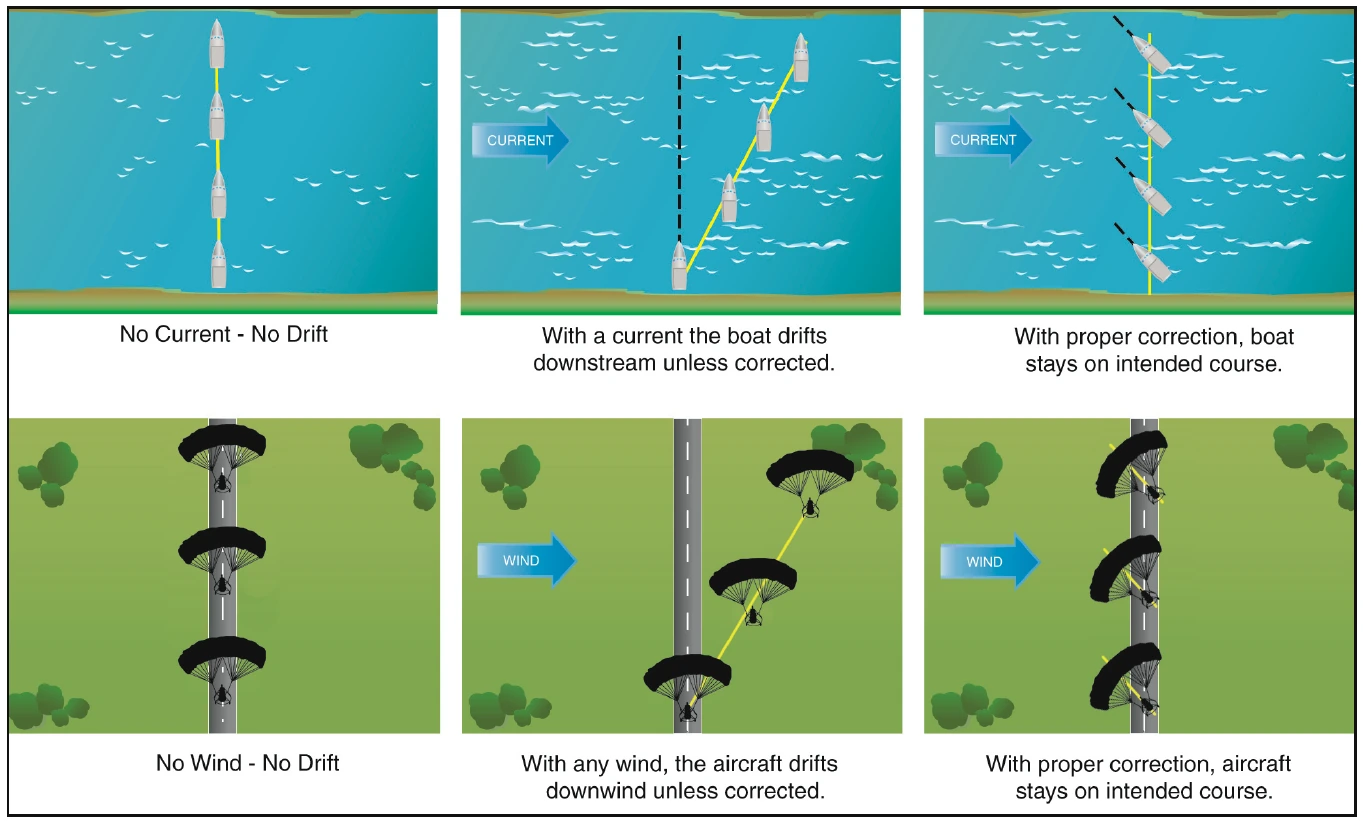
To understand the need for drift correction during flight, consider a flight with a wind velocity of 30 knots from the left and 90° to the direction the powered parachute is headed. After 1 hour, the body of air in which the powered parachute is flying will have moved 30 NM to the right. Since the powered parachute is moving with this body of air, it too will have drifted 30 NM to the right. In relation to the air, the powered parachute moved forward, but in relation to the ground, it moved forward as well as 30 NM to the right.
There are times when the pilot needs to correct for drift while in a turn. [Figure 9-2] Throughout the turn the wind will be acting on the powered parachute from constantly changing angles. The relative wind angle and speed govern the time it takes for the powered parachute to progress through any part of a turn. This is due to the constantly changing groundspeed. When the powered parachute is headed into the wind, the groundspeed is decreased; when headed downwind, the groundspeed is increased. Through the crosswind portion of a turn, the powered parachute must be turned sufficiently into the wind to counteract drift.
To follow a desired circular ground track, the wind correction angle must be varied in a timely manner because of the varying groundspeed as the turn progresses. The faster the groundspeed, the faster the wind correction angle must be established; the slower the groundspeed, the slower the wind correction angle must be established. You will see then that the PPC should have the steepest bank and fastest rate of turn on the downwind portion of the turn and have the shallowest bank and slowest rate of turn on the upwind portion.
The principles and techniques of varying the angle of bank to change the rate of turn and wind correction angle for controlling wind drift during a turn are the same for all ground track maneuvers involving changes in direction of flight.