
Chapter 4
Assessing Risk
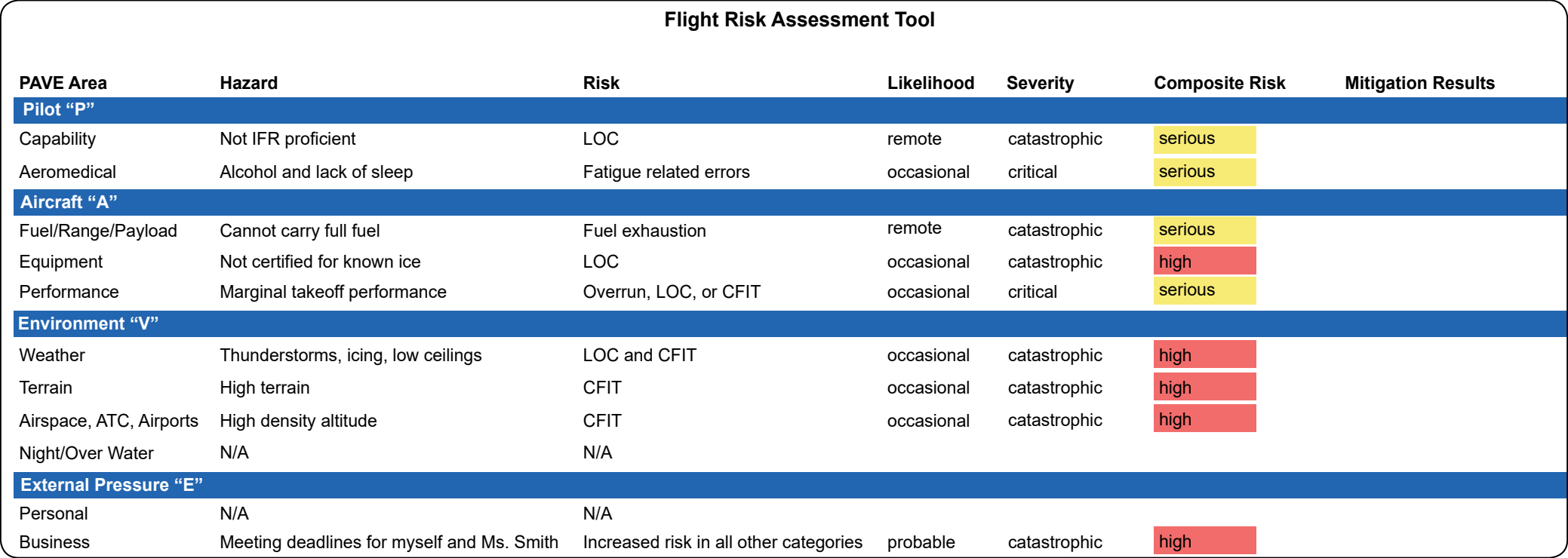
Finally, the aircraft may lack the performance needed to depart from the 5,000-foot runway at Animas Air Park. Having the Smiths on board, everyone’s baggage, and a reduced fuel load would result in a takeoff at the aircraft's maximum gross weight of 2,740 pounds. The calculated takeoff distance would be 4,700 feet, and using her 20 percent safety factor produces a desired runway length of 5,640 feet, which exceeds the available runway distance. Under these conditions, Tricia determines that an overrun is possible at least some of the time and could cause major damage or severe injuries. This “occasional” likelihood and “critical” severity produces a serious (yellow) risk level from the risk assessment matrix. [Figure 4-3]

Environment
She identified three areas with environment-related risk. The weather hazards on the direct route to Santa Rosa include thunderstorms, icing, and low ceilings. There could be severe turbulence in the convective activity, which covers most of the route and poses at least an upset potential at some time, producing an “occasional” likelihood. An upset in severe turbulence could result in a LOC-I event and “catastrophic” fatal accident. The “occasional” likelihood and “catastrophic” severity indicate a high (red) risk on the risk assessment matrix.
Tricia’s original proposed route traverses some very high and rugged terrain. If she were to attempt to fly under the low ceilings and weather, the terrain would be a hazard with an associated CFIT risk. A CFIT event, while unlikely for a pilot with her experience, would still be possible and could result in fatalities. This “remote” likelihood and “catastrophic” severity indicate a serious (yellow) risk on the risk assessment matrix.
The Animas Air Park elevation of 6,684 feet combined with July temperatures result in a high density altitude, which constitutes a hazard. The combination of high density altitude and high terrain in the area could lead to a “catastrophic” CFIT accident. This could occur at least sometime or with “occasional” likelihood. The combination of “occasional” likelihood and “catastrophic” severity indicate a high (red) risk on the risk assessment matrix.

Both Tricia and Martha face pop-up business events that appear to be critical, and Tricia has agreed to provide a solution to their transportation requirement.
Tricia feels the pressure to get to Santa Rosa before the Tuesday meeting. The Smiths are good friends, and she does not want to disappoint them. She feels additional pressure because the Smiths are expected to officiate at the Independence Day festivities and wish to attend parties that night. They may not be aware of any reason why Tricia could not depart early on Tuesday and get to Santa Rosa in time for their meetings using a single-engine GA airplane.
She concludes that external pressures are magnifying the identified risks, indicating a “probable” likelihood and “catastrophic” severity with high (red) risk levels.

She finishes recording her risk assessment analysis [Figure 4-6] and begins determining ways to mitigate the risks (see the case study section in Chapter 5, Mitigating Risk). She will soon need to discuss the next steps with the Smiths.
Chapter Summary
Risk assessment is a critical element in the risk analysis process. To determine overall risk levels, the pilot assesses both risk likelihood and risk severity for all identified hazards. The primary tools for this process are the FRAT and the risk assessment matrix. A pilot’s risk assessment accuracy should improve with practice.